

When the Extraordinary Lands in Your Backyard
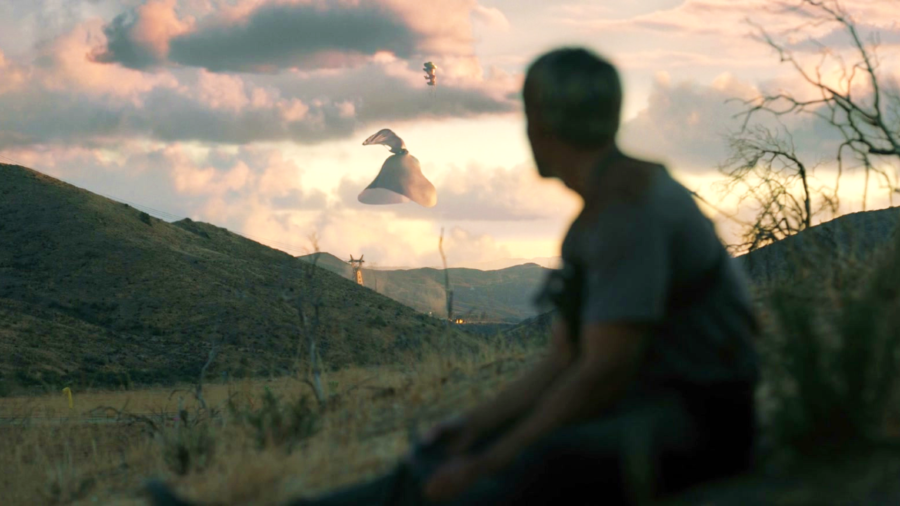
Imagine living on a remote California property and discovering that something otherworldly has chosen your home as its hiding ground. Would you alert the authorities, install surveillance equipment, or perhaps attempt to monetize the greatest discovery in human history? This premise forms the foundation of Jordan Peele’s ambitious 2022 film Nope, a genre-bending thriller that transcends conventional alien invasion narratives to examine fundamental questions about legacy, exploitation, and family loyalty.
Rather than presenting extraterrestrials as hostile invaders or benevolent messengers, Nope approaches the unknown with a lens distinctly grounded in human experience. The film asks audiences to consider what happens when the extraordinary collides with the mundane struggles of everyday life, and how ordinary people might respond to an extraordinary situation.
The Haywood Legacy: A Family Under Pressure
The narrative centers on OJ Haywood, portrayed with remarkable depth by Daniel Kaluuya, whose world collapses when a freak accident claims his father’s life during what appears to be a metal rain event. A simple nickel transforms into a lethal projectile, piercing through Otis Sr.’s eye and brain in a moment of inexplicable violence. This traumatic opening establishes the tone for everything that follows – the Haywood family finds themselves entangled with forces beyond their comprehension, all while struggling to maintain the family equine training business that has served Hollywood productions for generations.
Keith David’s portrayal of Otis Sr. provides the emotional anchor that OJ desperately needs as he inherits responsibility for the ranch. The weight of paternal expectation settles heavily on OJ’s shoulders as he attempts to navigate both grieving and business management simultaneously. When a violent incident on a film set results in OJ and his sister Emerald being blacklisted from Hollywood productions, the family’s financial situation grows increasingly precarious.
Keke Palmer delivers a commanding performance as Emerald, commonly called Em, bringing youthful energy and unwavering optimism to a character who sees opportunity where her brother perceives only obstacle. The sibling dynamic between OJ and Em feels refreshingly authentic, capturing the tension between cautious responsibility and daring ambition that often characterizes brother-sister relationships. Their interactions reveal years of shared history, unspoken understanding, and occasional friction that authentic familial connections naturally produce.
Jupe’s Journey: From Child Star to Theme Park Entrepreneur
To sustain the ranch operation, OJ begins selling horses to Steven Yeun’s Ricky “Jupe” Park, a figure whose cheerful exterior conceals significant trauma. Jupe’s backstory constitutes one of the film’s most disturbing and fascinating elements. As a child performer, he survived the violent rampage of a chimpanzee named Gordy on the set of Gordy’s Home, a family sitcom that ended in tragedy when the animal attacked cast and crew members.
Rather than allowing this horrific experience to define his limitations, Jupe transformed his survival into a commercial enterprise. Jupiter’s Claim, his Western-themed attraction, allows devoted fans of the defunct sitcom to experience accommodations filled with show memorabilia. Jupe has essentially constructed an entire livelihood around processing and monetizing his most terrifying childhood memory, a coping mechanism that the film examines with both sympathy and critique.
This pattern of exploitation becomes central to understanding Jupe’s character and, by extension, the film’s thematic concerns. When Jupe discovers the UFO activity on the Haywood property, recognizing it from his childhood experiences with Gordy, he sees another opportunity for commercial exploitation rather than genuine understanding or caution.
Confronting the Unknown: Technological Innovation Meets Ancient Fear
As OJ observes increasingly strange electrical phenomena and notices his prized horse Lucky exhibiting bizarre behavioral changes, he becomes convinced that something unseen lurks above the clouds. The decision to document the phenomenon leads OJ and Em to purchase surveillance equipment, drawing the involvement of Brandon Perea’s Angel, an enthusiastic electronics sales representative who becomes an unlikely ally in their investigation.
The methodical approach to capturing evidence of the UFO reflects contemporary cultural preoccupations with verification and documentation in the age of smartphones and social media. Rather than simply experiencing the unknown, the characters feel compelled to capture, prove, and ultimately monetize their encounter. This impulse toward documentation serves both practical and thematic purposes within the narrative.
Michael Wincott’s Antlers Holst enters the picture as a celebrated cinematographer whose expertise in visual storytelling proves invaluable for the Haywood siblings’ project. His involvement raises the stakes considerably, transforming what began as an effort at documentation into something approaching artistic endeavor. The collaboration between Holst and the Haywoods suggests that confronting the unknown may require blending technological capability with creative vision.
Deeper Themes: Exploitation and Human Resilience
At its philosophical core, Nope examines how individuals and societies relate to phenomena beyond their comprehension. The film presents multiple forms of exploitation – Jupe’s commercial manipulation of his trauma, the entertainment industry’s historical exploitation of the Haywood family’s equine training skills, and humanity’s broader tendency to seek profit from encounters with the unexplained.
Yet Nope refuses to become merely a critique of exploitative behavior. Running parallel to the commentary on monetization is a narrative of genuine resilience and adaptation. As the UFO’s presence intensifies and the threat to Agua Dulce becomes undeniable, the characters demonstrate remarkable capacity for problem-solving and cooperation. The film’s portrayal of ingenuity reaches its creative apex with the deployment of Wacky Waving Inflatable Arm Flailing Tube Men as bait – a solution that perfectly captures the film’s tonal balance between genuine tension and dark humor.
The Haywood siblings ultimately recognize that their unique position, possessing both land access and mounting evidence of extraterrestrial activity, presents an opportunity they cannot ignore. While Jupe’s approach to exploitation involves manipulation and self-promotion, OJ and Em seek simply to document truth and secure their family’s future. This distinction matters significantly to the film’s moral framework.
Visual Excellence and Emotional Authenticity
Director of Photography Hoyte van Hoytema’s work elevates Nope from genre exercise to visual masterpiece. The cinematography captures the stark beauty of the California landscape while constructing an atmosphere of mounting dread. Wide shots emphasize the isolation of the Haywood property, while intimate close-ups reveal the emotional complexity brewing beneath the surface of each character’s composed exterior.
The action sequences deserve particular mention for their clarity and impact. Unlike some UFO narratives that rely on chaotic editing and disorienting visual effects, Nope presents alien encounters with deliberate, almost clinical precision. This approach paradoxically increases rather than decreases the sense of menace, as viewers witness the extraterrestrial presence with uncomfortable clarity.
The relationship between OJ and Em emerges as the film’s most effective emotional element. Palmer and Kaluuya share a screen presence that convincingly conveys years of sibling history – the bickering that masks genuine concern, the competing visions for family future, and ultimately the united front they present when confronting external threats.
A Must-Watch Experience
Nope represents Jordan Peele’s most ambitious directorial effort to date, demanding multiple viewings to fully appreciate its layered narrative and thematic complexity. The film successfully combines science fiction, horror, and family drama into a cohesive whole that entertains while provoking genuine thought about how humanity processes the inexplicable.
For viewers seeking substantive engagement with questions of exploitation, legacy, and survival, Nope delivers substantially. Its release on Netflix (May 18, 2026) has made this conversation-starter more accessible than ever, inviting new audiences to experience its distinctive blend of wonder and unease.