


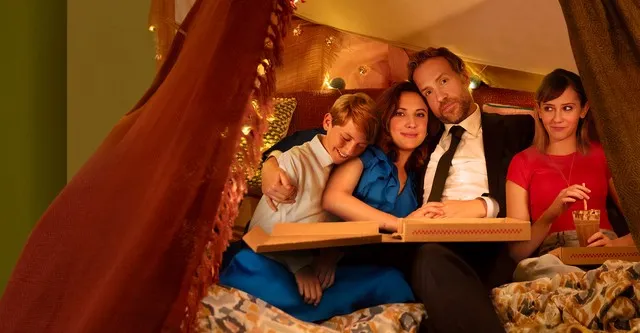
The beloved British comedy series returns with its fifth season, premiering globally on July 8, 2026, exclusively on Apple TV+. Created by Andy Wolton, Trying has spent four seasons guiding audiences through the emotional journey of Nikki and Jason as they navigated infertility, adoption processes, and the chaotic realities of parenthood. Now in Season 5, the series poses an entirely different question: what happens when the family you’ve fought so hard to build suddenly faces unexpected disruption?
The narrative picks up directly where Season 4 left off, with Kat—the biological mother of Princess and Tyler—standing at the front door. Rather than glossing over two years of off-screen developments, the season dives immediately into the uncomfortable reality that Nikki and Jason’s carefully constructed family now includes someone they never anticipated. This premise sets the stage for what might be the series’ most emotionally complex season yet, blending the heartfelt humor that defines the show with genuine relational tension.
Synopsis
Trying Season 5 introduces a significant shakeup to the established family dynamic when Kat, the biological mother of Princess and Tyler, reappears at Nikki and Jason’s doorstep. After years of building their family through adoption, the couple must now navigate the presence of a woman who shares a biological connection with their children.
Nikki finds herself facing an unexpected rival for her children’s affection—not through any malicious intent on Kat’s part, but through the simple fact that Princess is now seeking answers about her origins. Meanwhile, Jason returns to education, pursuing social work after encouragement from Penny, while Nikki embarks on a new career in the travel industry. The couple’s stable marriage begins to show cracks as they respond differently to these new pressures.
Jason’s educational journey introduces him to a world of younger students whose lifestyle choices make him feel like “an archaeological exhibit from the era of irresponsible lager.” Simultaneously, Nikki develops an unexpected connection with her charming colleague Kerry, played by Colin Morgan, creating tension in her marriage. The season balances these personal challenges with the ongoing dynamics of Princess’s anger, Tyler’s uncertainty, and the supporting characters’ own subplots, including Scott’s ill-fated Atlantic rowing expedition.
Performances
Esther Smith continues to deliver exceptional work as Nikki, capturing the character’s signature blend of anxiety and determination. Smith excels at the rhythm of embarrassment comedy, allowing Nikki to realize her mistakes slightly before everyone else does. Her portrayal of Nikki’s growing concern about Kat’s presence demonstrates remarkable subtlety—watch how she studies Princess during conversations, her reactions often arriving before words do.
Rafe Spall matches Smith’s quality as Jason, particularly in showing how the character’s instinctive kindness faces new challenges. Jason’s quieter parenting scenes reveal a steadiness that never requires grand speeches. The chemistry between Smith and Spall remains the show’s emotional anchor, now playing a couple who are both settled and uncertain simultaneously.
Scarlett Rayner delivers a sharp performance as Princess, playing her anger with the precision of a teenager who has identified adult hypocrisy. Rayner excels particularly when Princess’s certainty slips, revealing the underlying confusion beneath her righteous anger. Cooper Turner provides valuable balance as Tyler, whose response to Kat’s return is notably less decisive than his sister’s, reflecting that biological connection isn’t a universal instinct.
Colin Morgan makes a strong impression as Kerry, Nikki’s colleague. Rather than playing the character as an obvious plot device, Morgan creates plausible ease in his exchanges with Smith. The romantic tension feels organic rather than forced, with the show wisely avoiding the trope of making Nikki’s attraction mean her marriage has been fraudulent all along.
The supporting cast continues to entertain, particularly Darren Boyd as the perpetually optimistic Scott and Phil Davis as Vic, whose professional success somehow becomes a personal inconvenience.
Behind the Lens
Andy Wolton demonstrates careful creative control in navigating Trying‘s tonal tightrope. The decision to have Kat’s presence create “reasonable people hurting one another” rather than descending into custody melodrama shows sophisticated writing. The comedy remains strongest when Nikki and Jason enter ordinary situations and immediately expose the small personal defects that make normality impossible.
The Tuscany storyline exemplifies Wolton’s approach—the absurd premise of a holiday taken by mistake could easily collapse into pure silliness, but the writer keeps ridiculous events attached to recognizable behavior. Similarly, the theme-park episode works because Nikki’s fear of rollercoasters isn’t invented for one episode; it’s consistent with her established personality of announcing everything is fine moments before proving otherwise.
The direction maintains the series’ visual warmth while allowing space for darker emotional moments. Episode pacing lets character arcs develop naturally, particularly in how Nikki’s anxiety about her place in Princess’s life builds gradually rather than exploding into random hysteria.
Final Verdict
Trying Season 5 represents the series taking a dangerous but successful step: giving its happy couple new problems while ensuring they remain genuinely funny. The arrival of Kat, Nikki’s workplace attraction, and Princess’s justified anger provide richer material without transforming the show into melodrama. The slight unevenness in early episodes settles into sharp, affectionate television where Tuscany accidents, generational discomfort at student nights out, and doomed Atlantic rowing expeditions carry real emotional weight.
Five seasons in, Trying continues its remarkable ability to find comedy one inch away from genuine pain. The series understands that failed ambitions can expose deeper needs, that attraction can coexist with commitment, and that anger can exist alongside love. The show remains annoying in the best possible way—these characters keep changing, growing, and making mistakes while trying their best.
For longtime fans, Season 5 delivers the emotional complexity the series has been building toward. For newcomers, it provides an accessible entry point to a show that has quietly become one of television’s most consistent comedies. Available now on Apple TV+, this season proves that sometimes the hardest part of building a family isn’t the arrival—it’s what happens next.