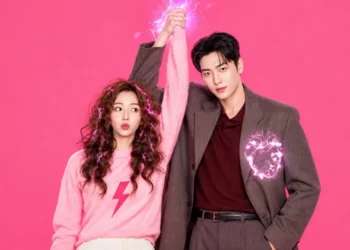


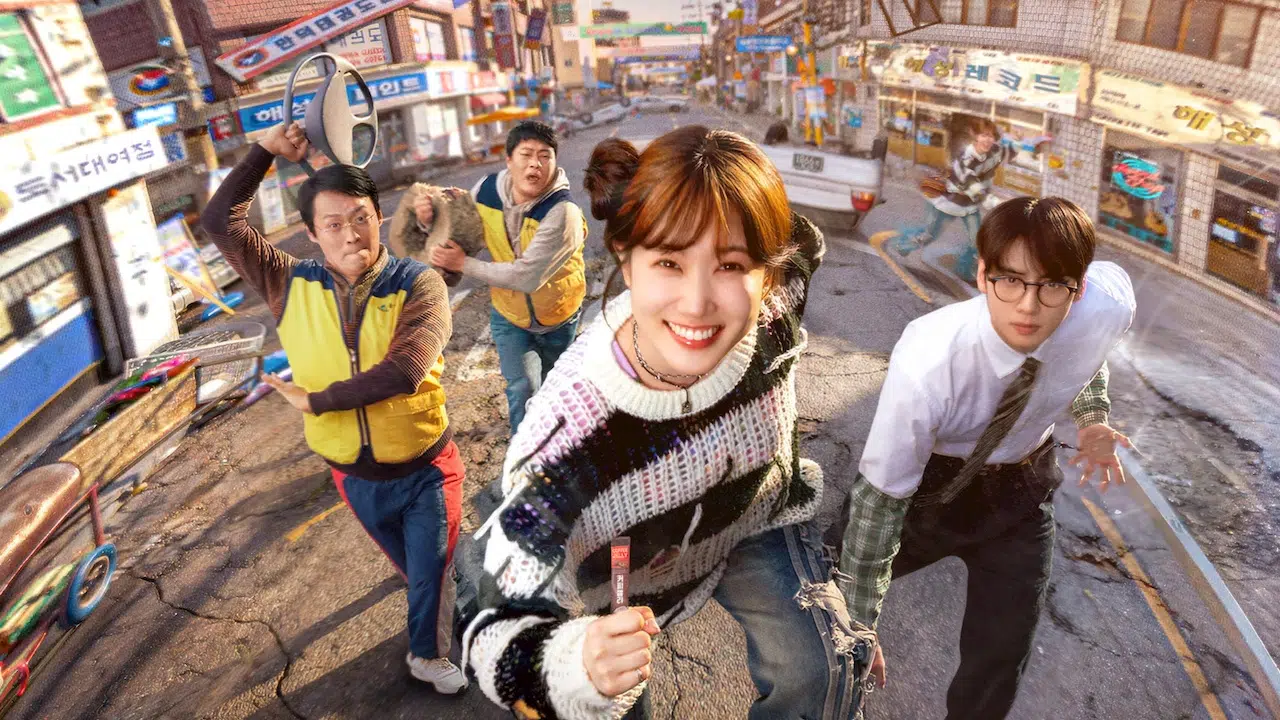
Korean television continues to push boundaries in unexpected ways, and The WONDERfools stands as a prime example of this creative ambition. Directed by Yoo In-shik, this eight-episode Netflix original blends superhero mythology with mystery, comedy, and emotional storytelling in a combination that feels surprisingly cohesive despite its apparent contradiction. The series stars Park Eun-bin as the determined Eun Chae-ni, with Cha Eun-woo portraying Lee Un-jeong, Choi Dae-hoon taking on the role of Gyeong-hun, and Im Seong-jae embodying Ro-bin. The ensemble cast also includes Kim Hae-sook as Kim Jeon-bok, Son Hyun-joo as Ha Won-do, Bae Na-ra, Jeong E-suh, and Choi Yun-ji, among others. Each episode runs between seventy and eighty minutes, giving the story ample room to develop its elaborate premise while maintaining viewer engagement throughout its compact season.
What makes The WONDERfools immediately distinctive is its willingness to embrace imperfection. In an entertainment landscape saturated with polished superhero narratives featuring confidently heroic figures saving the world in spectacular slow-motion, this series takes a radically different approach. Here, the so-called heroes are fundamentally flawed individuals who frequently make catastrophic decisions, and their supernatural abilities typically generate more chaos than they resolve. This deliberately chaotic energy becomes the show’s greatest asset, creating an experience that feels genuinely fresh and unpredictable in a genre that often adheres to predictable formulas.
Synopsis
The narrative unfolds against the backdrop of 1999, a period defined by widespread anxiety surrounding the anticipated Y2K catastrophe. This setting proves more than mere nostalgia bait; it fundamentally shapes the series’ tone and visual identity, grounding the supernatural elements in a specific moment of collective human apprehension. The central inciting incident involves illegal toxic waste dumping and mysterious laboratory experiments, events that trigger a series of paranormal transformations among a group of social outcasts who suddenly find themselves endowed with extraordinary abilities they neither asked for nor fully understand.
At the heart of the story stands Chae-ni, a headstrong young woman whose life has been shaped by the constant shadow of a serious cardiac condition. Having spent her existence under the dark cloud of an uncertain prognosis, she has developed both a reckless appreciation for adventure and a profound weariness with constantly guarding against danger. Rather than continuing to live cautiously, she makes the audacious decision to involve herself in an elaborate fake kidnapping scheme alongside two other individuals whose lives have been marked by misfortune: Gyeong-hun and Ro-bin. This ill-conceived plan spirals into an increasingly complex narrative where supernatural powers intersect with cult-like religious movements and the machinations of powerful figures conducting dangerous experiments behind the scenes.
The premise establishes a tone that oscillates between dark comedy and genuine emotional depth, never quite settling into a single mode for extended periods. This tonal flexibility keeps viewers constantly off-balance in the best possible way, as the series refuses to commit to either pure entertainment or serious drama, instead weaving both threads into a single, cohesive tapestry that defies easy categorization.
Performances
Park Eun-bin delivers what can only be described as a career-defining performance as Chae-ni, demonstrating remarkable range that transitions seamlessly between comedy and genuine pathos. Having previously demonstrated her abilities in more restrained, emotionally centered roles, her work here represents a bold departure into unbridled physical and comedic performance. She commits fully to every chaotic moment, whether Chae-ni is using her teleportation powers to create elaborate problems or confronting the profound vulnerability that comes with living under the constant threat of mortality. The quieter moments where Chae-ni’s armor cracks and reveals underlying fear become some of the series’ most powerful sequences, with Park navigating the delicate balance between comedy and tragedy with impressive finesse.
Cha Eun-woo provides an essential counterweight to the surrounding chaos through his portrayal of Lee Un-jeong. His presence offers a calm, emotionally complex presence that prevents the series from becoming purely absurdist. Un-jeong carries the weight of understanding just how dangerous the trio’s situation has become, and Eun-woo conveys this tension through subtle performance choices that ground the character’s uncertainty in relatable human emotion. His performance brings an unexpected realism to scenes involving teleportation, conspiracy elements, and action sequences, transforming what could easily become cartoonish into something genuinely compelling.
The comedy duo of Choi Dae-hoon and Im Seong-jae initially risks alienating viewers with their characters’ irritating tendencies, but their evolution throughout the series proves remarkably effective. Both actors gradually reveal deeper layers beneath their characters’ obnoxious surfaces, transforming what begin as frustrating figures into genuinely sympathetic individuals whose fears and vulnerabilities are explored with increasing depth. Their relationship with Chae-ni develops into one of the most emotionally satisfying elements of the entire series, providing both comic relief and genuine heart.
Among the antagonists, Bae Na-ra deserves particular recognition for his chilling portrayal of Kim Pal-ho. After establishing his ability to embody menace in Weak Hero Class 2, he demonstrates similar skills here, bringing a genuinely unsettling energy to the role. There exists something intrinsically unsettling about his presence, particularly in his eyes, that creates an immediate sense of dread whenever the character appears on screen. Similarly, Son Hyun-joo creates a distinctive form of villainy through Ha Won-do, whose method of manipulation relies on exploiting religious fear rather than overt violence. This approach proves far more disturbing than conventional aggressive antagonism, as it speaks to deeper truths about how vulnerability can be weaponized by those with sufficient cunning and willingness to prey upon the frightened.
Behind the Lens
Yoo In-shik’s direction deserves substantial credit for maintaining coherence across a narrative that could easily have spiraled into incoherent confusion. His approach embraces the chaos without losing sight of the emotional core driving the story forward, a balance that requires both technical skill and clear artistic vision. The decision to anchor the narrative in 1999 proves particularly astute, as the Y2K setting accomplishes multiple objectives simultaneously. It differentiates The WONDERfools from the numerous modern superhero properties dominating streaming platforms while on the other hand creating an atmosphere where paranoia and conspiracy thinking feel natural rather than paranoid.
The production design team has clearly invested significant effort in recreating the late 1990s aesthetic, with careful attention to fashion, technology, and cultural details that would have defined that particular moment in Korean history. This commitment to period authenticity serves a purpose beyond mere nostalgia; it creates visual space for the supernatural elements to feel organic rather than intrusive. The grittier, less polished aesthetic lends credibility to fantastic story elements by refusing to present them against the clean, modern backdrop that characterizes most contemporary superhero media.
The series also benefits from confident visual storytelling that knows when to embrace spectacle and when to dial back for intimate character moments. The action sequences, while sometimes chaotic in ways that mirror the characters’ relationship with their own powers, maintain a coherence that allows viewers to follow the physical storytelling even when the plot itself becomes more complex. This visual fluency helps smooth over some of the narrative’s more convoluted elements, keeping viewers emotionally invested even when the logical progression of events becomes difficult to track.
Final Verdict
The WONDERfools represents a genuinely creative take on the superhero genre that deserves recognition for its willingness to be weird, emotionally honest, and entertaining simultaneously. While the series is far from flawless—episodes occasionally suffer from overlong running times that test patience, some storylines receive development that exceeds their actual interest level, and certain emotional beats become repetitive over the season’s duration—these shortcomings prove relatively minor against the overall viewing experience.
The show’s greatest strength lies in its full commitment to chaos without abandoning emotional authenticity. Where darker, more cynical superhero narratives often struggle to balance entertainment with depth, The WONDERfools manages to be genuinely funny, surprisingly moving, and unexpectedly sincere. The performances, particularly from Park Eun-bin and Cha Eun-woo, elevate material that could easily have become silly, giving viewers genuine characters to invest in despite the absurd circumstances surrounding them.
For those seeking something different from the conventional superhero formula, this series offers a compelling alternative that embraces messiness as a feature rather than a bug. The retro atmosphere, the unusual power dynamics, and the emotional core centered on people searching for purpose create a distinctive package that lingers in memory long after the credits roll. The WONDERfools proves that the superhero genre still contains unexplored territory for creators willing to take risks, and it stands as a worthwhile addition to Netflix’s growing library of Korean original content.
The WONDERfools is streaming exclusively on Netflix.
Also Read:
“The WONDERfools” Netflix Release: Cast, Plot & Everything We Know
“The WONDERfools”: Netflix’s New Heroic Comedy Unleashes Chaos in 1999 Korea