

Karla Murthy’s documentary The Gas Station Attendant emerges as a deeply personal and universally resonant film that masterfully blurs the boundaries between documentary filmmaking and intimate family memoir. Through a carefully constructed archive of home movie footage, candid voiceover narration, and a sweeping personal narrative, Murthy creates a meditative essay that explores the complexities of immigrant family life, generational trauma, and the long road to reconciliation.
The film opens with Murthy herself acknowledging being “stuck in a time loop” as she sifts through boxes of aging videotapes—a metaphor that perfectly encapsulates the film’s central preoccupation with memory, time, and the weight of the past. What follows is a drifting, contemplative journey through her family’s history, examining both the unique experiences of an immigrant family and the universal themes that connect us all.
A Multi-Generational Portrait
Murthy constructs a multi-generational portrait that extends far beyond a simple character study of her father. The film traces his journey from a young man in Houston to an older figure perseverance through financial hardship, while also capturing the filmmaker herself as a child and later as a parent watching her own children run barefoot on sandy shores. This ambitious scope allows the documentary to function simultaneously as a personal letter to her father and as a broader meditation on immigrant family dynamics.
The documentary’s voiceover operates in a direct address style that feels both confessional and authoritative. While occasional poetic moments emerge, the film’s central theme remains quietly motivating—a quest for peace and understanding amid the shadows of debt, fear, and generational struggle.
A Journey Toward Reconciliation
One of the film’s most candid moments occurs during a drive from New Orleans to Houston, when Murthy’s father openly discusses his crushing debt while offering timeless advice about marriage: “Make peace no matter how long it takes.” This assertion becomes the thematic anchor of the entire documentary—a pathway to making peace with the past, with family burdens, and with the complicated stories that lurk behind smiling family photographs.
As Murthy explains, The Gas Station Attendant represents “reliving the past” and “looking for answers”—a therapeutic practice designed for personal healing as much as public consumption. The weight of her father’s financial struggles became her burden to bear, and the film represents her attempt to step back to move forward.
Precedents and Elevations
The documentary joins a distinguished tradition of personal filmmaking, including works like Stories We Tell by Sarah Polley and No Home Movie by Chantal Akerman. These films transformed deeply personal narratives into accessible works that resonate with universal audiences. Murthy follows in their footsteps, elevating her raw archival material through skilled craft while maintaining an intimate, vulnerable quality.
However, The Gas Station Attendant possesses a unique dynamic. While it presents itself as a cultural artifact—a documentary formatted for the contemporary streaming market—it remains, at its core, a profoundly personal document meant for therapeutic ends.
Landscapes of Memory
Murthy returns to the familiar landscapes of her Houston childhood—cul-de-sacs, highway overpasses, and suburban farmhouses—creating a visual dialogue between past and present. The transition between high-definition video and mini DV footage shot years earlier creates a powerful dialectic, allowing viewers to travel through time alongside the filmmaker.
The documentary visits the “beaches of home,” including her father’s childhood in India and her mother’s homeland in the Philippines. As Murthy describes it, this represents “a time-traveling gift to see your parents in the places that made them.” Yet the gift isn’t purely joyful—it offers recognition and understanding, even when revealing painful truths about abject poverty and disenfranchisement.
Beyond the Title
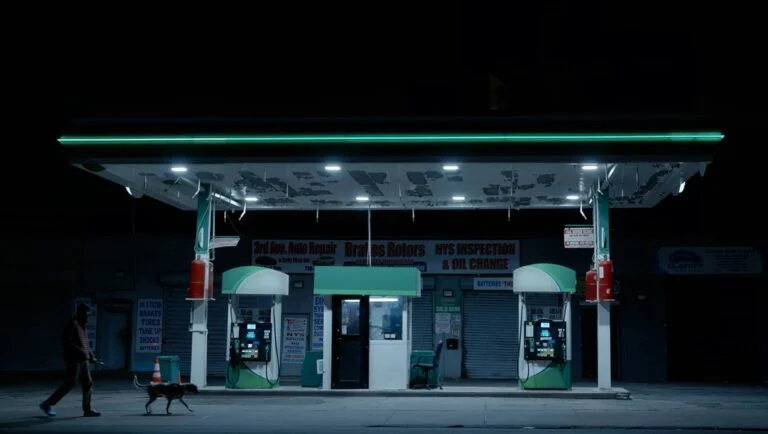
The film’s title references one of Murthy’s father’s many part-time jobs—a graveyard shift at a gas station counter. This fear for his well-being, including a touching visit to the memorial of a young Nepalese attendant killed in a robbery, catalyzes Murthy’s inward investigation. The material began as questions posed during late-night phone calls while her father served customers.
Yet the title proves subtly misleading. What we actually witness is not simply “the gas station attendant” but rather a jewelry merchant, community figure, and doting father. This disconnect represents the film’s essential point: there always exists more beneath the surface, more complexity than what we initially perceive.
Final Thoughts
The Gas Station Attendant stands as a formally competent documentary that occasionally achieves poetic heights while maintaining a somewhat conventional structure. Yet its greatest strength lies in its generosity—as a personal document that invites viewers to examine not only Murthy’s family but to reflect upon their own. Karla Murthy has opened her personal archive in such a way that learning becomes inevitable—for her and for her audience.
Runtime: 1 hour 23 minutes Distributor: Greene Fort Productions Theatrical Release: June 12, 2026.