

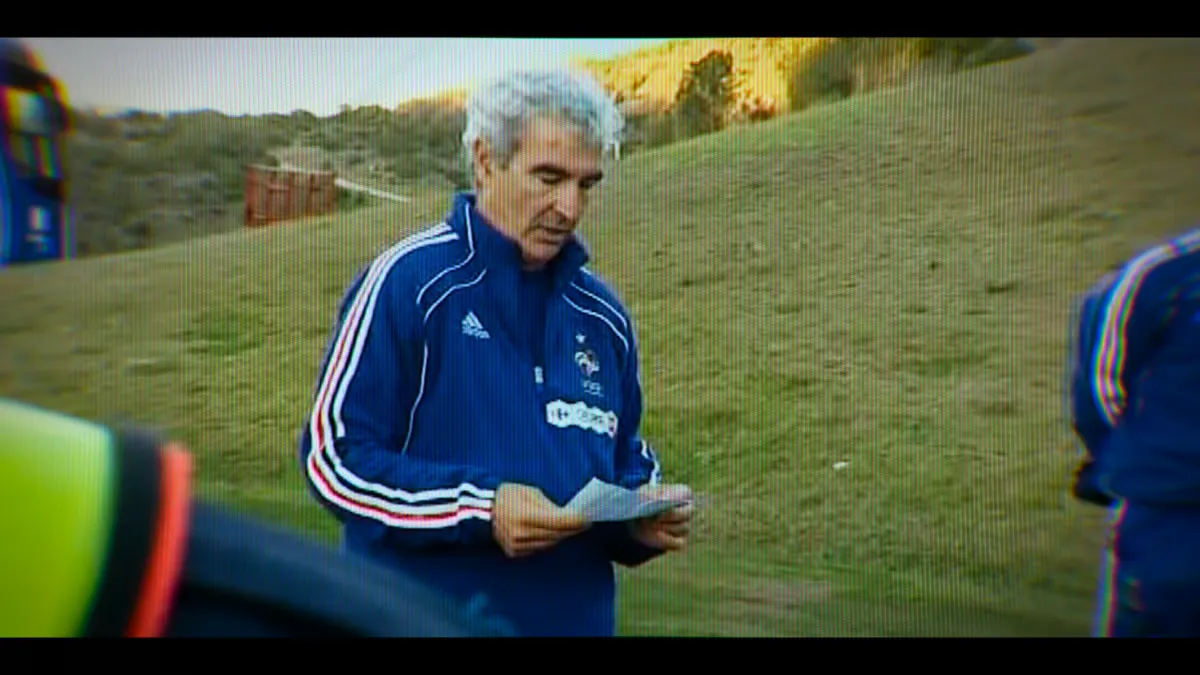
June 2010 remains etched in French football history, not for triumph but for defiance. On a training ground in Knysna, South Africa, an entire generation of national team players refused to leave their bus, turning their backs on the world outside while their head coach stood, reading a players’ statement through a closed window. Fifteen years later, director Christophe Astruc returns to that morning not to recycle familiar images but to reconstruct the institutional failures that made the strike inevitable. The Bus: A French Football Mutiny arrives on Netflix with a mission far more ambitious than nostalgia: it asks why no one in power saw the crisis coming, even when every warning sign was visible.
Why Knysna Still Haunts French Football
Some moments in sport transcend their immediate context to become symbolic of deeper societal fractures. The locked bus in Knysna belongs to this rare category. The image itself is instantly recognizable yet difficult to fully explain: players sealed inside a vehicle, their coach on the asphalt reading their words aloud, an entire World Cup campaign collapsing into static. What Astruc’s documentary understands is that the real story lies not in that single morning but in the months of institutional negligence that preceded it.
The film dedicates minimal runtime to the bus itself, recognizing that audiences already carry that image in their collective memory. Instead, Astruc methodically reconstructs the federation’s deafness to the dressing room, a coaching staff operating without political protection, and a captaincy that changed hands three times in just two years. Public discourse had already begun weaponizing the team’s banlieue-recruited players in explicitly racialized terms long before the strike, creating a climate of hostility that the football authorities neither anticipated nor addressed. By the time France arrived in South Africa, the tournament’s internal reality had completely diverged from its public narrative, and the strike merely externalized what had been building internally for months.
Behind the Doors of the Locked Bus
Astruc structures the documentary around the contradictions of those who experienced the crisis firsthand rather than relying on archival footage of the World Cup itself. Raymond Domenech recounts his halftime confrontation with Nicolas Anelka during the Mexico match, unflinchingly presenting the same version he offered during the original controversy. The coach does not sanitize his account or rewrite history in hindsight, allowing viewers to form their own judgments about his version of events.
Patrice Evra, who served as captain and read the players’ statement to waiting journalists, describes his position as that of a man trapped between two refusals. The coaching staff refused to reconsider the Anelka expulsion once news leaked, while the public refused to interpret the dispute as anything other than player rebellion. The documentary captures this duality with remarkable clarity, showing how institutional inflexibility on one side met public narrative rigidity on the other.
William Gallas and Bacary Sagna, whose quiet presence during the crisis was interpreted as complicity, finally explain what they knew about the political atmosphere surrounding the squad and what they deliberately chose not to voice. Their testimony reveals the impossible calculating that players from marginalized backgrounds constantly perform when navigating institutionalized systems. Sylvain Wiltord, a veteran of the 1998 World Cup-winning generation, provides the documentary’s longest temporal arc, tracing the gradual erosion of the post-1998 compact between the national team and the country that once celebrated its diversity through the “Black-Blanc-Beur” framework.
What the Documentary Reveals About Institutional Failure
The documentary’s most powerful argument lies in its systematic demonstration that every actor in the chain of command possessed sufficient information to prevent the Knysna morning and yet none acted on that knowledge. Astruc never forces a narrator into the role of omniscient commentator explaining events to passive viewers. The film trusts audiences to synthesize contradictions across testimonies, constructing meaning from the gaps between accounts rather than having conclusions delivered prepackaged.
No soundtrack cues guide viewers toward particular sympathies. No dramatic replays inflate the bus image into cinematic spectacle. The bus appears once, Domenech’s statement-reading appears once, and then the documentary returns to present-day faces, allowing the weight of history to settle naturally into current conversations.
The timeline Astruc reconstructs mirrors what French audiences originally learned in fragmentary disclosures over subsequent weeks following the crisis. The 2-0 loss to Mexico, the halftime exchange that saw Anelka leave the stadium, the federation’s decision to expel the player, the leak to L’Équipe of disputed remarks, the players’ meeting on their team bus at the Pezula resort, the training ground confrontation between Evra and fitness coach Robert Duverne, and finally the retreat that became an international incident. Each fracture point becomes an opportunity to ask where institutional decisions were actually made and who occupied the room when those decisions crystallized.
The Bigger Picture: French Football’s Unresolved Crisis
The documentary situates the Knysna strike within a longer French argument that commenced with the 1998 World Cup victory and the celebratory framework that momentarily embraced the country’s ethnic diversity. By 2010, that framework had become hollow, its progressive surface masking a hardening public suspicion toward players recruited from suburban housing projects. Political speeches, editorial columns, and football discourse had converged on a narrative of distrust that the federation’s internal culture never adjusted to address.
The political aftermath of Knysna extended from the parliamentary hearing in August 2010 through the National Ethics Committee’s intervention to the federation’s own tribunal in November 2010. That tribunal handed suspensions to five players while branding the strike a mutiny, effectively closing the official record while leaving the more troubling questions untouched. In the years since, systematic absence has characterized public discussion of whether anyone in authority ever genuinely listened to player concerns before the bus became locked.
What the documentary implies without stating explicitly is that Knysna inaugurated rather than concluded a pattern of institutional crisis management. The Karim Benzema exile from the national team between 2015 and 2022 replicated the same posture: federation response beginning with sanction and concluding without explanation. The Pogba family extortion case in 2022 forced reconsideration of how the federation protects its players, something the 1998 settlement had treated as automatic. The collapse of Noël Le Graët’s presidency in 2023 over conduct the federation had repeatedly been informed about demonstrated the persistence of institutional deafness. Each episode asked the same fundamental question the 2010 strike posed: who at the apex of French football listens when players speak.
Final Thoughts on a Must-Watch Documentary
Astruc’s decision to present this as a single feature-length work rather than a serialized format constitutes its own argument about institutional failure. The serialized template popularized by productions like Drive to Survive fragments institutional analysis across episodes, granting each perspective its own dramatic arc and breathing room for narrative suspense. Working within Netflix’s platform while refusing its dominant form, Astruc compresses fifteen years of testimony into continuous viewing that denies audiences the comfort of processing any single testimony before confronting the next.
The federation receives no dedicated episode. The coaching staff receives no dedicated episode. The players collectively receive no dedicated episode. By refusing this compartmentalization, the film argues that the Knysna strike was never a sequence of separable failures passed down through organizational hierarchy. It was simultaneous, indivisible, and systemic: a culture of institutional failure manifesting all at once rather than accumulating through discrete stages.
What parliamentary hearings, federation tribunals, coaching bans, tearful politician appearances, and fifteen years of editorial commentary could never settle remains parked on that Knysna training ground. The documentary asks whether French football’s institutions were ever capable of honest dialogue with the generation they recruited, coached, and demanded embody their nation. It leaves that question parked there, refusing resolution, challenging audiences to carry it forward into whatever selection, briefing, judgment, and institutional culture the 2026 World Cup squad encounters.
Also Read:
Norway’s Remarkable World Cup Return: Inside the New Netflix Documentary