


The Hindi film industry has seen its fair share of courtroom dramas over the years, yet few manage to transcend the conventional tropes of the genre while still delivering the intellectual satisfaction that audiences expect from legal thrillers. 𝒮𝓎𝓈𝓉𝑒𝓂, now streaming exclusively on Amazon Prime Video, emerges as a refreshing addition to this space, offering viewers a layered narrative that operates on multiple frequencies simultaneously. Directed by Ashwiny Iyer Tiwari, this feature-length drama eschews the typical high-octane courtroom confrontations in favor of a more understated, introspective approach that demands patience but ultimately rewards those willing to engage with its quieter complexities.
What sets 𝒮𝓎𝓈𝓉𝑒𝓂 apart is its willingness to explore the gray areas of the legal system while simultaneously championing two female protagonists who challenge the entrenched patriarchal structures within their professional ecosystem. Rather than presenting a straightforward battle between good and evil, the film acknowledges the uncomfortable truth that justice often exists in shades of ambiguity. This philosophical undercurrent runs throughout the narrative, preventing the film from becoming merely another legal procedural and elevating it into something more thought-provoking.
The timing of this release proves particularly apt, as discussions around judicial reform and systemic inequality have gained significant traction in public discourse. By placing two women at the center of its narrative—one navigating the privileged corridors of inherited influence and the other occupying the more modest position of a court stenographer—the film implicitly commentary on the disparate opportunities that exist within ostensibly merit-based systems. This thematic richness provides the foundation for a drama that transcends pure entertainment to become a vehicle for social reflection, even as it occasionally stumbles in its execution.
Synopsis
The narrative centers on Neha Rajvansh, a determined young attorney portrayed by Sonakshi Sinha, who finds herself perpetually overshadowed by the formidable reputation of her father Ravi Rajvansh, a celebrated lawyer played by Ashutosh Gowariker. Rather than coasting on her family’s established credentials, Neha embarks on a mission to establish her professional identity independent of her father’s considerable legacy. This struggle forms the emotional core of the story, as she seeks validation not through nepotistic advantages but through genuine accomplishment.
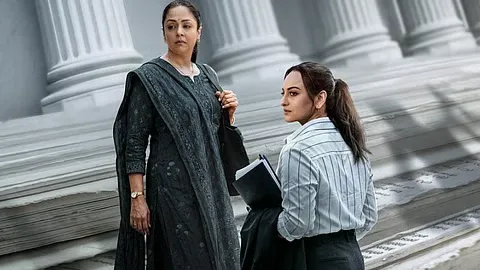
In a pivotal character-establishing moment, Ravi presents Neha with an ultimatum that will test her resolve: she must independently win ten consecutive cases before earning the privilege of joining his prestigious practice. This challenge forces Neha to venture outside her comfort zone, recruiting Sarika, an astute court stenographer portrayed by Jyotika, as her confidential assistant and unofficial sounding board. The partnership proves transformative, as Sarika’s perspective—unencumbered by the biases that often accompany legal training—provides Neha with invaluable insights that her formal education failed to deliver.
The stakes escalate dramatically when Neha secures her most significant case yet: a high-profile murder investigation that places her directly in opposition to her own father’s legal interests. Ravi has taken on the defense of the accused, creating an unprecedented conflict between familial loyalty and professional obligation. As Neha and Sarika investigate the darker corners of this case, they unearth evidence suggesting not all is as it appears, setting the stage for revelations that will challenge everything they thought they understood about the pursuit of justice.
The film’s conclusion deliberately resists easy resolution, offering viewers an ending that generates more questions than answers while simultaneously providing sufficient closure to feel satisfying rather than simply frustrating. This approach invites audience engagement with the material long after the credits roll, encouraging speculation about the true nature of the justice system depicted.
Performances
Sonakshi Sinha delivers what might be considered one of her most nuanced screen performances to date, embodying Neha’s journey from uncertain newcomer to confident legal practitioner with credible subtlety. Her portrayal particularly shines during the film’s second half, as the character develops the instinctive sharpness that separates adequate lawyers from exceptional ones. Sinha effectively conveys the internal conflict between ambition and integrity, never allowing Neha to become a one-dimensional heroine but instead presenting a fully realized human being grappling with genuine moral quandaries.
Jyotika, however, arguably steals the show with her portrayal of Sarika, a character whose apparent simplicity masks considerable depth. Her performance operates on quieter frequencies than Sinha’s more visible journey, yet every glance and measured response suggests a mind constantly processing information and drawing conclusions. The actress brings remarkable dignity to a role that could easily have been reduced to mere support, instead creating a fully realized woman whose contributions prove essential to the narrative’s progression. The scenes shared between Sinha and Jyotika crackle with authentic chemistry, their evolving professional relationship convincingly evolving into genuine mutual respect and understanding.
Ashutosh Gowariker occupies the more familiar territory of the patriarchal figure, delivering a performance that adheres to recognizable archetypes without descending into caricature. His Ravi Rajvansh embodies the confident authority that comes with decades of professional success, yet the performance hints at vulnerabilities beneath the domineering exterior. Adinath Kothare as Neha’s brother Alok and Nishant Singh as Sarika’s husband Laxman provide solid supporting turns that ground the central narrative in relatable domestic dynamics, their relative brevity on screen belying the impression they leave with viewers.
Behind the Lens
Director Ashwiny Iyer Tiwari demonstrates considerable ambition in her approach to 𝒮𝓎𝓈𝓉𝑒𝓂, working from a screenplay co-written with Harman Baweja, Arun Sukumar, and Tasneem Lokhandwala. The collaborative writing effort manifests in a narrative structure that initially appears linear but gradually reveals unexpected layers upon closer examination. This architectural approach extends to the technical execution, with cinematographer Rangarajan Ramabadran employing visual strategies that reward repeat viewings. The choice to incorporate revelatory information within the frame’s background elements creates a viewing experience that genuinely improves upon subsequent watches.
Editor Charu Shree Roy deserves particular commendation for maintaining momentum across a lengthy runtime that occasionally threatens to stall. The pacing choices demonstrate sophisticated understanding of when to allow scenes room to breathe and when to push forward, though some sequences in the courtroom segments do feel slightly compressed, denying viewers the full weight of the legal confrontations depicted. This structural tension between ambitious scope and practical execution represents the film’s most significant creative compromise.
The dialogue work by Akshat Ghildial proves consistently insightful, particularly in scenes where Neha and Sarika engage in philosophical discussions about justice, privilege, and the compromises that professional life demands. These verbal exchanges elevate the material beyond genre conventions, providing intellectual substance that distinguishes 𝒮𝓎𝓈𝓉𝑒𝓂 from more formulaic legal dramas. The writing’s occasional pretentiousness remains forgivable given the genuine insights it delivers, though viewers seeking purely escapist entertainment may find some passages self-consciously meaningful.
Final Verdict
𝒮𝓎𝓈𝓉𝑒𝓂 ultimately succeeds as a meditation on justice, legacy, and the personal costs of professional integrity, even when its execution occasionally falls short of its considerable ambitions. The film’s willingness to complicate its own narrative—particularly in the final act where revelations recontextualize earlier events—demonstrates respect for audience intelligence that more genre entries frequently neglect. While some courtroom sequences lack the visceral intensity their dramatic potential demands, the stronger sequences compensate adequately, culminating in a climactic stretch that delivers emotionally and intellectually satisfying conclusions.
For viewers patient enough to engage with its deliberate pacing and thematic complexity, 𝒮𝓎𝓈𝓉𝑒𝓂 offers substantial rewards. The performances anchor the material in human reality, preventing the philosophical discussions from becoming abstracted musings disconnected from authentic emotional experience. Amazon Prime Video has found a worthy addition to its original content library, one that should particularly appeal to audiences seeking substantive drama over spectacle. This female-led narrative proves that compelling storytelling need not rely on conventional action beats or artificial escalation, instead finding power in quiet determination and moral complexity.