

The landscape of independent cinema continues to evolve, and A Mosquito in the Ear stands as a testament to the power of restrained, emotionally intelligent storytelling. Released by Persimmon on June 11, 2026 in the United States, following its world premiere at the Santa Barbara International Film Festival, this American-Indian collaborative drama directed by Nicola Rinciari adapts Andrea Ferraris’s Italian graphic novel “Una Zanzara nell’Orecchio” into a haunting exploration of what happens when family begins before understanding does.
This is not a film about heroic adoptions or convenient happy endings. Instead, it charts the turbulent first days of an American couple’s attempt to welcome a four-year-old girl into their lives, and the cultural and emotional chasms that widen with each failed attempt at connection. For audiences seeking cinema that challenges rather than comforts, this independent feature delivers an emotional sting that lingers long after the credits roll.
Synopsis
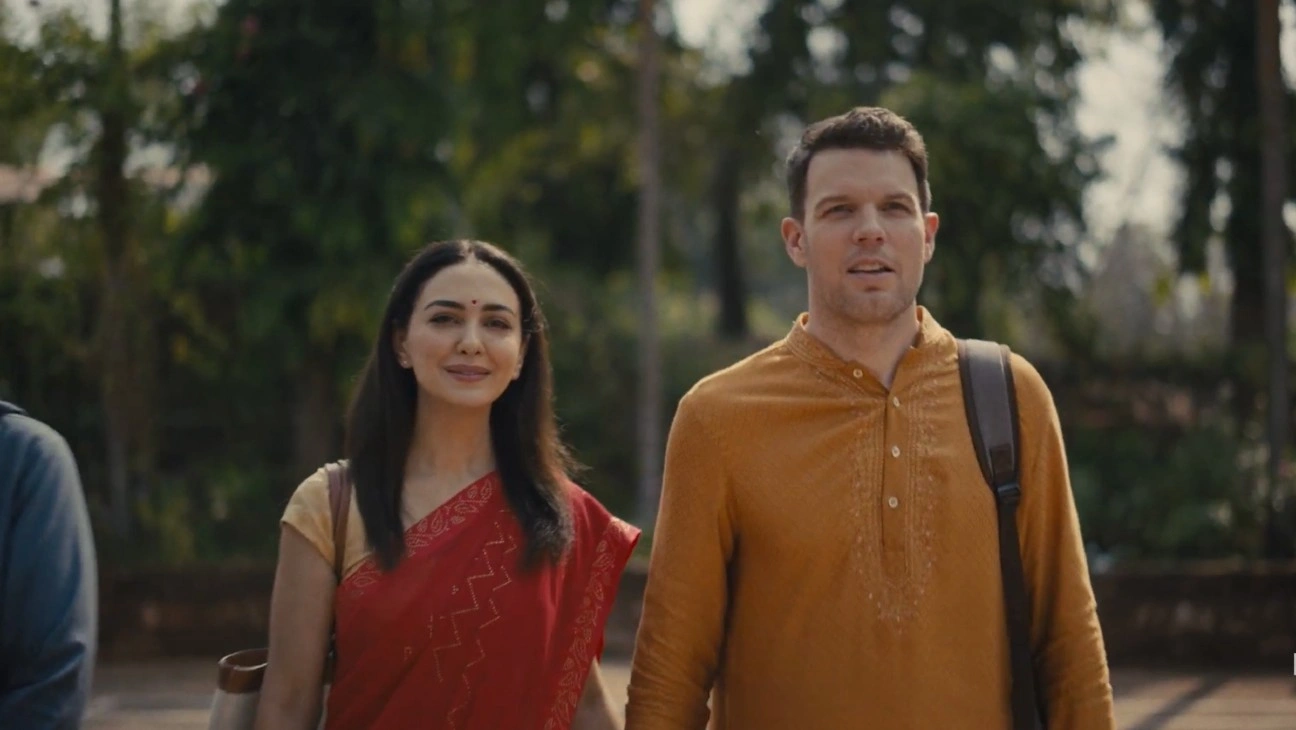
A Mosquito in the Ear introduces Andrew and Daniela, portrayed by Jake Lacy and Nazanin Boniadi, an American couple who have navigated six years of bureaucratic hurdles to adopt Sarvari, a four-year-old girl played by Ruhi Pal, from an orphanage in Goa, India. What should represent the culmination of their journey becomes the beginning of an invaluable test of their relationship, their patience, and their definition of parenthood.
From the moment they arrive at the orphanage, Sarvari resists their attempts at connection. She clings to the familiar—the children she has known, the routines that define her world, the sounds of her native language. As Andrew and Daniela struggle to bridge the gap between their idealized vision of family and the chaotic reality before them, their marriage begins to buckle under the weight of exhaustion, guilt, and seemingly impossible communication barriers.
The film derives its title from a powerful metaphor: for Sarvari, the English spoken around her functions as nothing more than a mosquito buzzing persistently near her ear—constant, irritating, and utterly incomprehensible. This metaphor becomes the emotional grammar through which the entire narrative operates, transforming what could have been a straightforward adoption drama into a complex meditation on displacement, fear, and the fragile architecture of trust.
Performances
Ruhi Pal delivers what is undoubtedly the most demanding and affecting performance in the film. As Sarvari, she communicates primarily through resistance, silence, sudden emotional eruptions, and physical movement. Each tantrum, each retreat, each moment of frozen fear feels specificity rather than generic childhood misbehavior. Pal carries the considerable weight of conveying emotional storytelling largely through gesture, rhythm, and reaction, and she does so with startling control.
Nazanin Boniadi brings a tense warmth to Daniela, portraying a woman whose longing for motherhood must now survive its unexpected reality. Rather than an idealized maternal figure, Boniadi presents Daniela as someone exhausted, anxious, and occasionally overwhelmed by the dual pressure of managing a child’s fear while absorbing her husband’s panic. Her bond with Sarvari develops not through dramatic breakthroughs but through quiet, persistent presence.
Jake Lacy’s Andrew serves as a counterweight—messier, more visibly unsettled, and frequently uncertain how to navigate his new role. His character arc, which includes a memorable walk during a stressful moment and a later apology, sketches a man confronting his own limitations without being transformed into a villain. Lacy portrays a new father discovering, without graceful buffer, how quickly fear can expose vulnerability.
Micky Singh’s Sister Aruna provides essential stability as the film’s translator and emotional anchor, though the script wisely avoids making her a magical solution to the family’s communication struggles.
Behind the Lens
Director Nicola Rinciari demonstrates remarkable restraint throughout A Mosquito in the Ear, concentrating the drama within the compressed timeframe of the first days following adoption. This decision creates an almost claustrophobic pressure, as if every hotel room, car ride, and street corner serves as a testing ground for whether this nascent family unit can survive its initial hours together.
The location filming in India provides texture without devolving into visual exoticism. Crowds, streets, orphanage spaces, and domestic interiors consistently remind Andrew and Daniela—and the audience—that they operate as guests in a culture they have not yet learned to interpret.
The film’s artistic motif deserves particular attention. Andrew, Daniela, and Sarvari are all artists, and their drawings create one of the rare spaces where communication transcends translation. Rinciari allows this motif to function quietly, permitting marks on paper to carry emotions that spoken language cannot express.
The final sequence, in which Sarvari runs into the crowded streets, lands with genuine force precisely because the film has prepared viewers for both the child’s terror and the parents’ desperation. The editing and pacing serve that dread without amplifying it into manufactured hysteria.
Final Verdict
A Mosquito in the Ear represents humane, observant, and emotionally precise cinema. It understands that love cannot simply erase fear on command, that trust—like language—must be learned one difficult sound at a time. This is not adoption as greeting-card warmth but adoption viewed through confusion and legitimate fear.
For audiences seeking independent cinema that respects emotional complexity, that treats its youngest character as a person rather than a symbol, and that finds power in small, bruising moments, this film delivers. Rinciari keeps the emotion grounded, while the performances transform miscommunication into gripping human drama. Its restraint, ultimately, provides its sharpest sting.