

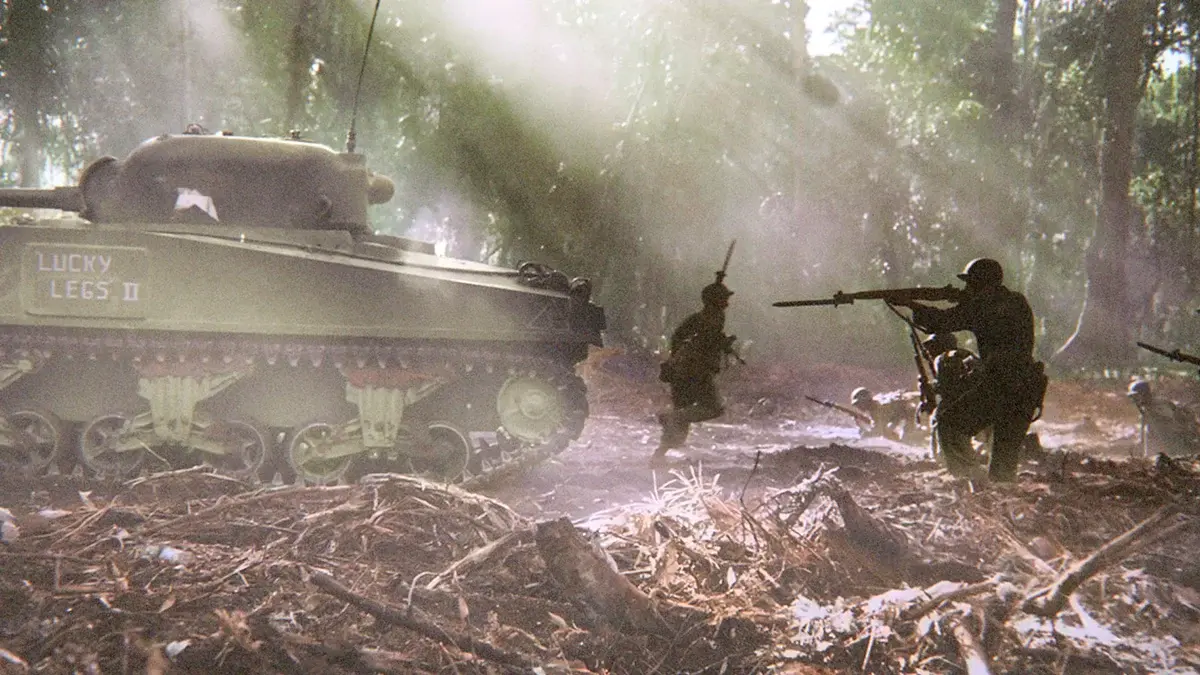
The HISTORY Channel has commissioned what may be the most ambitious documentary project ever produced about the Second World War. World War II with Tom Hanks represents a landmark achievement in historical filmmaking, delivering an uncompromising 20-episode chronicle that spans the entirety of humanity’s most consequential conflict. This exhaustive docuseries premiered on May 25, 2026, launching with three back-to-back episodes that immediately established its status as the definitive cinematic treatment of the global war that shaped the modern world.
An Unprecedented Collaborative Achievement
This monumental undertaking emerged from a powerful partnership between Nutopia, A+E Factual Studios, and The National WWII Museum. The involvement of the museum—widely recognized as the authoritative institution for preserving and interpreting World War II history—ensures that every factual claim presented carries genuine scholarly credibility. Executive producers Jon Meacham and Gary Goetzman have assembled a production that refuses to compromise on historical accuracy or production quality, creating a viewing experience that demands serious engagement from its audience while remaining accessible to casual viewers seeking to understand this pivotal era.
The series spans approximately 860 minutes of broadcast time, allowing for an extraordinarily comprehensive examination of the war years from the 1939 invasion of Poland through the dawn of the atomic age. Unlike previous documentaries that compress these events into single installments or abbreviated series, this project grants itself the temporal space necessary to explore every significant dimension of the conflict with appropriate depth and nuance.
Storytelling Grounded in Authentic History
What distinguishes World War II with Tom Hanks from its predecessors is its unwavering commitment to historical authenticity. The production completely rejects modern dramatic recreations or stylized reenactments, anchoring its presentation entirely in archival footage, rare photographs, radio broadcasts, and analytical commentary from academic experts and retired military leaders. This approach protects the visual authority of the work, ensuring that viewers are never distracted by contemporary actors in period costumes. The stark reality of historical events speaks for itself, and the filmmakers trust their audience to engage with that reality directly.
The narrative architecture follows a rigorous chronological progression that allows audiences to experience the war’s development with maximum clarity. The opening episode delivers a day-by-day structural breakdown of the September 1, 1939, German invasion of Poland, capturing both the tactical paralysis of Polish defense and the immediate humanitarian catastrophe that befell civilians caught in the crossfire. This granular focus succeeds because it connects directly to deeper historical causation, carefully unpacking how the post-1919 European economic collapse—including the punitive terms of the Treaty of Versailles and the cascading effects of the 1929 global depression—created the conditions that allowed the National Socialist German Workers’ Party to seize power in 1933.
Confronting Difficult Historical Truths
The documentary demonstrates particular courage in its willingness to examine the profound diplomatic failures of Western European leadership during the rise of fascism. The narrative takes an unflinching look at the appeasement policies pursued by Great Britain and France during early German territorial aggressions, documenting with scholarly precision the fatal hesitation of London and Paris as Warsaw faced destruction. This critical examination extends to the complex, fragile alliances that defined the era, including a sharp evaluation of the Molotov-Ribbentrop Pact and the Soviet Union’s opportunistic eastern invasion of Poland to reclaim territories ceded after the First World War.
When the narrative turns to Operation Barbarossa, the series visualizes the massive 1,800-mile Eastern Front where three million Axis troops advanced into Soviet territory. The production employs effective geographical comparisons—likening the invasion path to an attack spanning the entire coastline between Seattle and San Diego—to help contemporary audiences grasp the staggering scale of this campaign. The storytelling gains additional intellectual weight through its analysis of the Red Army’s internal weaknesses, particularly how Joseph Stalin’s purges of the mid-1930s had decimated his own officer corps, leaving the Soviet military catastrophically unprepared for the German onslaught.
America’s Complex Path to War
The midsection of the series transitions masterfully from battlefield tactics to political strategy, focusing on the complex domestic pressures facing the Roosevelt administration during the critical years of 1940 and 1941. The documentary details FDR’s strategy of incremental mobilization with remarkable clarity, highlighting how he used executive authority to initiate the first peacetime conscription draft in American history while quietly retooling domestic industrial manufacturing to supply Allied forces. This nuanced examination reveals a dual-track approach where the United States prepared for unavoidable conflict while officially maintaining a stance of strict neutrality.
Perhaps most impressively, the production establishes its critical independence by confronting uncomfortable aspects of American foreign policy that many documentaries prefer to overlook. The series takes a hard look at the State Department’s refusal to grant entry to thousands of Jewish refugees fleeing systematic violence in Germany and Poland, documenting how immigration quotas remained strictly enforced despite clear evidence of mass atrocities available to policymakers. By detailing this tragic failure, the series dismantles the comforting myth of immediate, unblemished Western heroism and forces audiences to confront the cold realities of national self-interest that often governed wartime decision-making.
Expert Analysis and Authoritative Narration
The collaboration with institutions like The National WWII Museum brings immense credibility to the project. Senior historians, including the distinguished Robert Citino, provide essential context explaining the broader social and political currents that drove military decisions at the highest levels. Complementing this academic perspective are the operational insights of retired military leaders such as General Wesley Clark, who analyze battlefield choices through a professional lens and explain how wartime logistics and operational strategies laid the groundwork for post-war security alliances like NATO. This bridge between historical action and modern institutional architecture enriches the analysis with genuine intellectual depth.
Holding these diverse perspectives together is the authoritative vocal presence of Tom Hanks, whose narration throughout all twenty episodes remains consistently measured and steady. Avoiding theatricality or forced emotion, Hanks delivers his commentary with a respect for the somber weight of the historical material that allows the stark imagery and expert analysis to carry the narrative’s emotional impact without artificial manipulation. His familiar voice serves as a trustworthy guide through complex historical terrain, inviting viewers to engage seriously with material that might otherwise feel overwhelming in its scope and intensity.
A Complete Window Into a Turning Point
The final segments of the documentary shift from the resolution of the war to its long-term historical consequences, tracing how the destruction of traditional European powers directly caused the structural alignment of the Cold War and the beginning of the atomic age. By examining the collapse of old empires and treating the conflict as a massive social turning point, the series cements its status as essential historical analysis for contemporary audiences seeking to understand the forces that continue to govern international relations.
Viewers can watch the broadcast live on the HISTORY Channel on Monday nights or stream episodes the following day on platforms such as Philo, Hulu with Live TV, and DIRECTV Stream. This accessibility ensures that this remarkable documentary project can reach the broadest possible audience, fulfilling its educational mission while setting a new standard for what historical documentary filmmaking can achieve.
Also Read:
WWII Unfiltered: Tom Hanks Docuseries Delivers Definitive Historical Saga From Memorial Day