

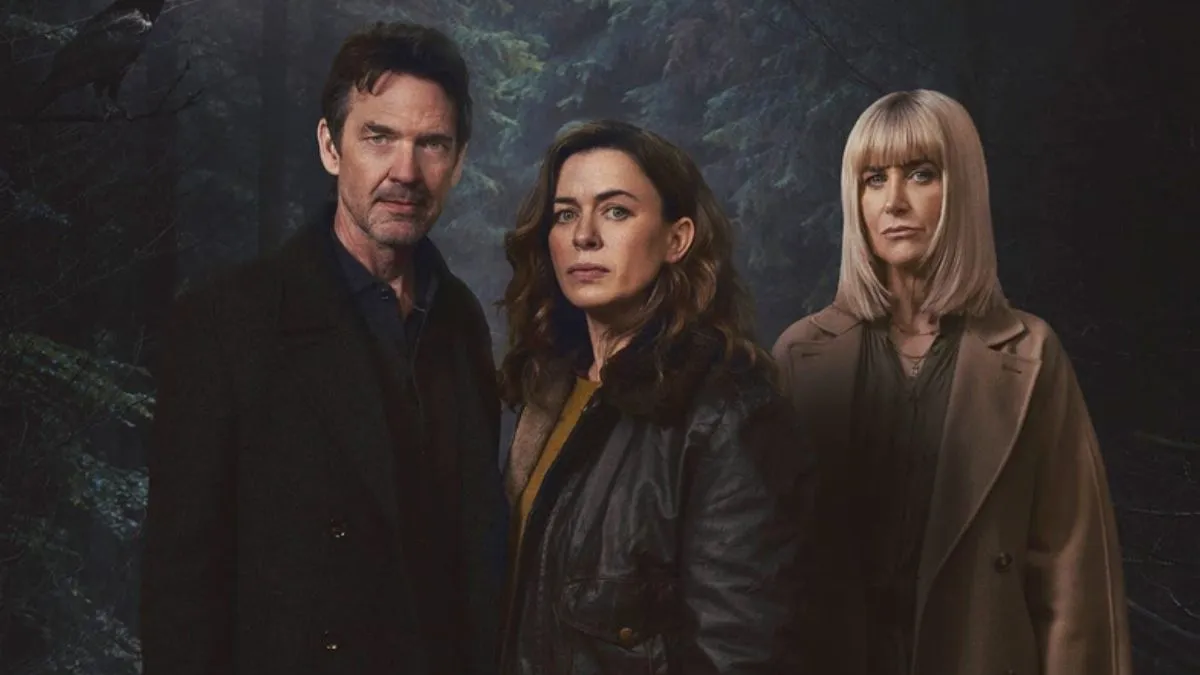
Returning to the bleak world of The Crow Girl feels less like a continuation and more like a plunge back into icy water. The second season wastes no time easing viewers in; it drops DCI Jeanette Kilburn and psychotherapist Sophia Craven straight into the aftermath of the first finale, trusting the audience to remember every scar left behind. That immediate immersion signals the show’s intent: to treat trauma not as exposition but as fuel for the narrative engine that drives the entire run.
Synopsis
A mummified corpse discovered inside a church wall and a second body found in a freezer launch Jeanette into a case that refuses to follow a linear path. As the investigation twists back on itself, the line between victim and perpetrator blurs, especially where Victoria Burkeman is concerned. The season explores how past abuses echo in present violence, weaving psychological tension into a procedural framework without resorting to cheap shock tactics.
Performances
Eve Myles portrays Jeanette with a restrained, businesslike façade that occasionally fractures, revealing the weight she carries without ever begging for sympathy. Her exhaustion seeps through subtle gestures, making her resilience feel earned rather than theatrical.
Katherine Kelly’s Sophia Craven is a study in performative composure. Kelly leans into the character’s instability, delivering moments where Sophia’s professional mask slips, especially during scenes with Victoria. The rawness she brings makes every interaction feel perilously charged, elevating the psychological stakes beyond the plot mechanics.
Clara Rugaard continues to keep Victoria enigmatic. Her unpredictable presence acts as the season’s heartbeat, leaving viewers perpetually questioning whether she is a wounded survivor or a hidden catalyst forging a darker force. Rugaard’s ability to sustain that ambiguity fuels much of the show’s tension.
Behind the Lens
The creative team sustains a grim aesthetic that mirrors the narrative’s darkness. Cinematography favors cold palettes and tight framing, amplifying the sense of claustrophobia that surrounds the characters. Direction trusts the audience’s memory, foregoing lengthy re‑introductions and allowing the bruised psyches of the leads to propel the story forward.
Writing balances procedural detail with deep psychological insight. The disturbing exchanges between Victoria and her imprisoned mother—an enabler turned participant—are handled with unsettling precision, turning each revelation into a wound rather than a twist. However, the season’s appetite for relentless misery occasionally dulls its impact; a few more moments of restraint in the latter half could have sharpened the emotional payoff.
Final Verdict
The Crow Girl Season 2 is an unflinching, harrowing thriller that trusts its audience to sit with discomfort. While its unyielding grimness can tip into numbness, the series’ strongest asset lies in the central relationship between Jeanette and Sophia—a slow‑burn intimacy that does more heavy lifting than the mystery itself. Performances are uniformly strong, particularly Eve Myles’ stoic resilience and Katherine Kelly’s volatile empathy.
For viewers who appreciate crime dramas that prioritize character over cliché, this season offers a compelling, albeit unsettling, experience. It earns its ambition through nerve‑racking performances and a willingness to let darkness linger long after the credits roll.