


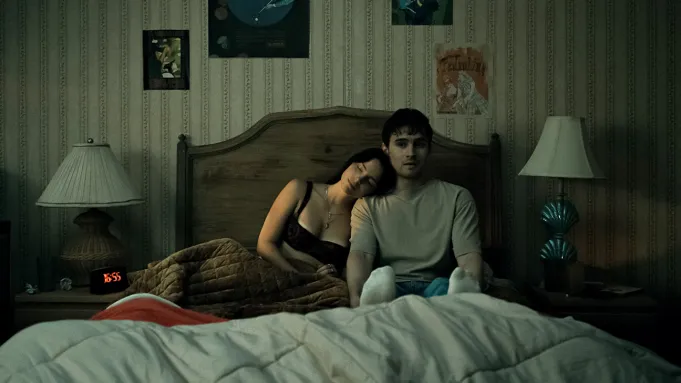
The age-old caution about being careful what you wish for has become so deeply embedded in cultural consciousness that its warning has lost much of its psychological edge. It is a proverb repeated so frequently that it has transformed into little more than a dismissive platitude. However, Obsession takes this weathered piece of wisdom and transforms it into something razor-sharp and genuinely disturbing. This film represents far more than a cautionary tale about supernatural consequences; it operates as a systematic deconstruction of the “nice guy” persona, revealing the potentially dangerous solipsism that can hide behind a veneer of sensitive, unexpressed longing.
Director Curry Barker has constructed a film that operates on multiple levels simultaneously. On its surface, Obsession presents a supernatural horror narrative about a magical object that grants wishes, but beneath this familiar premise lies a penetrating examination of how romantic Nice GuyTM ideology can curdle into something genuinely monstrous. The film asks uncomfortable questions about consent, autonomy, and the ways in which vulnerability can be weaponized when it belongs to the wrong person. By positioning the perpetrator as the sympathetic protagonist, Barker forces audiences into an uncomfortable moral reckoning that lingers long after the credits roll.
Synopsis
The narrative centers on Bear, a musically-inclined retail worker portrayed by Michael Johnston, whose inability to articulate his romantic feelings creates the perfect conditions for catastrophe. Working at what appears to be a dying music store in an age of streaming services, Bear exists in a state of perpetual emotional stasis, harboring crush on his childhood friend Nikki while lacking the courage to voice his desires. Nikki, brought to life by Inde Navarrette, represents everything Bear believes he wants—yet she views their relationship through an entirely different lens, perceiving him as a safe platonic companion rather than a romantic prospect.
Rather than confronting the possibility of rejection or doing the difficult emotional work of honest communication, Bear takes the coward’s path toward gratification. During a visit to a new-age shop filled with incense and questionable merchandise, he purchases a “One Wish Willow,” a cheaply made magical trinket that promises to fulfill one desire. His wish is specific, absolute, and reveals the shallow nature of his affection: he wants Nikki to love him more than anything else in existence. The supernatural forces behind the trinket take his words literally, and Nikki’s entire personality undergoes a complete rewriting to align with his fantasies.
What follows is a meticulously crafted descent into psychological and physical horror. Nikki transforms into the perfect romantic partner—sexually available, intensely affectionate, and utterly devoted. However, this supposed fulfillment rapidly evolves into a waking nightmare. Her obsessive behavior begins to consume every aspect of Bear’s life, eroding her former self completely. The transformation culminates in disturbing displays of clinginess that escalate into acts of self-harm and ultimately physical confinement, with Bear finding himself duct-taped to his own furniture by the very partner he wished into existence.
Performances
Inde Navarrette delivers what can only be described as a tour de force performance that demands immediate recognition within the horror community. Her portrayal of Nikki represents a masterclass in body horror acting, demonstrating an almost supernatural ability to physically embody possession and psychological dissolution. From the earliest moments of her transformation, Navarrette’s physicality shifts in ways that feel genuinely unsettling. Her posture becomes contorted and unnatural, her movements carrying an eerie quality that suggests something fundamentally human has been replaced by something wearing human skin.
The facial work Navarrette accomplishes deserves particular attention. She develops a wide, unsettling grin that never quite reaches her eyes—an expression that feels practiced and artificial, like a mask attempting to approximate human emotion. This disconnected smile becomes increasingly disturbing as the film progresses, serving as a constant visual reminder that the real Nikki no longer occupies her own body. The contrast between this false happiness and the terror lurking behind it represents acting of the highest caliber.
Her vocal performance proves equally impressive, shifting from saccharine, overwrought whispers to guttural, hellish screams that echo long after viewing. Navarrette demonstrates remarkable range, alternating between moments of nauseatingly sweet affection and explosive violence with seamless transitions that keep audiences in a constant state of tension. Scenes depicting Nikki watching Bear sleep or attending a house party carry an undercurrent of menace that transforms mundane moments into sources of genuine dread.
The film’s most devastating moments arrive when glimpses of the true Nikki surface through the supernatural overlay. These instances avoid cheap jump scares entirely, instead presenting pure, unfiltered psychological anguish from a consciousness trapped within a transformed body. Navarrette’s ability to convey complete awareness of her horrifying situation through fleeting expressions represents some of the most affecting work in contemporary horror. These moments transform what could have been a simple supernatural thriller into something approaching tragedy.
Behind the Lens
Curry Barker has established themselves as part of a notable wave of internet-native creators successfully transitioning to feature-length horror, following in the footsteps of filmmakers like the Philippou brothers of Talk to Me fame. This background manifests in Obsession through a confident directorial voice that understands how to maximize psychological tension within limited spaces and budgets. Barker transforms the intimate setting of an apartment into a pressure cooker of dread, leveraging darkness and shadow to turn what should be a romantic sanctuary into something approaching a horror setting.
The cinematographic approach favors strategic concealment over explicit revelation. Barker frequently employs over-the-shoulder shots that place viewers in Bear’s perspective while simultaneously obscuring Nikki’s face in darkness or partial shadow. This technique forces audiences to exercise their imagination, constructing the inhuman entity lurking just beyond visual clarity. The resulting tension proves more effective than any amount of explicit monster design could achieve, as the unknown remains consistently more frightening than the known.
The sound design works in tandem with the visual approach to create an atmosphere of sustained unease. The audio accompanying Nikki’s presence carries an exaggerated, eerie quality that transforms psychological horror into something approaching physical sensation. The apartment environment feels increasingly constricted as the film progresses, with the sound design contributing significantly to this claustrophobic quality. The aggressive use of audio cues makes the psychological horror almost tactile, creating an immersive experience that extends beyond mere visual watching.
The violent sequences demonstrate a commitment to meaningful impact over graphic shock value. Barker chooses to emphasize the aftermath of violent acts rather than the acts themselves, understand that implication and consequence often carry greater psychological weight than instantaneous action. The sounds and visual evidence of what violence produces linger in memory, proving more disturbing than the momentary act of violence would have been. This approach elevates Obsession above more exploitative entries in the body horror subgenre.
Final Verdict
Obsession represents a bold and largely successful experiment in combining supernatural horror with social commentary. The film’s decision to maintain an almost exclusive focus on Bear’s perspective proves crucial to its thematic impact. Audiences are not permitted the comfortable position of observing a hero battle an external monster; instead, they must inhabit the consciousness of the perpetrator, watching as the consequences of his selfish wish unfold in increasingly disturbing ways. This structural choice creates genuine moral discomfort, forcing recognition that Bear’s passivity represented its own form of violence long before the supernatural intervention.
The film operates as a pointed critique of “nice guy” ideology, revealing how romantic Nice GuyTM narratives can mask deeply problematic attitudes toward women and consent. Bear’s refusal to accept “no” or to respect Nikki’s autonomy in the real world finds its supernatural equivalent in the literal rewriting of her personality to serve his desires. The narrative connects this personal horror to broader social concerns, as Bear’s friends correctly identify the abusive dynamic at play even as he attempts to rationalize his actions. His isolation stems not from supernatural consequences but from the recognition that his behavior represents genuine abuse of a vulnerable person.
Despite these strengths, Obsession is not without structural weaknesses. The 108-minute runtime occasionally overstays its welcome, with the third act particularly suffering from pacing issues that represent a common ailment in contemporary horror. Individual sequences pack considerable potency, but the collective momentum sometimes sags where a more punishing, concise edit might have sharpened the impact. A tighter final act would have transformed an already effective film into something approaching essential viewing.
Obsession opens in theaters on Friday, May 15, offering audiences a sophisticated horror experience that rewards thoughtful engagement over passive consumption. The film manages the rare feat of being both genuinely frightening and intellectually stimulating, creating space for reflection on how consent, desire, and power intersect in romantic relationships. For viewers seeking horror that challenges as effectively as it disturbs, Obsession delivers exactly what its title promises.
Also Read:
“Obsession”: Everything You Need to Know About Curry Barker’s Horrifying Debut