

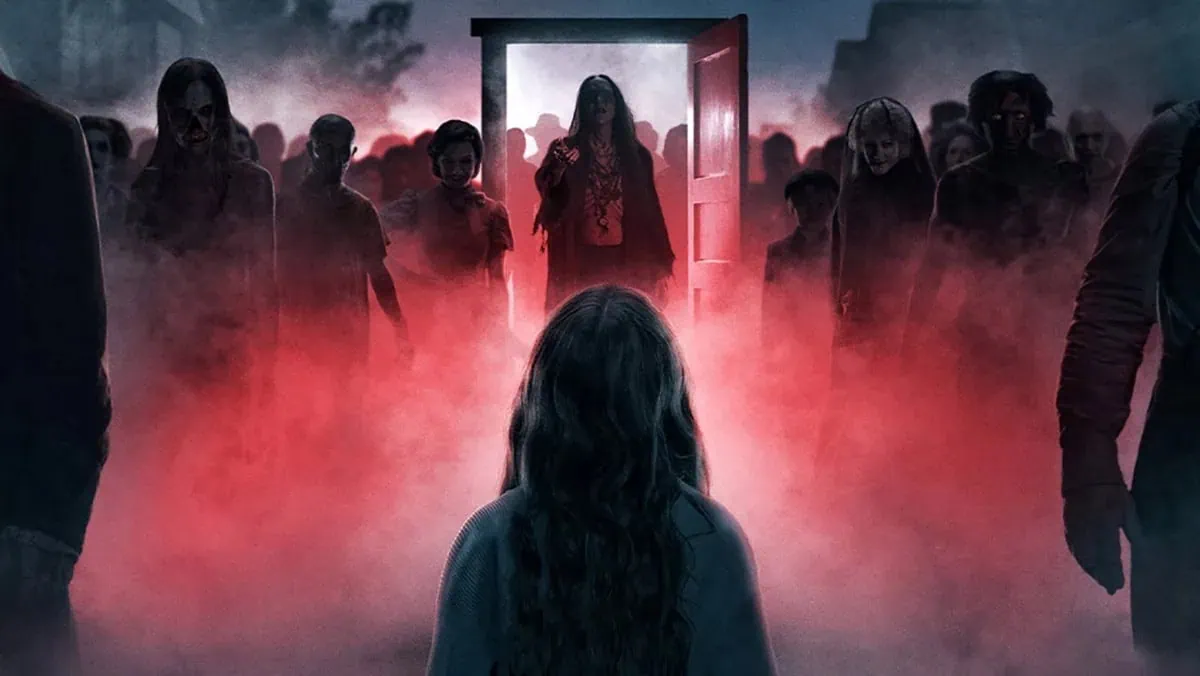
The Insidious franchise has built its reputation on tapping into the primal fear of the unknown. When the first film introduced audiences to the shadowy realm known as the Further, it combined elemental horror with inventive storytelling to create a modern classic. Six instalments later, Insidious: Out of the Further attempts to rekindle that spark by bringing a new family, fresh scares, and a novel twist on the protagonist’s connection to the astral plane. Does this latest entry honour the series’ legacy, or does it falter under the weight of its own mythology? This review explores the film’s narrative, performances, direction, and overall impact, offering a balanced perspective for both longtime fans and newcomers.
Spoiler Free Synopsis
Gemma (Amelia Eve) is a dental hygienist raising her young daughter Maya in the house where she endured a traumatic childhood. Haunted by fragmented memories of her mother’s violent demise, Gemma begins to notice three unsettling elderly figures lurking around her neighbourhood. As the line between reality and the Further blurs, she discovers she can not only enter the astral realm but also pull entities back into the living world. This ability forces her to confront a repressed family secret while trying to protect Maya from repeating a destructive cycle. The film weaves psychological dread with supernatural set pieces, all set against the familiar backdrop of the Further.
Performances
Amelia Eve delivers a grounded portrayal of Gemma, balancing vulnerability with a steely determination that anchors the film’s emotional core. Island Austin, as Maya, captures the innocence and creeping terror of a child caught between two worlds, particularly in the couch‑fort sequence that showcases her ability to shift between realms convincingly. Lin Shaye returns as Elise Rainier, lending her trademark wit and warmth; even in spectral form, she remains the franchise’s most charismatic link to the supernatural. Maisie Richardson‑Sellers and Brandon Perea provide solid support as Clare, a spiritually attuned tattoo artist, and Nick, a sympathetic officer, while Sam Spruell’s portrayal of the death‑cult leader Cyrus Lam adds a suitably sinister edge, though his character never reaches the iconic status of previous Insidious antagonists.
Behind the Lens
Writer‑director Jacob Chase leans into dream‑logic visuals, moving beyond standard haunted‑house tropes. The most striking sequence unfolds inside Maya’s couch fort, where cushions morph into narrow, beige corridors reminiscent of the Backrooms—a claustrophobic, surreal set piece that transforms an everyday object into a source of genuine dread. Another memorable moment occurs in Gemma’s dental office, where a confrontation with an acolyte’s rotting mouth delivers unsettling body horror that feels fresh within the series. However, the film’s sound design and editing are uneven. While occasional groans and whispers heighten tension, the score often overwhelms subtle scares, and frantic, arrhythmic cuts can render supernatural encounters chaotic rather than terrifying. These technical inconsistencies prevent the movie from fully capitalising on its strongest concepts.
Final Verdict
Insidious: Out of the Further presents an intriguing premise—a protagonist who can bring entities from the Further back into our world—and offers several visually inventive moments that showcase the series’ potential for creativity. Nonetheless, the screenplay underutilises the emotional bond between Gemma and Maya, weakening the stakes of the impending danger. The reliance on familiar horror tropes, coupled with uneven audio‑visual execution, prevents the film from reaching the heights of its predecessors. Longtime fans will find enough to enjoy, particularly the return of Elise Rainier and the fresh take on astral travel, but the sequel ultimately feels like a competent, if uneven, addition to the Insidious saga—more a familiar playground than an infinite nightmare.