


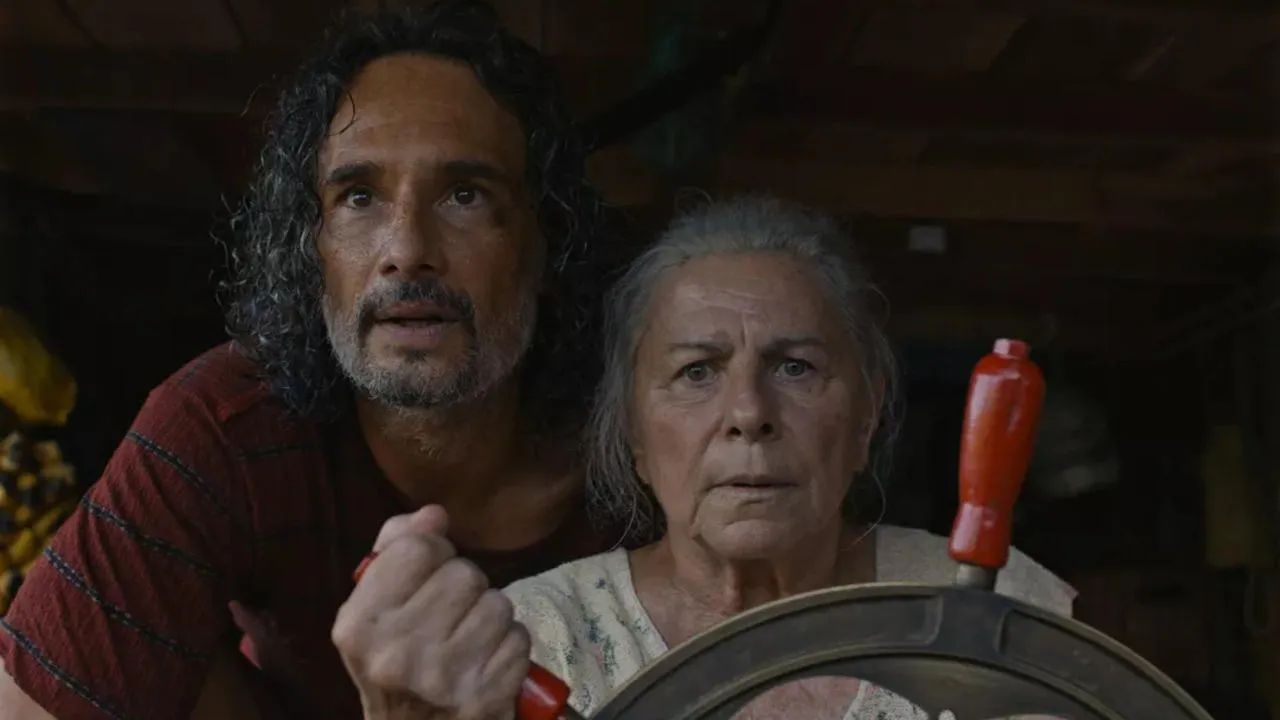
The cinematic landscape is no stranger to the “bleak future,” yet few filmmakers navigate the intersection of social realism and political dystopia as deftly as Gabriel Mascaro. With The Blue Trail, the Silver Bear winner at the Berlin Film Festival 2025, the Brazilian writer-director returns to the screen with a chillingly plausible vision of a society that has weaponized “patriotism” against its own lifespan. Following in the footsteps of his previous works, Mascaro crafts a narrative that feels less like sci-fi and more like an uncomfortable reflection of our current obsession with productivity and youth.
Story: The “Wrinkle Wagon” and the Price of Peace
The film opens with an ominous, disembodied voice echoing from the heavens, declaring that caring for the elderly is no longer a choice—it is a “patriotic duty.” For 77-year-old Tereza (Denise Weinberg), this duty is a death sentence. In this world, turning 80 marks the end of personhood. Citizens are loaded onto the “wrinkle wagon”—a government transport that treats humans like industrial waste—and shipped off to senior colonies to unburden the younger generation.
The tension escalates when Tereza’s employer informs her that the mandatory retirement age has been lowered from 80 to 75. Suddenly stripped of her autonomy and placed under the guardianship of her daughter, Joana (Clarissa Pinheiro), Tereza chooses a different path. Refusing to be “shackled to dependency,” she flees her suburban prison, embarking on a daring escape along the winding Amazonian rivers. Her journey is one of survival, but more importantly, it is an act of mutiny against a state that considers her an expired product.
Performances: A Masterclass in Quiet Rebellion
At the heart of the film is a towering performance by the veteran Brazilian actor Denise Weinberg. Weinberg eschews the trope of the “feeble grandmother,” instead portraying Tereza with a sharp, disgruntled grit that softens only when she finds true kinship. Her chemistry with Miriam Socarrás, who plays the free-spirited “Nun,” provides the film’s most tender moments. Together, they create a fleeting utopia on the water, proving that intimacy and evolution do not stop at 75.
Rodrigo Santoro offers a grounded presence as Cadu, the boatman who inadvertently becomes Tereza’s chauffeur to freedom. While Santoro provides a steady hand, the focus remains firmly on the women. Mascaro’s direction is revolutionary in its refusal to look backward; the film focuses entirely on who Tereza is and who she can become, rather than mourning the woman she used to be.
Behind the Lens: Magical Realism in the Amazon
Cinematographer Guillermo Garza captures the Amazonian odyssey with a striking visual palette. Despite the “boxy” aspect ratio, the landscapes feel limitless. Garza fills the screen with imaginative, haunting imagery—from riverbanks overflowing with discarded rubber tires to the claustrophobic interiors of the boat.
Mascaro also introduces elements of magical realism that elevate the film from a standard drama to something more ethereal. On Cadu’s boat, Tereza discovers rare snails whose “blue drool” allows those who consume it to see the future. While this concept adds a layer of surreal beauty, the film occasionally struggles to balance these fantastical elements with its grounded social critique. Some plot points—like the revelation that freedom can be purchased from the colonies—feel slightly rushed within the film’s lean runtime, leaving the audience craving a deeper dive into the world’s lore.
Final Verdict
The Blue Trail is a haunting, visionary piece of cinema that turns a lens on the one thing we all share but rarely discuss: the inevitability of aging in a world that prizes utility. While the narrative occasionally feels overambitious for its length, the strength of the performances and the sheer creativity of the world-building make it a must-watch. It is a rare, defiant look at later-life resistance that lingers long after the credits roll.
Rating: 4/5 Stars