


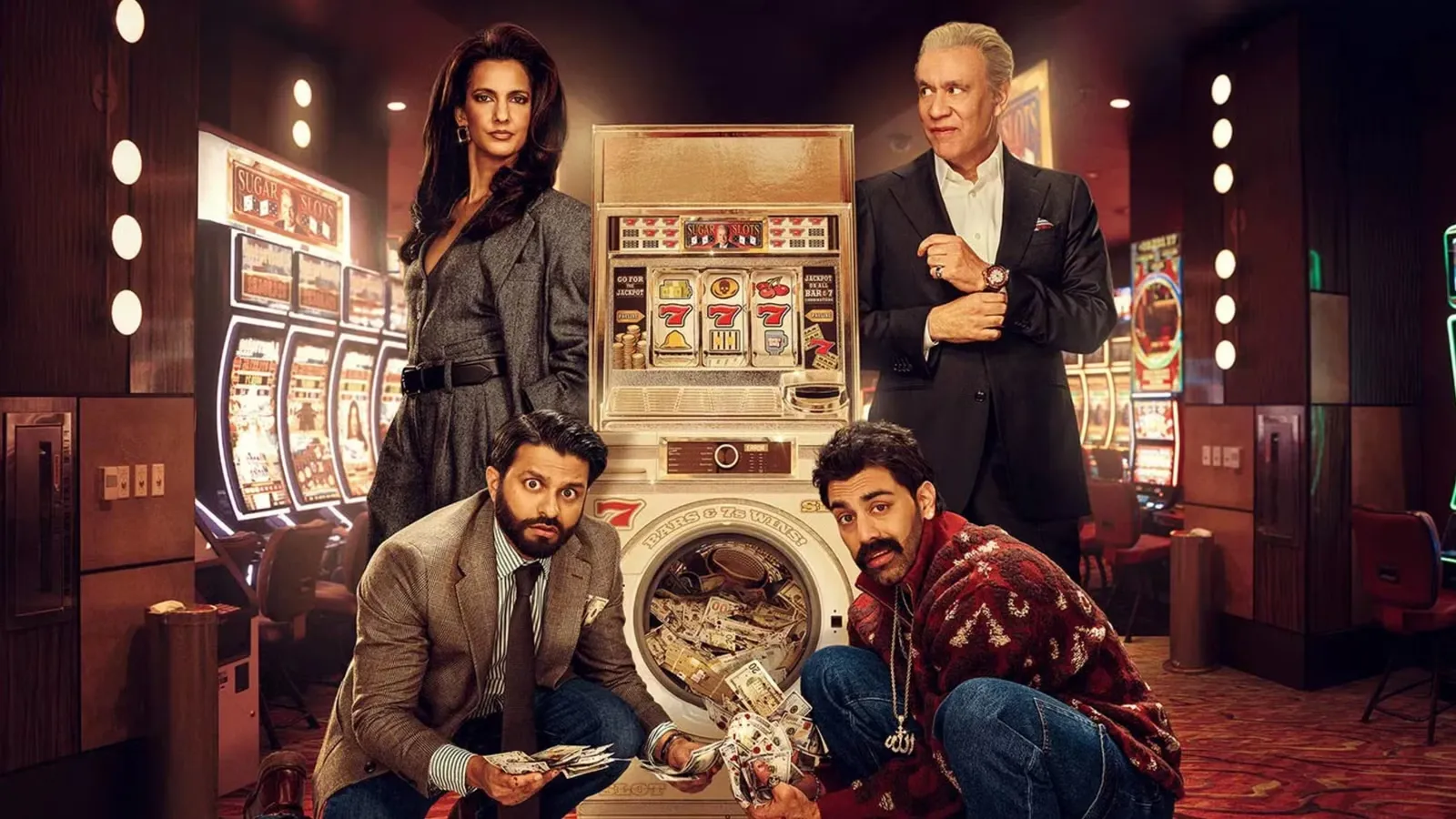
The sophomore installment of Hulu’s most culturally specific crime comedy arrives with amplified ambition and tightened execution. Deli Boys Season 2 transcends the sophomore slump by transforming its protagonists from bewildered inheritors into reluctant expanders of a criminal empire they never asked for. The series understands that family business complications reach universal resonance when filtered through specificity, and this season leverages that truth into streaming comedy gold.
Synopsis
Mir and Raj Dar have survived their father’s questionable legacy, but surviving and thriving exist in entirely different universes. When their illicit operation ballooned beyond the confines of their modest Philadelphia deli, the brothers discovered that success creates its own catastrophic logistics. Stashing dirty money throughout cooler units and food storage areas transforms their legitimate business front into a financial headache disguised as a sandwich shop.
Enter Max Sugar, a casino mogul promising legitimate laundering pathways that could elevate the Dar operation from neighborhood nuisance to regional player. Meanwhile, the resurrection of the revenge narrative involving Ahmad reintroduces ghosts from the past, while district attorney Andrew Chadwater’s anti-drug mayoral campaign forces the family deeper into political crosshairs. Raj’s startling framing for murder catapults him into unexpected notoriety, turning incarceration into viral social media phenomenon.
The six-episode arc moves with remarkable velocity, replacing first-season learning curves with expansion pressures that generate fresher dramatic stakes. These brothers no longer wonder whether they belong in organized crime—they now confront what happens when the machine actually functions.
Performances
Poorna Jagannathans’s Lucky Auntie emerges as the undisputed crown jewel of this iteration. She transforms criminal absurdity into household management expertise, delivering ruthless efficiency wrapped in theatrical brilliance. Her wardrobe functions as psychological warfare—animal prints, leather, and metallic accents communicate authority without uttering a single syllable. The character’s romantic entanglement with Max Sugar crackles precisely because she perceives his danger while embracing it anyway. Vulnerability remains foreign territory until Danyal arrives, introducing emotional complexity through verbally charged exchanges that carry cultural weight impossible to replicate through standard exposition.
Asif Ali and Saagar Shaikh demonstrate comfortable settled chemistry as Mir and Raj respectively. The elder brother’s desperate attempts at strategic thinking produce comedy through genuine belief in his own leadership capabilities. The younger sibling’s impulse-driven chaos maintains ridiculous momentum while loyalty prevents descent into meaningless noise. Their fraternal rhythm sustains narrative warmth throughout escalating criminal pandemonium.
Fred Armisen’s Max Sugar provides measured menace occasionally overshadowed by surrounding volatility. Andrew Rannells injects gleeful antagonism into Chadwater’s political ambition. Kumail Nanjiani’s Danyal introduces romantic-legal chaos efficiently, while Nandika weaponizes oversharing into comedic warfare.
Behind the Lens
Wendy Wang’s musical composition integrates stronger tabla presence, granting comedic sequences cultural heartbeat. The strategic deployment of “Chaap Tilak” during flashbacks weaves Sufi poetry into crime comedy territory, creating symbolic richness where inheritance operates simultaneously as criminal, familial, musical, and emotional inheritance.
Production design maintains visual clarity despite accelerating narrative pace. Lucky’s costuming communicates perpetual danger and glamour while brothers’ wardrobes occupy transitional space between deli employees and aspiring power brokers.
Editing prioritizes momentum over meditative exploration. Some supporting narratives deserved additional breathing room—the deli’s emotional centrality somewhat diminishes as casino operations dominate landscape. Six episodes permit little wasted screen time but constrain potentially richer character development.
Final Verdict
Deli Boys Season 2 succeeds through understanding that cultural authenticity manifests through rhythm, profanity, food references, family insult precision, and generational continuity rather than expository explanation. The series occupies rare streaming territory—crime comedy with specific immigrant perspective operating without translation for presumed mainstream audiences. This confidence defines its sharpest competitive advantage.
The season transforms protagonists from survivors into Expanders facing fresh categorical pressures. Mir and Raj remain simultaneously dangerous, foolish, and sincerely sympathetic—a calibration the series executes with remarkable consistency. Explosive misunderstandings, absurd escalations, and family loyalty paradoxes generate entertainment value transcending demographic boundaries.
For audiences seeking distinctive crime comedy honoring familial specificity while delivering universal laugh potential, this season represents essential viewing. Streaming comedy rarely achieves this balance between cultural honesty and broad accessibility—and Deli Boys Season 2 accomplishes it relentlessly.
Apart from Hulu, Deli Boys Season 2 is now streaming on JioHotstar.