


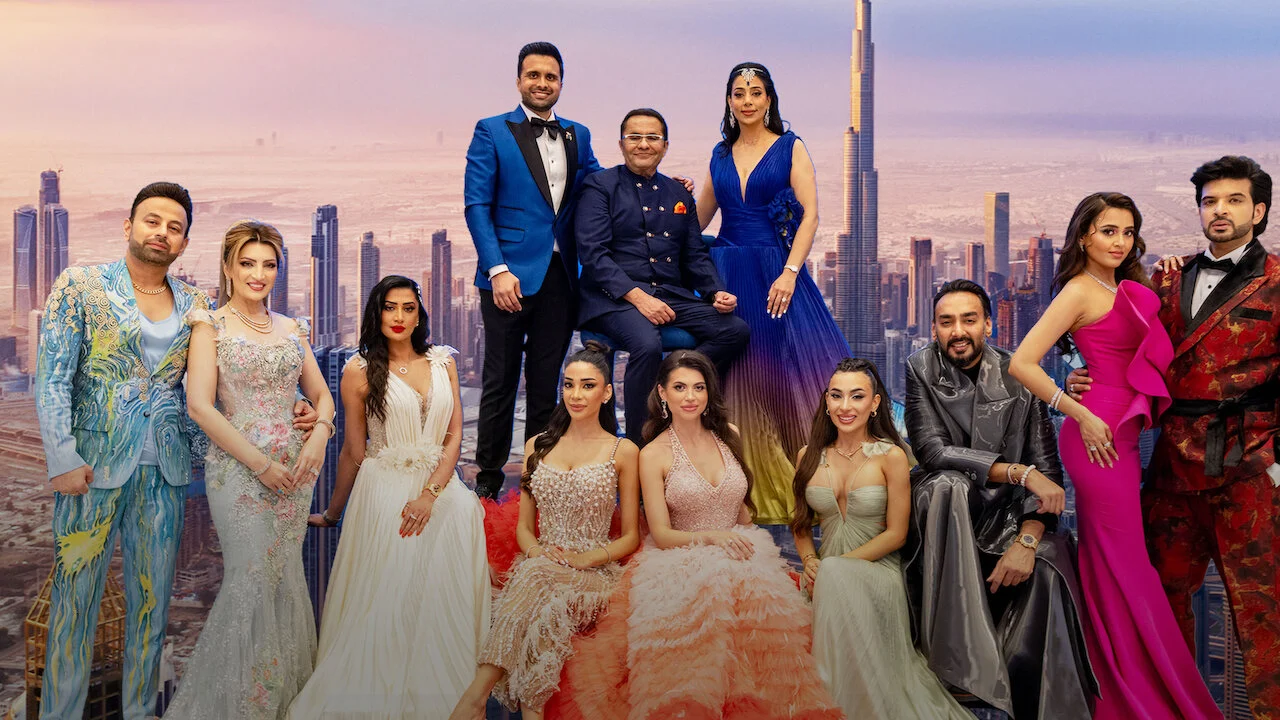
Netflix has ventured into the reality television space once again with Desi Bling, a seven-episode series that promises an exclusive glimpse into the opulent lifestyles of Dubai’s Indian elite. Centered around television’s beloved power couple Karan Kundrra and Tejasswi Prakash, the show attempts to document their journey of establishing a luxury restaurant venture in one of the world’s most extravagant cities while navigating its complex social landscape. With an ensemble cast that includes prominent figures from Dubai’s affluent Indian community, the series positioning itself as a guilty pleasure watch that combines luxury, drama, and relationship dynamics. However, despite its promising premise and star power, Desi Bling ultimately struggles to deliver a cohesive and engaging viewing experience, leaving audiences entertained in fragments rather than as a whole.
The timing of this series couldn’t be more interesting, as fans have spent years speculating about the real-life relationship status of Kundrra and Prakash. The show capitalizes on this curiosity by presenting itself as a window into their world, yet it often feels like a missed opportunity to explore their bond more deeply. Instead, viewers are thrust into a chaotic narrative that tries to be too many things at once, resulting in a series that dazzles superficially but lacks substantial depth.
Synopsis
The premise of Desi Bling centers on established television actors Karan Kundrra and Tejasswi Prakash as they embark on an ambitious new business venture—a luxury restaurant in Dubai. Upon arriving in the city known for its skyline of architectural marvels and limitless extravagance, the couple decides to immerse themselves in Dubai’s elite social circles to build connections and establish their presence before launching their entrepreneurial endeavor.
Their introduction to this world comes through the Sanpal family, consisting of Tabinda and Satish Sanpal, whose luxurious residence within the iconic Burj Khalifa serves as a frequent backdrop for the series. The couple presents an almost picture-perfect life with their daughter Bella, whom Tabinda affectionately describes as Dubai’s wealthiest baby, complete with gold cutlery, designer wardrobe, and even a custom pink Rolls Royce. However, beneath this polished exterior lies a marriage fraught with complications—Satish’s penchant for partying creates tension, leading Tabinda to believe that conceiving another child through IVF might resolve their growing distance.
The narrative expands to include Dyuti Parruck, known as ‘Mr Golden Visa,’ whose remarkable journey from earning a modest 1,300 dirhams salary to becoming a self-made millionaire serves as an inspiring subplot. Alongside his wife Iryna Kinakh, the couple represents the aspirational dream of Dubai prosperity, yet their marriage has deteriorated significantly. The series documents their escalating conflicts, including accusations of lies, blocked contacts, and ultimately divorce papers being offered as an ultimatum—a storyline that dominates several episodes and leaves viewers questioning the authenticity of their association.
The Mirza sisters, Alizey and Lailli, provide comic relief and gossipy interludes throughout the series, frequently clashing with Pamela Serena, whom Karan playfully labels the “Kamolika” of their Dubai social circle. These interactions, while occasionally entertaining, often feel like filler content designed to break up the more intense dramatic sequences. The Danube family members make appearances that are largely unremarkable, contributing little to the overarching narrative while occupying precious screen time that could have been devoted to more compelling storylines.
Throughout the chaos, the central question remains: where do Karan Kundrra and Tejasswi Prakash truly fit into this ecosystem? The show struggles to answer this satisfactorily, as both leads sometimes appear disconnected from the very world they are attempting to infiltrate. Kundrra’s networking abilities allow him to integrate seamlessly into yacht parties and social events, while Prakash finds herself navigating trust issues and emotional isolation, creating a parallel narrative of personal struggle amid external glamour.
Appearances
Karan Kundrra and Tejasswi Prakash, both accomplished television actors in their own right, bring a natural charisma to Desi Bling that elevates otherwise mundane sequences. Kundrra comes across as socially adept and relatively comfortable in elite settings, though his interactions often feel performative rather than genuine. Prakash, on the other hand, displays genuine emotional vulnerability that humanizes her beyond the glamorous facade the show attempts to construct. Her tearful moments of frustration and attempts to forge meaningful connections provide some of the series’ most authentic television moments.
The supporting cast delivers performances that range from compelling to cringe-worthy. The Sanpals, particularly Tabinda, bring an unsettling confidence to their unconventional lifestyle choices, making viewers simultaneously bewildered and fascinated by their dynamics. Dyuti Parruck’s dramatic revelations about his marriage create intense viewing moments, though his confrontational approach to conflict resolution makes him a divisive figure. Iryna Kinakh’s emotional breakdown during several confrontations reveals the human cost behind the luxurious trappings, adding necessary weight to what could have been a purely superficial narrative.
The Mirza sisters and Pamela Serena contribute entertainment value through their feuds and dramatic exchanges, though these moments often feel scripted rather than spontaneous. Their scenes provide lighter reprieve from the heavier relationship conflicts, but they never quite transcend the reality television formula that constrains the entire production.
Behind the Lens
From a production standpoint, Desi Bling excels in visual presentation. Dubai’s architectural wonders and luxurious settings are captured beautifully, creating an aspirational aesthetic that serves the show’s core premise effectively. The cinematography elevates mundane social gatherings into visually stunning sequences, though this polished exterior often contrasts sharply with the uncomfortable realities being documented.
The direction, however, reveals significant flaws in narrative construction. The series attempts to balance multiple storylines simultaneously—Kundra and Prakash’s relationship journey, Dyuti and Iryna’s marriage crisis, the Sanpals’ unconventional lifestyle, and various interpersonal conflicts—without successfully prioritizing any single narrative thread. This results in a fragmented viewing experience where audiences struggle to invest emotionally in any particular storyline before being whisked away to another.
The editing choices further compound these issues, with dramatic music cues often feeling overused and manipulative. The production seems uncertain whether it wants to be a genuine documentary about immigrant success stories or a melodramatic reality series focused on conflict and controversy. This identity crisis permeates every episode, preventing the show from carving out a distinct niche in the reality television landscape.
Final Verdict
Desi Bling ultimately represents a textbook case of promising concept undermined by uneven execution. The series possesses all the ingredients for compelling reality television—wealthy personalities, complex relationships, aspirational settings, and genuine dramatic potential—yet fails to synthesize these elements into a satisfying viewing experience. While individual moments and storylines prove entertaining in isolation, the cumulative effect is exhaustion rather than engagement.
The show works best for dedicated fans of Kundrra and Prakash who will appreciate any content offering insights into their relationship. For casual viewers, the eight-episode run becomes increasingly tedious as the narrative circles without resolution and new conflicts feel recycled. The series would have benefited immensely from a more focused approach, either exploring the couple’s journey independently or dedicating entire episodes to the various social circles they navigate.
Watch If: You are an ardent supporter of the lead pair, enjoy reality television focused on ultra-wealthy lifestyles, or seek background entertainment while multitasking.
Skip If: You prefer narratives with clear progression and resolution, dislike manufactured drama, or struggle with cringe-inducing moments in reality programming.