

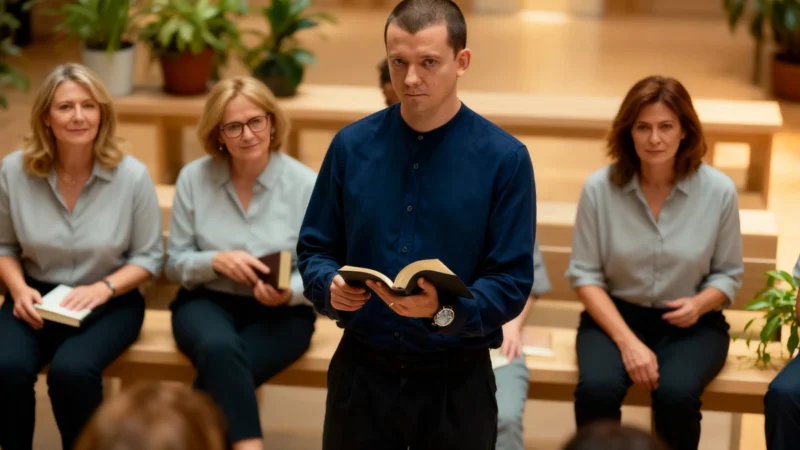
Netflix’s latest British import, Unchosen, enters the crowded arena of psychological thrillers with a compelling premise. Set within the confines of a high-control religious sect, the six-part series aims to explore profound themes of faith, autonomy, and the desperate quest for liberation. Prioritizing character depth over cheap shocks, it promises a slow-burn dissection of a community built on fear. While the series constructs an impeccably eerie atmosphere and is powered by strong performances, it ultimately struggles to maintain its initial tension, leaving viewers with a sense of unfulfilled potential.
The Story
Unchosen centers on Rosie, a young woman entrenched in a repressive Christian cult where every aspect of life is meticulously governed. Her fragile world is irrevocably shaken after a chance encounter with Sam, a mysterious outsider hiding from a dangerous past. This meeting acts as a catalyst, causing Rosie to question the very foundations of her existence.
As their secret connection deepens, it sparks a chain reaction of doubt and defiance within the community, threatening to tear the sect apart. The narrative compellingly frames Rosie’s internal struggle: is the known devil inside the cult’s walls safer than the unknown world beyond them? The story kickstarts with a dramatic incident, hooking the audience with the promise of escalating terror. However, as the plot unfolds, the stakes curiously diminish. The cult’s iron grip, initially presented as inescapable, proves surprisingly lax, allowing characters to depart with puzzling convenience. This narrative convenience undermines the tension, leading to a finale that feels more obligatory than explosive.
Performances
The cast of Unchosen is undoubtedly its strongest asset, consistently elevating the material they are given. Molly Windsor is profoundly effective as Rosie, masterfully conveying a torrent of fear, isolation, and dawning resolve with remarkably restrained expression. Asa Butterfield brings a compelling intensity to Sam, perfectly embodying a character who is both a potential savior and a portent of danger. Fra Fee also delivers a noteworthy performance, adding layers to the complex social structure of the cult.
Despite their talents, the characters themselves are often written with a frustrating one-dimensionality. The internal conflicts, while dramatic initially, become repetitive, leaving the talented cast underutilized. Their excellent work shines through, but they are often fighting against a script that cycles through the same emotional beats without sufficient evolution.
Behind The Lens
Where Unchosen truly excels is in its production and atmosphere. The series is visually steeped in a muted, claustrophobic palette that mirrors Rosie’s psychological imprisonment. The direction and cinematography create a consistently eerie and oppressive tone, making the community itself feel like a character—rigid, watchful, and unforgiving. The production design meticulously captures the stark, simplistic rigidity of the sect, reinforcing the themes of control.
Thematically, the series offers a potent exploration of religious power dynamics and distorted idealism. It effectively highlights the stark power imbalance between genders within the group and presents a painful, nuanced study of eroded female autonomy as Rosie discovers her life is built on a lie. The ethical complications of her relationship with Sam are also a compelling, if underexplored, facet of the story.
Final Verdict
Unchosen is a series of tantalizing contradictions. It is crafted with a clear artistic vision, boasting a chilling atmosphere, intelligent themes, and a cast that delivers powerful performances. For viewers seeking a slow-burn character study set in a unique world, there are elements to appreciate. However, its failure to maintain narrative momentum and its tendency toward predictable, convenient resolutions ultimately hold it back from greatness. The pacing falters, the stakes evaporate, and the plot becomes mired in repetition. While not without merit, Unchosen leaves you contemplating the thrilling show it could have been, rather than the uneven one it is.