

Introduction: Beyond the Trophies
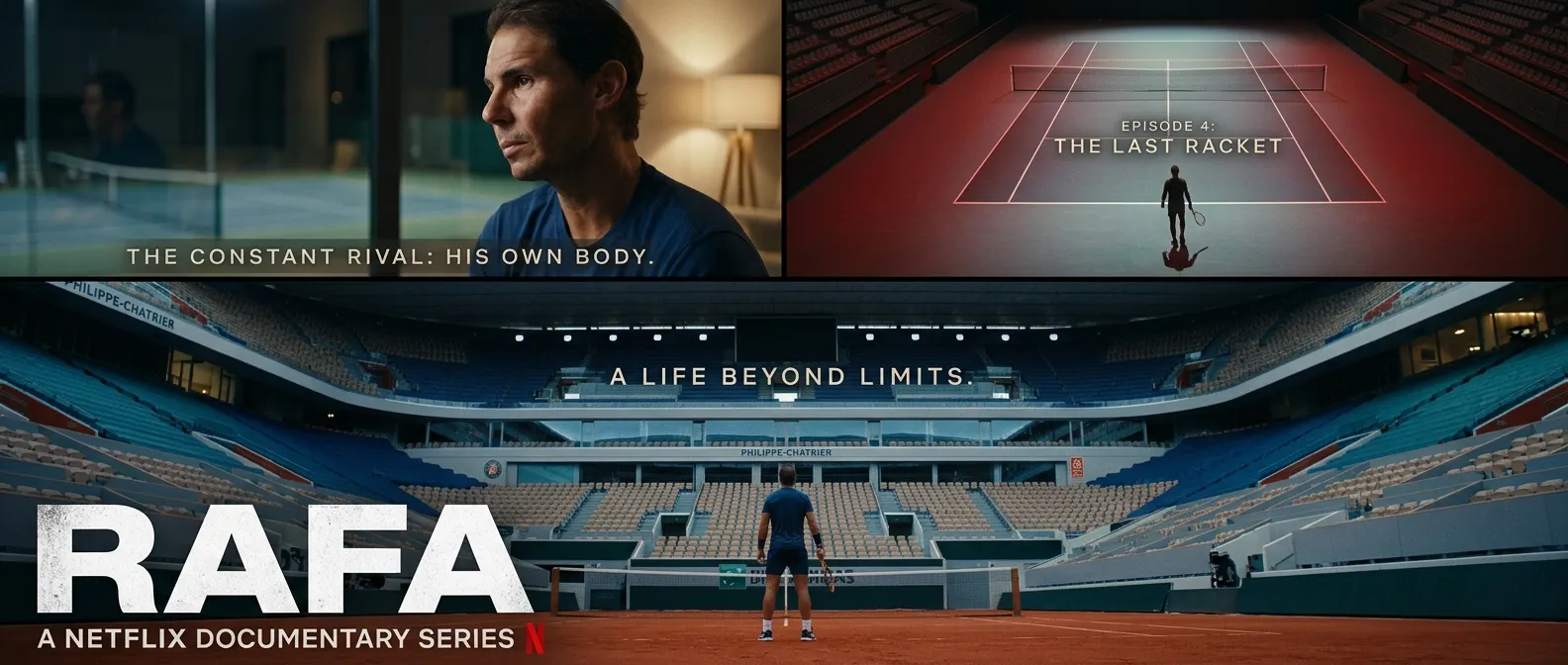
The new Netflix documentary Rafa steps away from celebrating twenty-two Grand Slam trophies to expose what those championships truly demanded. Rather than presenting a highlight reel of dominance, filmmaker Zach Heinzerling crafts something far more compelling: an intimate examination of one athlete’s twenty-three-year negotiation with his own body. The four-part series follow s Nadal’s journey from his childhood in Mallorca to his final professional match, but its true focus remains fixed on the physical toll and mental resilience that made such excellence possible.
This isn’t simply another sports documentary. It’s a forensic exploration of sacrifice, showing audiences exactly what victory cost someone who refused to accept defeat as an option.
The Body That Paid the Price
What makes Rafa distinctive is its unwavering focus on physical deterioration rather than athletic achievement. Nadal’s body became his greatest opponent throughout his career, starting with his left foot diagnosed with Müller-Weiss syndrome at just sixteen years old. This degenerative condition in the midfoot bone typically signals career endings, yet Nadal managed it brilliantly for two decades.
The documentary revisits his 2022 Roland Garros triumph—not as a highlight, but as proof of extraordinary tolerance. He played the entire tournament with his left foot essentially numb, using anesthesia to function because the alternative meant withdrawing entirely. That choice defines the documentary’s central theme: what elite athletes willingness to sacrifice when rest represents impossibility.
His shoulders, knees, and left foot ultimately remained held together through tape, injections, and pure determination. Remove the silverware accumulated and viewers witness something stranger than any trophy collection—a man who structured his entire adult existence around refusing to quit.
Engineering Endurance
Nadal constructed a remarkable capacity for attrition point by point, delivering the same devastating topspin repeatedly as he did ten thousand times before, treating each rally as though championship status depended upon it—because for him, it genuinely did.
The documentary reveals his pre-match rituals as anything but charming superstitions. Watch his meticulous placement of water bottles, labels facing the court consistently, an act representing impose order upon the single controllable space in an uncontrollable career. Other documentaries might frame these habits as quirky charm, but Rafa presents them correctly—as visible expressions of an internal-discipline system, where audiences observe actual engineering occurring.
Nadal’s uncle Toni shaped both his game and psychological toughness from childhood. Former world number one Carlos Moya later assumed technical direction during career’s second act, assisting redesign a playing style destroying his body physically. The medical interventions, strategic planning, surgical procedures, and foot management represent unglamorous infrastructure elite sports normally hides from view—yet this documentary displays it all unreservedly.
The Rivals’ Perspective
Roger Federer, Novak Djokovic, and John McEnroe appear but not for sentimental farewell sequences. They serve as witnesses rather than supporting cast—athletes who spent years positioned opposite the net attempting solve a riddle that mostly solved itself through sheer persistence. Their insights emphasize what competing against someone treating exhaustion as tactical weapon creates psychologically.
Comparing Rafa to Federer’s retirement documentary proves revealing. That earlier film functioned as elegy—tender, brief, and emotional. This production reads more like forensic analysis—clinical examining mechanisms driving sustained excellence over unprecedented duration.
A Legacy Without Sentiment
The documentary premieres during this year’s Roland Garros—Nadal’s first retirement-phase French Open, first Paris fortnight in two decades where tournament draw doesn’t shape around his presence.
Ending at 2024 Davis Cup in Málaga feels purposeful. No fairy-tale final moment, no record-extending twenty-third major completing narrative perfectly. Instead: home crowd goodbye, match loss, body finally winning ongoing argument persisted for years. The film wisely refuses romanticize conclusion.
Here’s documentary’s genuine achievement: transcending tennis entirely.
Conclusion: Who Becomes You When Competition Ends?
Twenty-three years brought continuous object for discipline—the subsequent point, upcoming tournament, following surgical recovery. Film circles question it cannot answer, opening precisely when final match concludes: Who becomes Rafael Nadal when nothing remains to overcome?