

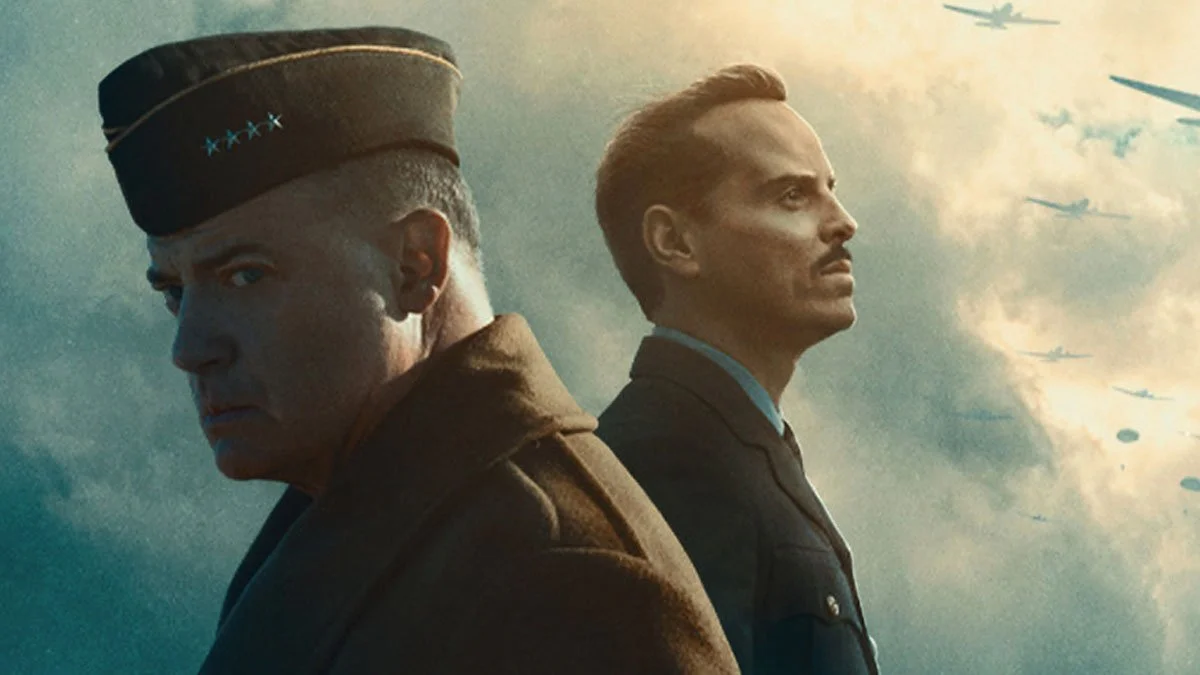
Pressure, directed by Anthony Maras, stands as a compelling historical military drama that finally gives viewers an inside look at one of World War II’s most pivotal yet rarely explored moments—the critical 72-hour window before the Normandy invasion. This film brings to the forefront the immense pressure faced by Group Captain James Stagg (Andrew Scott) and how his meteorological expertise determined whether thousands of Allied soldiers would live or die on June 6, 1944.
While countless WWII films have depicted the beach landings at Omaha, Utah, Gold, Juno, and Sword beaches, Maras uniquely chooses to focus not on the soldiers storming the shores, but on the men and women wrestling with arguably the most consequential weather forecast in military history. The result is a gripping, tension-filled drama that proves sometimes the biggest battles happen far from the front lines.
Synopsis
The narrative unfolds at Southwick House in England, where Allied leaders convened in early June 1944 to determine the fate of Operation Overlord. Set against the backdrop of the largest amphibious invasion in military history, Pressure centers on the fierce disagreement between two competing meteorologists: Group Captain James Stagg (Andrew Scott), Winston Churchill’s trusted weather expert, and Irving Krick (Chris Messina), an American meteorologist whose forecast predicted clear skies for the invasion window.
Eisenhower (Brendan Fraser), Supreme Commander of Allied Forces in Europe, faces an impossible decision—launch the invasion on schedule or delays operations that could cost thousands of lives either way. Stagg advocates for postponement based on emerging data suggesting catastrophic weather approaching within 48 hours, while Krick insists the conditions will hold.
The stakes couldn’t be higher: delaying means risking discovery by German forces or missing the narrow tidal window necessary for a successful landing. Proceeding blindly could send troops into a deadly storm, dooming the entire operation. Adding to the tension, Eisenhower still grapples with the traumatic aftermath of Exercise Tiger—a disastrous D-Day rehearsal that resulted in 749 American servicemen dead due to friendly fire and poor coordination.
The film masterfully builds suspense through escalating conflicts between characters, each defending their position while the clock ticks toward an irreversible decision that would determine the future of Western democracy.
Performances
Andrew Scott delivers a nuanced portrayal of the tenacious meteorologist whose unwavering commitment to scientific truth potentially saved countless lives. His performance captures the isolation and immense burden of responsibility carried by a man whose expertise stood against popular opinion and political pressure. Scott’s ability to convey internal conflict through subtle facial expressions remains as impressive as ever.
Brendan Fraser offers a surprisingly compelling Eisenhower—showing vulnerability beneath the uniform of a military leader. His portrayal reveals a man torn between duty, guilt over previous failures, and the crushing weight of commanding millions of soldiers’ fates. Fraser’s chemistry with Scott creates palpable tension throughout their confrontational scenes.
Chris Messina effectively portrays the overconfident American meteorologist whose arrogance stems from professional hubris. Kerry Condon brings depth to Kay Summersby, Eisenhower’s steadfast aide, while Damian Lewis delivers a commanding presence as General Bernard Montgomery—effectively conveying the resentment of a commander passed over for supreme command.
The ensemble cast functions seamlessly, with each actor contributing to the overarching atmosphere of dread and uncertainty that permeates every scene.
Behind the Lens
Anthony Maras, known for Hotel Mumbai, demonstrates remarkable directorial restraint by choosing to confine the action primarily within the walls of Southwick House. This claustrophobic setting actually amplifies the psychological intensity, forcing audiences to feel trapped alongside the characters as they await news that could change the course of the war.
Working from a screenplay co-adapted from David Haig’s 2014 stage play, Maras cleverly structures the narrative to mirror the ticking clock facing historical decision-makers. The screenplay wisely allocates time to developing character relationships and establishing personal stakes before delivering the climactic weather report sequences.
The production design authentically recreates the wartime atmosphere, while cinematography effectively utilizes lighting to establish mood—particularly during nighttime scenes where characters grapple with impossible choices in shadow. Though the budget constraints prevent massive battle sequences, the absence actually strengthens the film’s central message: that victories are won through preparation and intelligence, not merely brute force.
Final Verdict
Pressure succeeds as both a historical lesson and a compelling thriller. It fills a significant gap in WWII cinema by illuminating the human elements behind strategic decisions that often receive mere footnotes in textbooks. The film serves as a reminder that history’s pivotal moments frequently hinge on individuals working behind the scenes, far from the glory of combat.
While the pacing occasionally lags during exposition-heavy dialogue sequences, the strong performances and mounting tension ultimately compensate for these minor flaws. For history enthusiasts, war drama lovers, or anyone seeking thought-provoking cinema, Pressure delivers a substantively engaging experience that prompts reflection on the complex realities of leadership under pressure.
This film represents quality craftsmanship over spectacle—a welcome throwback to an era when studios produced thoughtful wartime dramas emphasizing strategy and human psychology over action set pieces. Pressure earns its place among must-watch historical films for audiences seeking substance alongside storytelling.
Pressure opens in theaters Friday, May 29, via Focus Features—a welcome addition to this summer’s cinematic offerings for those appreciating intelligent, historically-grounded storytelling.