

The world of high-stakes television often looks for inspiration in the most prestigious corners of literature. In the case of the latest production from Caracol, Forbidden Woman, the creators have reached for the heavyweights of Russian literature, weaving the tragic romanticism of Leo Tolstoy and the moral complexity of Fyodor Dostoevsky into a modern-day power struggle. Now available on Netflix, this sprawling 61-episode drama bridges the gap between traditional nightly serials and prestige streaming content. It is a series that wears its influences proudly, transforming a traditional melodrama into a sharp critique of gender, public image, and the heavy price of personal freedom.
Synopsis
The story ignites with a violent assassination attempt. Karen Arbeláez narrowly escapes a disaster intended for her husband, a prominent figure in the middle of a presidential race. In the smoke and debris, she is rescued by Víctor Rodríguez, a charismatic singer whose world is the polar opposite of her polished, controlled life. This single event sets the stage for a profound conflict: Karen is caught between the life she chose with her powerful husband, Alejandro Orduz, and the man who literally gave her a second chance at life. As Alejandro uses their marriage as a tool for his political ascent, Karen begins to realize that in a world of polls and public relations, her own heart is the only thing she isn’t allowed to own.
Performances
Valerie Domínguez makes a triumphant return to the screen, delivering a nuanced performance as Karen. She brilliantly portrays a woman who is constantly being defined by the men around her—a political prop for her husband and a scandal for the media. Opposite her, David Palacio brings a raw, emotional energy to the role of Víctor, using music as a vessel for the truths the political world tries to suppress.
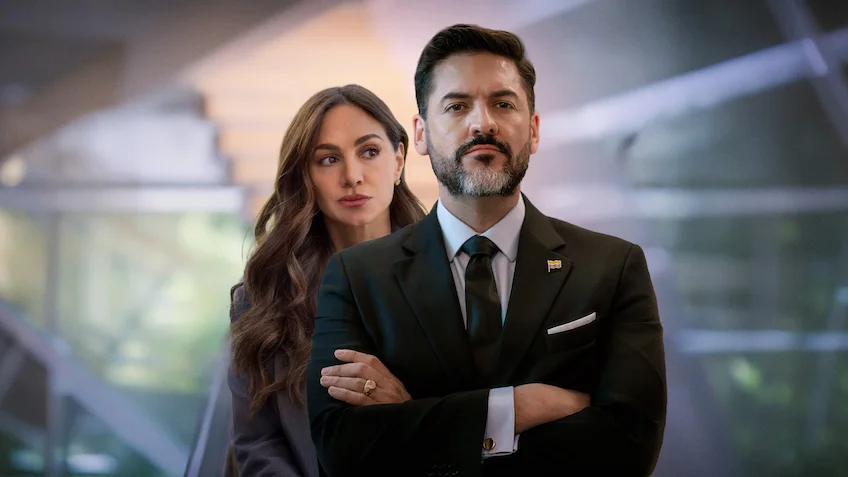
However, the standout performance comes from Rodrigo Candamil. As the presidential hopeful Alejandro Orduz, he avoids the typical villain tropes, instead playing a man who is chillingly pragmatic. He treats his wife’s emotions as logistical hurdles, making him a formidable and realistic antagonist. The ensemble is rounded out by strong turns from Caterin Escobar, Fernando Solórzano, Brian Moreno, and Laura Junco, who add depth to the show’s complex web of relationships.
Behind the Lens
Directors Daniel Arenas and Mauricio Cruz show a masterly command of the medium, navigating the 61-episode arc with a steady hand. One of the series’ most inspired choices is the integration of the music industry into the political narrative. By making Víctor a professional singer, the show allows its soundtrack to function as a secondary language. Where political dialogue is calculated and managed, the music is honest and rebellious.
Produced by Juan Carlos Villamizar, the production values are high, reflecting the heritage of Caracol’s most successful exports, such as The Queen of Flow and The Revenge of Analia. The series also cleverly intertwines a secondary plot inspired by The Brothers Karamazov, involving a son’s quest for vengeance against his corrupt father, which mirrors the themes of inherited trauma and the cages built by family.
Final Verdict
Forbidden Woman is more than just a tale of a love triangle; it is a sophisticated exploration of whether a woman can ever truly belong to herself when her life is treated as national property. By grounding its melodrama in the timeless structures of classic literature, the series achieves a weight that many modern dramas lack.
While 61 episodes may seem daunting for the typical binge-watcher, the slow accumulation of tension and the rhythmic pacing make it a rewarding experience. It is a bold, loud, and unapologetic drama that asks difficult questions about the intersection of private desire and public duty. For those seeking a series that offers both emotional depth and sharp political commentary, Forbidden Woman is a journey worth taking.