


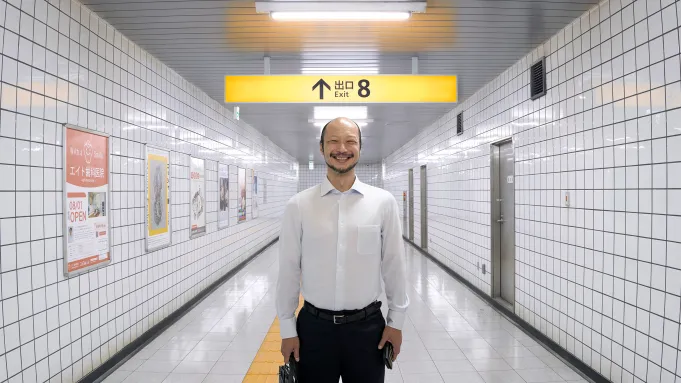
Time-loop narratives often serve as a metaphor for self-improvement, challenging a character to evolve their mindset to break free from a recurring day or event. Exit 8 cleverly fits within this tradition while also standing apart as a masterclass in atmospheric, psychological horror. More importantly, it achieves a rare feat: it’s one of the most authentic and inventive translations of pure video game mechanics into the cinematic language, building a compelling feature from a minimalist source.
Story
Directed by Genki Kawamura and co-written with Kentaro Hirase, the film is adapted from the minimalist indie game The Exit 8 by Kotake Create. Unlike blockbuster game adaptations filled with lore, the original is a first-person “spot the difference” walking simulator set in a Japanese subway tunnel. The film faithfully replicates this premise. An unnamed man (Kazunari Ninomiya) finds himself trapped in an endless underground passage. To find the elusive Exit 8, he must walk forward only if his environment is perfectly normal. The moment he detects a subtle anomaly—a distorted poster, a ghostly figure, a spectral whisper—he must turn back or face a grisly reset.
The film brilliantly uses this simple rule to fuel its tension. As the protagonist grapples with the news that he might become a father, his personal turmoil merges with the supernatural loop, forcing him to alter his perspective to escape. The narrative expands when he encounters another lost soul, deepening the mystery but also testing the pacing of the confined setting.
Performances
Kazunari Ninomiya delivers a powerfully anxious and relatable performance as the central character. He effectively carries the film’s first act virtually alone, conveying fear, confusion, and determination through mostly voicework and physicality before becoming a fully realized on-screen presence. His portrayal of a man wrestling with impending fatherhood amid a cosmic nightmare grounds the fantastical story in palpable human emotion. The supporting actors who appear later in the loop serve their purpose well, providing catalysts for the protagonist’s development without overshadowing his journey.
Behind the Lens
The film’s greatest success lies in its direction and production design. Genki Kawamura makes the inspired choice to shoot the majority of the film from a first-person perspective, plunging the audience directly into the game’s immersive point of view before widening the lens. The production design team meticulously recreates the game’s eerily mundane subway tunnel, making every flickering light and innocuous poster a potential source of dread. The anomalies themselves are chillingly effective, ranging from bizarre and uncanny to outright terrifying, all executed with sharp visual and sound design that maximizes the psychological horror.
Final Verdict
Exit 8 is a triumph of innovative horror and a benchmark for how to adapt a video game’s core concept, not just its story. While the pacing stumbles slightly in the third act as the concept stretches to feature length, the overall experience is relentlessly tense and intellectually stimulating. It’s a smart, slick, and deeply creepy film that uses its game-like structure to explore themes of regret, responsibility, and the need for change. For fans of psychological horror and unique cinematic experiments, Exit 8 is an exit worth taking.
Exit 8 is now available on popular digital platforms including Prime Video on VOD basis.