

The early 2000s were a peculiar era for Hollywood psychological thrillers. It was a time when studios frequently churned out mid-budget features that often suffered from severe identity crises. Among these was the 2001 film Domestic Disturbance, a project that many hoped would overcome the lukewarm reception from critics. Much like its contemporary, The Glass House, Domestic Disturbance sits in a frustrating middle ground—it possesses the foundational elements for a gripping cinematic experience but consistently sabotages its own momentum.
A Clash of Hollywood Heavyweights
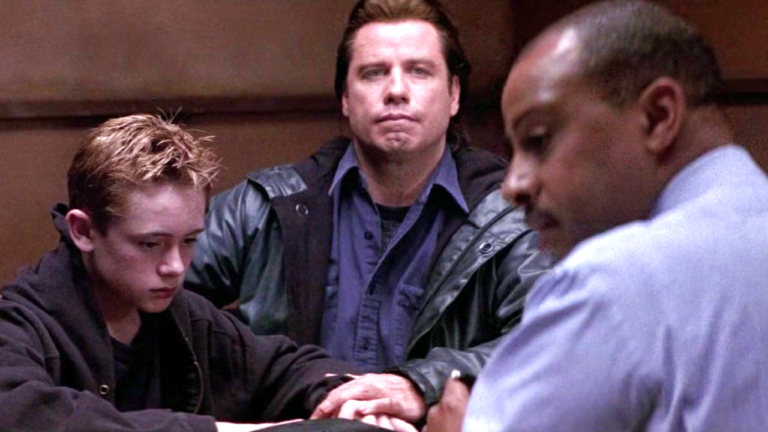
On paper, Domestic Disturbance should have been a home run. The film features an intriguing pairing of John Travolta and Vince Vaughn, two actors who, despite their vastly different styles, share a palpable on-screen chemistry. John Travolta plays Frank Morrison, a struggling boat builder facing financial ruin. His life is further complicated by his divorce from Susan, played by Teri Polo. While Frank attempts to rebuild his life with his new partner, Diane (Susan Floyd), Susan is moving forward with the wealthy and seemingly charismatic Rick Barnes, portrayed by Vince Vaughn.
Had the screenplay offered more nuance and subtext, this could have been a career-defining performance for both leads. Instead, the narrative feels restricted, preventing the actors from exploring the darker depths their characters desperately required.
A Predictable Downward Spiral
The central conflict revolves around Danny, the young son of Frank and Susan, played by Matt O’Leary. Danny has a reputation for being a troublemaker and a chronic liar, yet he maintains a bond of total honesty with his biological father. This dynamic becomes the film’s engine when Danny begins to suspect that his new stepfather is not the pillar of the community he pretends to be.
The tension escalates when a mysterious figure from Rick’s past, Ray Coleman (played by Steve Buscemi), appears at the wedding. When Danny witnesses Rick committing a cold-blooded murder, the film immediately loses its “whodunit” or “is he crazy?” mystery. From this point on, the audience is fully aware of Rick’s psychopathic nature, leaving little room for genuine suspense.
Where the Suspense Slips Away
The fatal flaw of Domestic Disturbance lies in its lack of ambiguity. A successful psychological thriller thrives on the “unreliable narrator” or the “slow burn” reveal. Here, the film shows its hand far too early. We see Rick being emotionally and physically aggressive toward Danny in private almost immediately. While these scenes demonstrate Rick’s volatility, they rob the audience of the chance to wonder if Danny’s past behavior is coloring his perception.
By the time Frank begins his own investigation—aided by detectives Edgar Stevens (Ruben Santiago-Hudson) and Warren (Chris Ellis)—the film transitions from a domestic drama into a generic chase movie. The police figures are portrayed as nearly incompetent, serving only as narrative hurdles rather than active participants in the plot.
Missed Opportunities and Sluggish Execution
As the film reaches its final act, Vince Vaughn’s character undergoes a jarring transformation, shifting from a calculated deceiver to a full-blown slasher villain. This sudden pivot feels unearned and highlights the script’s inability to escalate tension organically. Much like the guardians in The Glass House, once the villainy is out in the open, there is nowhere for the story to go but toward a predictable and loud confrontation.
Currently streaming on Netflix, Domestic Disturbance remains a fascinating artifact of its time. It is a movie that possessed all the right ingredients—a stellar cast, an unsettling premise, and a solid budget—but lacked the visionary direction needed to make it a classic. It serves as a reminder that even the most talented actors cannot fully compensate for a script that refuses to trust its audience’s intelligence.