

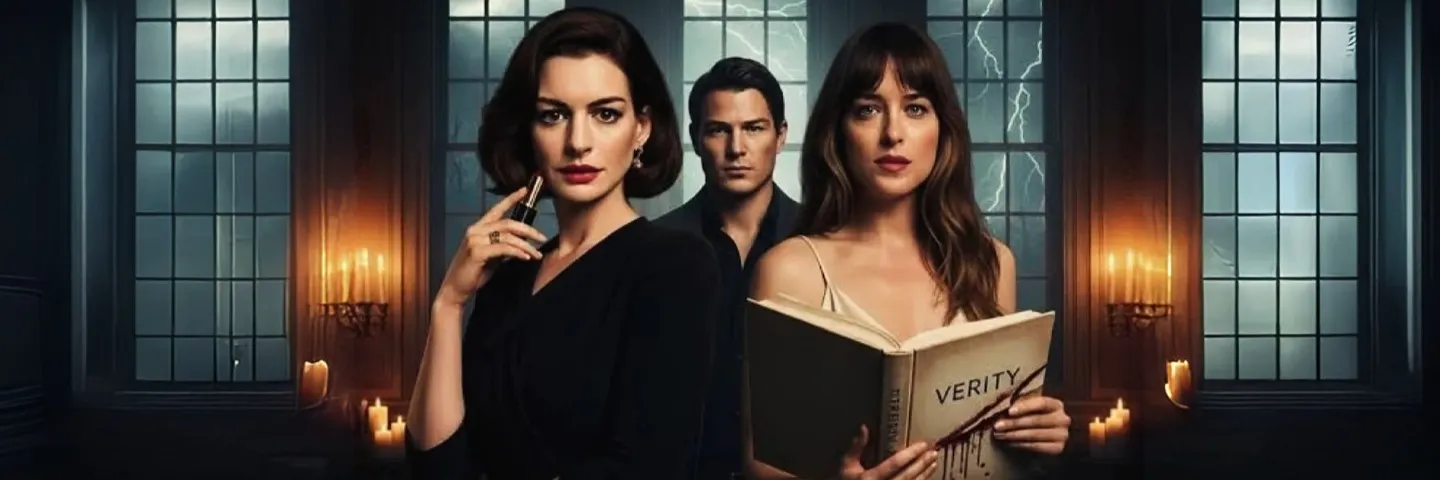
Amazon MGM Studios brings Colleen Hoover’s bestseller to the screen in Verity, a psychological thriller that arrived in U.S. theaters on October 2, 2026. Directed by Michael Showalter and adapted by Nick Antosca, the film follows a struggling writer who is hired to finish a famous author’s book series, only to uncover a disturbing manuscript that reshapes everything she thought she knew. With a cast led by Dakota Johnson, Anne Hathaway, and Josh Hartnett, Verity attempts to blend literary intrigue with tense domestic drama. This review breaks down the story, performances, direction, and overall impact, offering a clear verdict for readers deciding whether to add the film to their watchlist.
Synopsis
Lowen Ashleigh, a relatively unknown novelist, accepts a lucrative offer to complete the unfinished series of Verity Crawford, a bestselling author left incapacitated after a car accident. She moves into the Crawfords’ secluded lakeside home to study Verity’s notes and begin the ghost‑writing task. While sorting through the author’s materials, Lowen discovers a hidden autobiographical manuscript that hints at dark family secrets. As she grows closer to Verity’s husband Jeremy and their young son, the line between professional duty and personal entanglement blurs, forcing Lowen to question how much she truly knows about the people she is helping to portray.
Performances
Dakota Johnson delivers a restrained yet compelling portrayal of Lowen, using subtle gestures and measured speech to convey a woman torn between ambition and unease. Her ability to stay enigmatic makes the audience constantly reassess her motives. Anne Hathaway, as the unseen but ever‑present Verity, brings a theatrical intensity to the flashback sequences; her expressive narration and charged physicality give the hidden manuscript a visceral weight that lingers long after the scenes end. Josh Hartnett provides a warm, grounded counterpoint as Jeremy, whose earnest kindness feels both genuine and slightly unsettling in the film’s atmosphere of suspicion. The trio’s chemistry fuels the central tension, allowing the story to shift smoothly between moments of quiet intimacy and sudden jolts of dread.
Behind the Lens
Showalter’s direction emphasizes the stark contrast between the pristine, snow‑covered exterior of the Crawford residence and the claustrophobic, emotionally charged interiors. The angular architecture and muted palette create a visual metaphor for the characters’ facades versus their inner turmoil. Cinematography leans on tight framing during the manuscript reveals, making the audience feel as though they are peering over Lowen’s shoulder. The sound design employs low, resonant strings to underscore impending danger, while sudden silences amplify the shock of jump‑scares. Editing alternates between languid, reflective passages and quicker cuts during the thriller’s more urgent beats, though this rhythm occasionally feels uneven, causing the pacing to drag in the middle before picking up again for the final revelations.
Final Verdict
Verity succeeds as a character‑driven thriller that raises interesting questions about authorship, identity, and the ethics of ghost‑writing. The performances are the film’s strongest asset, with Johnson’s subtlety, Hathaway’s theatrical flair, and Hartnett’s sincere presence creating a compelling triangular dynamic. Showalter’s direction delivers a visually striking atmosphere, though the narrative’s reliance on withholding information for twist‑value leads to occasional pacing hiccups and a feeling that some reveals are more manipulative than satisfying. Overall, the movie earns a solid three‑star rating: it will keep fans of psychological suspense engaged, but those seeking a tightly wound, relentless thriller may find the experience uneven.
Also Read:
First Look: “Verity” Teaser Unveils a Chilling Gothic Thriller