

Linkin Park: Unshatter opens a difficult, candid window into a pivotal moment in modern rock history. Released to select cinemas worldwide on September 30, 2026, the documentary follows the band’s brave return to the studio and the stage after Chester Bennington’s death in 2017, a seven-year hiatus that reframed what the group could become without its iconic frontman. It is a film that refuses easy answers, instead offering a nuanced portrait of a group wrestling with legacy, friendship, and the complicated mathematics of renewal.
The central question—whether the Linkin Park name can still describe a collective vision after such a rupture—hangs over every rehearsal room, every whispered conversation, and every interpretive choice the film records. The documentary does not pretend that continuity equates to healing; it acknowledges that what fans attach to a voice cannot be replicated, and that any decision to proceed involves a constellation of hopes, fears, and practical realities. The result is a portrait of a band negotiating not only the logistics of returning to work, but the moral and emotional questions that come with continuing a musical project that has been woven into listeners’ lives.
Grief and Reunion
The film’s most gripping tension arises from the band’s internal disagreements. Rob Bourdon’s decision not to rejoin unsettles old rhythms; Brad Delson’s initial hesitation stirs mixed feelings in Mike Shinoda. These moments matter because they reveal a shared desire to move forward without erasing the past. The “reunion narrative” often promises recovery as a straightforward payoff, but Unshatter explicitly complicates that logic. Grief does not arrive with a single, tidy blueprint for action, and the group’s return cannot be read as a universal salve for every member’s pain.
Footage from Shinoda, Joe Hahn, and Dave Farrell in Shinoda’s studio grounds the film’s forward motion in tangible collaboration rather than speculation about fate. These early sessions show companionship and creative momentum that prefigure a future for Linkin Park that might still be taking shape. The documentary locates its raison d’être in the act of making music together—people gathering, exchanging ideas, testing sounds, and discovering that a potential continuation remains plausible even amid uncertainty.
Emily Armstrong
Into this process enters Emily Armstrong, whose arrival coincides with the band’s 2024 return and the From Zero era. Her presence reframes the idea of continuity within Linkin Park’s repertoire. When Armstrong contemplates singing Bennington’s parts on the existing catalog, the film raises a delicate performance question: familiar songs invite recognition, but a new vocalist requires space to imprint her own voice. The interviews that articulate confidence in Armstrong illuminate why the musicians welcome her, yet they cannot settle the intimate relationship audiences have with those tracks as originally performed. Unshatter must demonstrate what the revised lineup can accomplish together, and thus the concert footage becomes essential—providing the musical proof that decisions born in the studio extend their consequences into live performance.
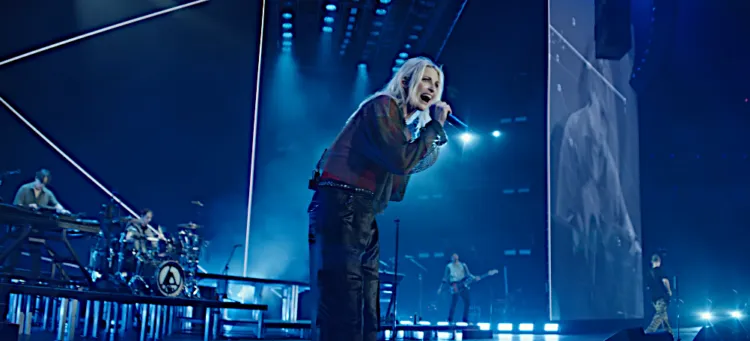
The film’s strongest argument for the band’s viability rests on the bridge between the intimate and the monumental. A standout sequence transitions from Armstrong recording “Heavy Is the Crown” in the studio to her delivering a blazing rendition in front of roughly 55,000 fans in São Paulo. This seamless jump makes a persuasive case that a revised lineup can carry the weight of a beloved catalog on a global stage. The stadium sequence is not merely spectacle; it is a crucial data point in arguing that the new configuration can sustain a meaningful relationship with listeners who expect more than nostalgia.
São Paulo
All the same, Unshatter treats the stadium triumph with measured caution. The São Paulo footage proves the band can generate exhilaration at scale, yet it also reveals the limits of a live audience’s capacity to resolve deeper questions about the reunion. Applause, though powerful, cannot answer every dissenting voice. The film remains clear-eyed about the hardness of the task: public enthusiasm is persuasive, but it is not a universal vote of confidence.
The documentary’s internal dynamics become more revealing as it chronicles Joe Hahn’s participation and the group’s broader conversations about identity. By opening doors to doubts surrounding the name and the hurt caused by members who were hesitant to return, Unshatter provides intimate access to disagreement that is unusually candid for a project that is inherently celebratory. Yet the scrutiny stops short in areas that originate outside the band’s circle. Armstrong’s past ties to Scientology—anointing a point of controversy among fans and critics—receives notably less attention than other interpersonal tensions. That omission shapes the film’s scope in a way that is both revealing and limiting: it deepens trust in the band’s inner deliberations while deflecting a portion of the public dispute from its lens.
This selective transparency subtly reshapes what acceptance looks like in this story. Viewers gain a thorough view of grief, compatibility, and the burden of performing songs that once belonged to a different singer, but they do not get a complete survey of every external conflict tethered to the lineup. Unshatter earns credibility through these specific admissions and then asks the audience to extend that trust toward a broader issue it does not interrogate. The film’s intimacy—an up-close window into the musicians’ emotional and creative process—offers a valuable, nuanced understanding while intentionally narrowing the scope of its inquiry.
Shinoda and Bennington
The archival interlude—featuring Shinoda and Bennington onstage together—reframes the reunion as a continuum that cannot be fully recaptured. It foregrounds a different kind of presence: a memory of collaboration that predates the current lineup and lingers as a historical touchstone. Bennington appears not only as a figure of loss but as a living artist who once shared the stage with Shinoda. This archival throughline decouples the past from the present, reminding viewers that nostalgia can illuminate but cannot govern a new chapter.
Across its many layers, Unshatter makes a persuasive emotional case for rebuilding, built on studio experiments, hesitations, and performances that help Armstrong secure her place. The documentary treats grief as a spectrum in which diverse responses can coexist without forcing reunion to function as a test of loyalty. The São Paulo sequence injects the necessary musical conviction that makes the new lineup feel legitimate, yet the film acknowledges that crowd enthusiasm cannot resolve every objection or philosophical debate about identity. Armstrong’s past, left unexamined in the course of the film’s narrative, stands as a reminder that there is no single, simple route to reintegration.
Final Verdict
In the end, Unshatter offers a portrait of a band negotiating the fragile line between remembrance and reinvention. It captures not merely a comeback but a careful, uneasy effort to harmonize distinct histories into a shared future. The documentary’s closing reflections emphasize that the act of making music together can be both a healing force and a complex negotiation—one that recognizes the enduring truth of loss while affirming the possibility of connection. The film asserts that a band can evolve without erasing the human bonds that once defined it, and it invites audiences to consider what it truly means for a legacy to endure.
Also Read:
Linkin Park’s “Unshatter” Chronicles the Band’s Brave Comeback