


There is something inherently compelling about watching someone excel at an unexpected skill, particularly when that expertise comes from an unlikely source. Daniel Roher’s Tuner understands this principle implicitly, delivering a modern noir that operates with an appealing cleverness and remarkable lightness of touch. Having previously established himself through a series of sharp, propulsive documentaries—including the Oscar-winning Navalny—Roher makes an impressive narrative leap that proves he is no one-trick pony. His debut into fiction filmmaking demonstrates both versatility and vision, crafting a story that zips along with the energy of a jazz improvisation while maintaining the emotional groundedness that made his documentary work so affecting.
From its very first frames, Tuner announces itself as something special: a genre exercise that refuses to take itself too seriously while never undercutting the genuine stakes and feelings at its core. This is the kind of film that could have easily devolved into a mere gimmick—the concept of a piano tuner turning safe cracker is inherently quirky enough to sustain a lesser movie entirely on novelty alone. Instead, Roher and co-writer Robert Ramsey have constructed something far more satisfying: a character study disguised as a crime caper, a love story wearing heist movie clothing, and ultimately something that defies easy categorization while hitting every emotional note it aims for.
Synopsis
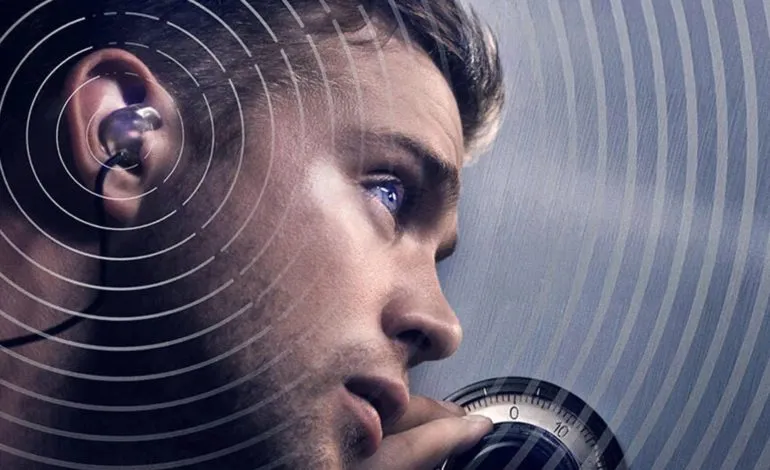
At the center of this elaborate dance is Nikki, a young New York piano tuner whose professional life operates in quiet service to the wealthy and their beautifully maintained instruments. Leo Woodall portrays Nikki as a man of extraordinary precision—someone whose hands move with measured confidence when adjusting the delicate internal mechanisms of a piano, but who carries himself with the guarded posture of someone perpetually on high alert. This is not coincidental, as Nikki’s hyperacusis means he experiences the world at a volume that would overwhelm most people. His solution—permanent earplugs or noise-canceling headphones—has become both his shield and his prison, forcing him to navigate social interactions through written notes and careful observation.
What makes Nikki’s condition fascinating within the context of the film is its counterintuitive utility. The same hearing that allows him to detect the slightest pitch instability in a piano’s strings proves equally valuable when assessing the internal mechanisms of safes. There is a beautiful symmetry in this revelation: the very sensitivity that limits Nikki in most contexts becomes his superpower in others. Roher is smart enough to mine this irony throughout, showing how Nikki’s condition simultaneously makes him vulnerable to the criminals who eventually exploit him and invaluable as a criminal himself.
Harry, Nikki’s employer and closest thing to family, provides both the emotional anchor and the catalyst for the film’s central conflict. Dustin Hoffman inhabits this role with the easy warmth of someone who has spent decades perfecting the art of playing gruff mentors, yet somehow makes the character feel fresh and genuinely touching. Their relationship—that of a young man who has found belonging with an older couple who welcomed him when no one else would—grounds the entire narrative in recognizable human warmth. When Harry and his wife Marla face a financial crisis that threatens their stability, Nikki’s decision to help by any means necessary feels not like the beginning of a criminal career but rather the natural extension of a lifetime of gratitude and love.
The break-in that changes everything unfolds with the kind of lucky accident that only happens in the movies, yet Roher sells it with enough conviction that viewers will suspend disbelief without much resistance. Nikki stumbles upon three thieves in the middle of a heist, and his expertise proves too valuable to ignore. The leader, Uri, recognizes immediately what Nikki can offer, and his pitch—framed not as criminal enterprise but as Robin Hood redistribution from the undeserving rich—finds fertile soil in Nikki’s observations about the contempt his wealthy clients display toward working people like himself and Harry.
Intertwined with the escalating heists is a romance that gives Tuner much of its beating heart. Havana Rose Liu plays Ruthie, an aspiring concert pianist whose dedication to her craft mirrors Nikki’s own perfectionism. Their connection develops through the shared language of music, of discipline, of understanding what it means to spend years honing a skill that may never receive wider recognition. There is something deeply moving about watching two guarded people slowly learn to lower their defenses with each other, particularly as their relationship is complicated by Nikki’s increasingly dangerous secret life.
Performances
Leo Woodall has been building toward a moment like this throughout his career, and Tuner represents the perfect vehicle for his talents. Every nuance of his performance feels earned—the way Nikki’s anxiety manifests in small physical habits, the gradual hardening of his resolve as he becomes more deeply ensnared in the criminal world, and most crucially, the capacity for warmth that survives despite everything. Woodall manages the difficult task of making Nikki sympathetic without erasing his complicity in increasingly serious crimes. We understand exactly why he makes each choice he makes, even when we can see the cliff edge toward which he is walking.
This is the kind of role that could easily have been written as a cipher, a passive participant in his own story. Instead, Woodall invests Nikki with genuine interiority, creating a character who feels fully realized even during the quieter moments that the film thankfully does not rush past. The emotional foundation Roher builds in the first act—showing us Nikki’s life before crime enters the picture—would not work without Woodall’s ability to communicate both vulnerability and quiet competence.
Dustin Hoffman, meanwhile, delivers a masterclass in the kind of performance he has been giving for decades but somehow makes feel new again. Harry could easily have been written as the clichéd wise mentor, a mentor whose advice Nikki should have heeded. Instead, Hoffman infuses the character with such lived-in quality, such genuine affection for Nikki mixed with the obliviousness of someone who has never truly understood the extent of his young friend’s struggles, that the relationship feels authentic in all its messy complexity. Watching Hoffman and Woodall share the screen is to witness two performers who genuinely seem to understand their characters’ bond, communicating volumes in the silences between their dialogue.
The supporting cast proves equally capable of matching these leads. Lior Raz’s Uri operates as a fascinating antagonist—not evil so much as pragmatic, presenting an ideology that the film is too intelligent to either endorse or dismiss entirely. His ability to articulate a moral framework that makes Nikki’s choices feel reasonable within their context is what elevates him beyond standard crime movie villains. Tovah Feldshuh brings characteristic gravitas to Marla, Harry’s wife, even in a relatively limited screen time establishing her as the emotional heart of Nikki’s chosen family.
Behind the Lens
Daniel Roher’s directorial choices reveal a filmmaker who understands exactly what kind of movie he wants to make and possesses the technical skill to realize that vision. The early sections of Tuner demonstrate remarkable restraint, spending sufficient time with Nikki and Harry that they transform from plot devices into genuinely compelling individuals we care about. This patience pays enormous dividends later, when the stakes feel real precisely because we have invested in these characters as more than vehicles for genre thrills.
The technical execution is where Tuner truly distinguishes itself from the pack. Greg O’Bryant’s editing deserves particular praise, operating with the rhythmic precision of an accomplished jazz drummer—knowing exactly when to accelerate, when to hold back, when to introduce a counter-rhythm that makes the overall composition more interesting. The pacing never flags, never allows the audience to disengage even during scenes that exist primarily to develop character rather than advance plot.
Then there is the sound design, which must be experienced to be fully appreciated. Given Nikki’s hyperacusis, the film’s aural landscape becomes another character entirely, allowing viewers to viscerally understand his experience through carefully crafted immersion. The difference between Nikki’s internal reality and the objective sounds around him creates a disorienting but always purposeful effect, particularly during heist sequences where his heightened awareness becomes the audience’s heightened awareness as well.
Visually, Roher finds inspiration in unlikely places. Tuner feels like a kinetic hybrid of disparate influences—the precise choreography of “Baby Driver” applied to the emotional intensity of “Whiplash,” yet somehow transcending both comparisons to become something entirely its own. The camera often mirrors Nikki’s perception, lingering on details that someone with his particular sensitivity would notice, creating an aesthetic that reinforces the character’s interior experience.
Final Verdict
Tuner is precisely the kind of surprise that makes following new filmmakers worthwhile. Daniel Roher has not merely transitioned successfully from documentary to narrative—he has demonstrated that his instincts for compelling storytelling translate across formats. This is a film that earns its emotional payoffs by doing the necessary groundwork, building characters we genuinely care about before placing them in increasingly dangerous situations.
Is everything here entirely original? The crime-gone-wrong narrative has been explored countless times, and certain plot developments feel familiar to an extent predictable in their mechanics. The film takes a moment to find its rhythm in the opening act, and some viewers may find themselves drumming their fingers impatiently before the story properly gets going. Additionally, while the romance is genuinely affecting, it does occasionally threaten to derail the heist momentum the film builds so carefully.
Yet these are minor complaints about a movie that gets so much else so impressively right. By its conclusion, Tuner has established itself not merely as an entertaining genre exercise but as something more: a film about found family, about the impossibility of keeping our different selves separate, about the music that exists in unexpected places if we only listen closely enough. Like any memorable jazz composition, it improvises brilliantly within its structure, finding new melodies in familiar scales and making the whole experience feel freshly imagined.
This is one crime film that never goes out of tune and it’s playing in theatres from May 22, 2026.