


For over forty years, David E. Kelley has been the undisputed architect of appointment television. With a legendary filmography that spans the whimsical legal antics of Ally McBeal and The Practice to the prestige drama of Big Little Lies and Presumed Innocent, his creative touch is synonymous with quality. His latest venture for Apple TV, Margo’s Got Money Troubles, adapts the acclaimed novel by Rufi Thorpe into an eight-episode limited series. Bolstered by a powerhouse cast including Elle Fanning, Nicole Kidman, and Nick Offerman, the series attempts to tackle modern taboos with the signature wit and emotional depth audiences have come to expect from a Kelley production.
Story
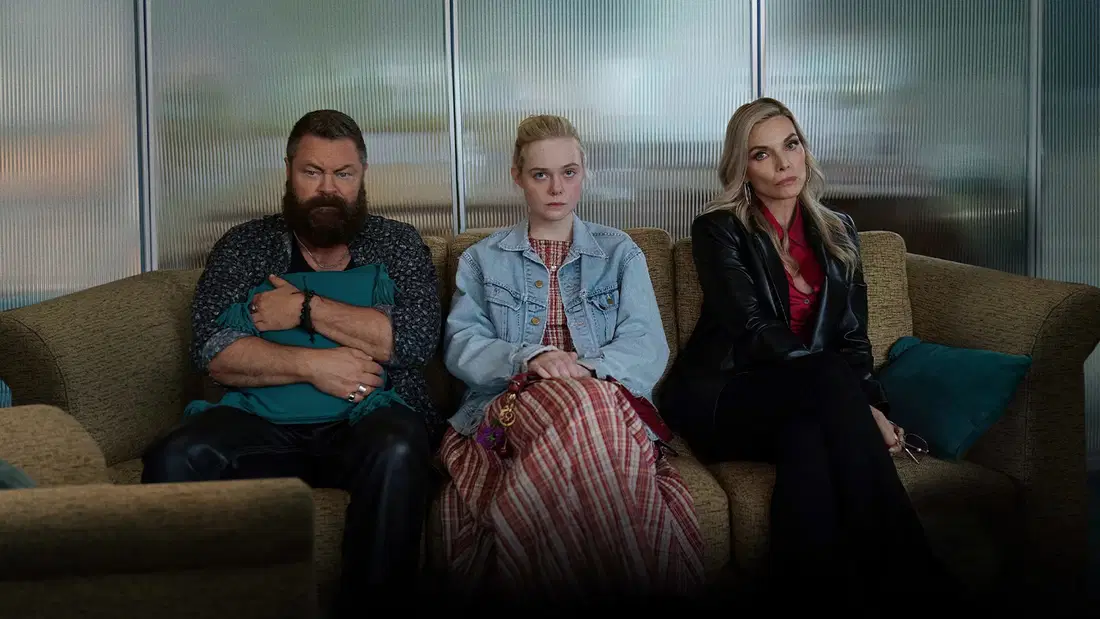
The narrative centers on the titular Margo (played by Elle Fanning), a young woman whose life plan is derailed after an affair with her community college professor results in an unplanned pregnancy. Left to navigate the complexities of sudden motherhood, she finds an unconventional support system in her estranged parents: Shyanne (Michelle Pfeiffer), a veteran of the service industry, and Jinx (Nick Offerman), a former professional wrestler grappling with the physical and mental tolls of his past.
Desperate to provide for her newborn and facing an empty bank account, Margo pivots to OnlyFans. What begins as a financial Hail Mary soon evolves into a transformative—and highly controversial—journey of self-discovery. The plot thickens when the child’s father, Mark, discovers her online presence and initiates a legal battle for custody. This sets the stage for a high-stakes confrontation that pits Margo’s unconventional choices against societal judgment.
Performances
The strength of Margo’s Got Money Troubles lies heavily in its stellar ensemble. Elle Fanning is a revelation as Margo, delivering a performance that transitions from vulnerable and overwhelmed to a woman of iron-clad resolve. While the early episodes establish her charm, Fanning truly commands the screen in the latter half of the season.
Equally impressive is Nick Offerman, who underwent a staggering physical transformation to play Jinx. Beyond the impressive physique, Offerman finds the soul of the character, particularly when portraying Jinx’s battle with addiction and his fierce loyalty to his daughter. The supporting turns by Michelle Pfeiffer, Nicole Kidman, and Thaddea Graham add layers of texture to the world, ensuring that every interaction feels grounded and purposeful.
Behind the Lens
One of the most fascinating aspects of the series is its exploration of the “carny” lifestyle. By drawing parallels between the world of professional wrestling and modern content creation on OnlyFans, the writing deconstructs the stigma surrounding sex work. The series argues that whether it is a wrestler performing in a ring or a creator engaging with an audience online, the core element is a transactional performance designed to put food on the table.
The series does take a few episodes to find its rhythm; the initial pacing feels a bit tentative as the world-building is established. However, once the central conflict regarding the custody battle and Margo’s burgeoning career takes center stage, the writing becomes incredibly sharp. David E. Kelley uses the platform to challenge the audience’s biases, asking why society feels entitled to police the survival tactics of a struggling mother.
Final Verdict
While it requires a small measure of patience to get past the initial setup, Margo’s Got Money Troubles eventually blossoms into one of the most poignant entries in David E. Kelley’s storied career. It is a creative, bold, and ultimately empathetic look at the lengths a parent will go to for their child. The first three episodes of this ten-episode season premiered on April 15 on Apple TV. If you stick with Margo through her initial hurdles, the emotional payoff is more than worth the investment.
Also Read:
Elle Fanning Leads All-Star Cast in “Margo’s Got Money Troubles”