

Five years have passed since the world crumbled under a barrage of extinction-level events. In Greenland: Migration, the franchise shifts from the panic-fueled adrenaline of the first film to a slow-burn, atmospheric exploration of life after the collapse. While the original movie captured the sudden terror of an impending comet, this sequel explores the grueling reality of what happens when the dust refuses to settle. It is a bleak, breathtaking road movie that forces us to ask what, exactly, is left worth saving.
Story
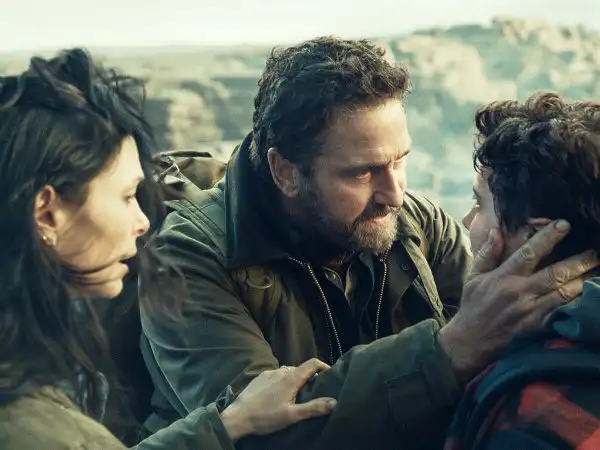
The Garrity family—John, Allison, and their son Nathan—have exhausted their welcome in the subterranean bunker that served as their sanctuary. When seismic instability renders their underground home a death trap, they are forced into the light of a ruined world. Their objective is clear but daunting: a rumored refuge in southern France known as The Crater, a site supposedly shielded by breathable air.
As they traverse a desolate Europe, the film paints a haunting portrait of a planet choked by toxins and unpredictable meteor debris. From the sunken, ghostly ruins of Liverpool to the jagged, alien-looking canyons of the English Channel, the journey is less of an escape and more of a fight against entropy itself. It is a picaresque trek where the environment—radioactive storms and collapsing landscapes—is as deadly as the desperate scavengers they encounter along the harsh, gray trail.
Performances
At the heart of this exhaustion are Gerard Butler and Morena Baccarin. Butler brings a weary, grounded physicality to John Garrity; he portrays a man physically weathered by radiation and emotionally hollowed out by the burden of keeping a family alive. He doesn’t play a superhero, but a father running on fumes.
Morena Baccarin provides the necessary emotional anchor, balancing desperate survival instincts with a fraying moral compass that prevents the story from spiraling into pure nihilism. Returning as Nathan, Roman Griffin Davis delivers a standout performance, embodying a teenager who remembers almost nothing of the world before the comet. His struggle with his insulin supply remains a tense, humanizing anchor for the otherwise expansive scope of the film.
Behind the Lens
Director Ric Roman Waugh successfully scales up the ambition of the series without losing the intimacy of the character work. Utilizing Iceland’s rugged vistas, the production design highlights the stark, ash-covered reality of a broken Earth. One particular sequence—a life-or-death crossing of a rope bridge over a French canyon—stands out as a masterpiece of sustained tension, using vertical space to trigger legitimate audience anxiety. The decision to juxtapose these massive set pieces with quiet, observational shots of the family against a decaying backdrop gives the film a poignant, reflective gravity.
Final Verdict
Greenland: Migration is a rare sequel that evolves its premise rather than just repeating it. It transforms from a disaster thriller into an intense study of human resilience and the fleeting nature of empathy in a fallen world. It is a heavy, visually arresting, and emotionally demanding experience. For fans of high-stakes survival epics, this is a must-watch that proves the most dangerous part of the apocalypse isn’t just the falling debris—it’s the long walk toward a future that might not exist.
Greenland 2: Migration is now streaming on Lionsgate Play after the theatrical debut on January 9, 2026.
Also Read:
“Greenland 2: Migration” – New Release Date, Cast Updates & What to Expect from the Sequel