

William Golding’s Lord of the Flies has been casting a long shadow over popular culture since its publication over seven decades ago. The novel’s exploration of civilization’s fragility and humanity’s capacity for savagery has resonated through generations, inspiring parodies on animated sitcoms, borrowing plot elements from prestige dramas like Lost and Yellowjackets, and even influencing Stephen King’s fictional town of Castle Rock. You could argue that reality television as we know it, from Survivor to every survival competition that followed, exists partly because of this seminal work.
Enter Jack Thorne, the visionary writer who captured global attention with the powerful limited series Adolescence. Known for crafting socially conscious dramas that spark vital conversations about masculinity, internet culture, and the troubled psyches of young men, Thorne brings the same nuanced sensibilities to this four-part adaptation. After premiering on the BBC in February, the series now streams exclusively on Netflix, offering audiences a fresh interpretation of literature’s most disturbing thought experiment about stranded children and their descent into primal chaos.
What makes this adaptation particularly compelling is Thorne’s dual focus: honoring the intricate characterization of Golding’s original while simultaneously illuminating how its themes echo through our contemporary political landscape. The result is a haunting, thought-provoking viewing experience that feels both faithfully literary and startlingly relevant.
Story: When Innocence Meets Its Darkest Potential
For those who never cracked Golding’s novel in high school English class, the premise remains stark and unsettling. A plane carrying British schoolchildren crashes on a remote tropical island during an unspecified war. The adult pilot dies, leaving the young passengers completely alone with no guidance, no authority figures, no established rules—only each other and their rapidly diminishing grip on civilization.
Set in the 1950s, the narrative follows the familiar but always chilling trajectory: the children initially attempt to mirror adult society, electing a leader and establishing rudimentary systems of governance. They debate where to build facilities and how to distribute responsibilities. They cling to the familiar rhythms of British order and structure, perhaps because they know nothing else.
But order cannot hold indefinitely. Factions emerge, friendships shatter, and power struggles consume the fractured group. The choir, led by the ambitious and merciless Jack, transforms from musical ensemble to band of hunters. The delicate balance between the sensible Ralph, the intellectual Piggy, and the contemplative Simon cannot survive contact with fear, hunger, and the seductive freedom of the untamed island.
This television adaptation introduces a structural innovation that strengthens the storytelling. Each of the four episodes centers on one of the primary characters, offering deeper psychological portraits and new flashback sequences that enrich our understanding of who these children were before circumstances stripped away their social conditioning. Ralph, Piggy, Simon, and Jack each receive their moment of focus, revealing interiority that the novel could only suggest.
The shift from feature film to limited series proves inspired. The extended format allows the descent into anarchy to unfold with devastating patience, letting viewers absorb every incremental loss of hope and humanity. Where previous adaptations had to compress Golding’s commentary, this version breathes, lingers, and confronts.
Performances: Young Cast, Immense Impact
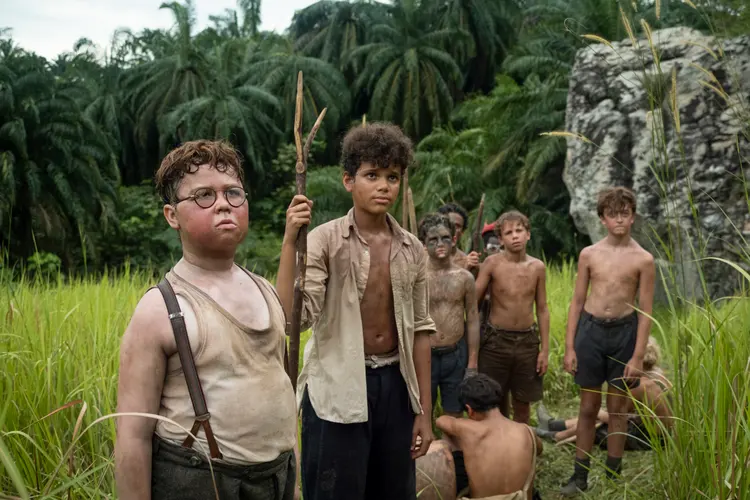
The casting decision sets this adaptation apart from its predecessors. Rather than older teenagers playing younger roles, the production assembled over thirty actual children of various ages, many with little to no professional acting experience. This choice transforms the entire endeavor, lending an authenticity that amplifies the horror exponentially.
When we see small children committing acts of violence, the effect cuts far deeper than when older actors simulate the same brutality. These kids look genuinely vulnerable, genuinely dangerous, and the dissonance between their innocent faces and their savage actions creates an unshakable unease throughout the series.
David McKenna’s portrayal of Piggy stands as the revelation of the ensemble. Rather than simply rendering the character as the fat, glasses-wearing comic relief of lesser adaptations, McKenna brings remarkable depth: a sharp mind constrained by physical limitations, a wry sense of humor that emerges despite circumstances, and an unwavering moral compass that becomes increasingly tragic as the world around him collapses. Piggy’s death, always devastating, feels here like the final snuffing of reason itself.
Lox Pratt embodies Jack with a frightening versatility, alternating between petulant petulance and calculated menace. The young actor, soon to appear as Draco Malfoy in HBO’s upcoming Harry Potter series, delivers a performance that makes Jack simultaneously infuriating and terrifying. His Jack doesn’t monologue about evil—he simply becomes it, gradually and then all at once. Winston Sawyers captures Ralph’s earnest leadership and gradual defeat with affecting sensitivity, while Ike Talbut’s Simon conveys a spiritual quality that makes his fate particularly heartbreaking—the one boy who might have seen clearly was never going to survive among those who refused to look.
Behind the Lens: Where Environment Becomes Character
Director Marc Munden approaches the Malaysian filming location as an additional cast member, transforming the lush tropical setting into a character that evolves alongside the children. Wildlife footage, vibrant color palettes, and sweeping vistas blend with close-up work that becomes increasingly claustrophobic as the narrative progresses.
The cinematography employs a documentary quality that grounds the fantastic elements in sensory reality. Extreme close-ups capture every emotion flickering across young faces, while complementary shots of rotting fruit, decomposing animal remains, and crawling insects create an atmospheric dread that never overwhelms but constantly whispers that nature itself has turned hostile. The visual language suggests a world in putrefaction, mirroring the corruption taking place within the children’s souls.
Night sequences prove particularly effective, bathed in hallucinatory reds and pinks that transform the familiar island into something otherworldly. These aren’t merely aesthetic choices—they function as visual correlatives to the children’s psychological disintegration, making the abstract concept of losing one’s grip on civilization heartbreakingly concrete.
Technical achievement aside, one element doesn’t quite land: the CGI wild pigs, which remain unconvincing throughout. However, this minor shortcoming vanishes against the production’s otherwise immaculate craft. Every frame suggests meticulous attention to how environment shapes character and how isolation strips away the civilizing influence of society.
Final Verdict: Timely, Terrifying, Essential
The lessons Golding embedded within Lord of the Flies feel less like literary artifacts and more like urgent warnings in our current moment. The fragility of social norms, the dangerous appeal of charismatic populism, the seductive nature of tribal identity—these themes resonate with terrifying urgency whether one sees reflections in political movements, socialmedia dynamics, or simply the breakdown of discourse in online spaces.
Crucially, Thorne refuses to beat viewers over the head with contemporary parallels. Rather than updating the setting to modern times or inserting obvious commentary on current events, he trusts Golding’s framework to speak for itself. The adaptation pokes at broader truths about human nature, allowing audiences to draw their own connections to the world they inhabit. This restraint strengthens rather than diminishes the impact—what remains uneasily relevant after seventy years requires no artificial enhancement.
The series succeeds as both faithful adaptation and independent artistic achievement. It honors its source material while carving out new emotional and psychological territory through format, performance, and visual storytelling. Those familiar with the novel will discover depths they may have missed; those encountering the story for the first time will find themselves genuinely shocked by where human nature can lead when adult supervision disappears entirely.
For anyone who ever rolled their eyes at this “boring” book assignment in high school, this adaptation offers a compelling argument for revisiting Golding’s vision. It transforms required reading into essential viewing—a rarity in the world of literary adaptations. The series manages to be simultaneously faithful and fresh, classic and contemporary, comfortable and deeply unsettling.
Rating: ★★★★½ (4.5/5)
Also Read:
“Lord of the Flies” Lands on Netflix: Your Essential Guide to the Modern Adaptation