

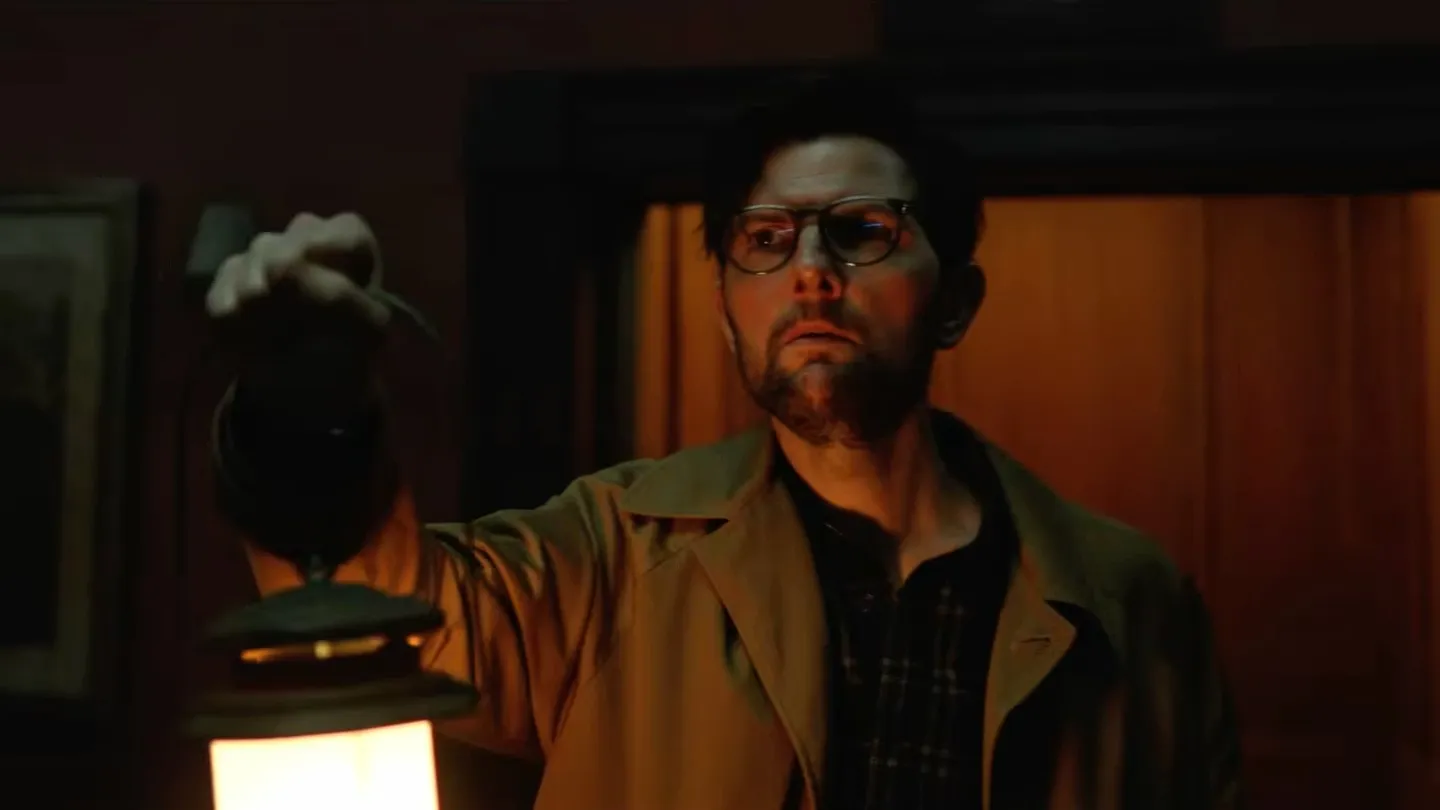
A haunted inn, scattered ashes, and an ancient witch—these elements converge in Hokum, a supernatural horror film that arrived in theaters under Neon’s distribution banner on May 1, 2026. The film traces the journey of Ohm Bauman, a reclusive fantasy novelist portrayed by Adam Scott, who travels to a remote Irish countryside inn seeking closure by laying his parents to rest. What begins as an intimate pilgrimage into grief quickly transforms into a confrontation with something far older and far hungrier than personal mourning. Hokum establishes itself not merely as a tale of paranormal terror but as a meditation on guilt, creative arrogance, and the inescapable weight of stories that refuse to remain fictional.
The Story: Grief, Guilt, and Ancient Warnings
Ohm Bauman arrives at the weathered Irish hotel carrying more than luggage—he carries the accumulated burden of unresolved loss and artistic detachment. The establishment once hosted his parents during their honeymoon, and now it awaits their son with damp corridors, stagnant air, and memories that refuse to settle into peace. As a successful writer of fantasy novels, Ohm possesses the intellectual tools to dismiss local legends, yet those very tools prove insufficient against the forces awakening within the Honeymoon Suite.
The narrative weaves Ohm’s personal crisis with an allegorical thread drawn from his own manuscript. His unfinished story about a conquistador searching for treasure trapped inside an unbreakable glass bottle serves as a mirror reflecting his emotional paralysis. Just as the conquistador cannot shatter the vessel that contains his desire, Ohm cannot break through the barriers protecting his capacity for connection, tenderness, and genuine remorse.
When Fiona, a source of brief warmth within the inn’s cold atmosphere, vanishes during an ordinary evening, Ohm finds himself drawn deeper into hallways where personal failure and ancient folklore begin sharing the same breath. The hotel’s dead recognize his guilt, and he learns—through pain and gradual revelation—that some narratives demand blood before surrendering their final sentence. The folklore surrounding a witch inhabiting the Honeymoon Suite transforms from dismissed superstition into a moral grammar that challenges Ohm’s entire worldview. Isolation strips away his intellectual armor, leaving him exposed to judgments he cannot sarcastically deflect or logically argue away.
The witch embodies something older than modern skepticism, carrying the weight of land, season, and inherited ritual. She represents a past that refuses burial beneath reason, arriving like patient judgment finally collecting debts accumulated across years of avoidance. Ohm’s trip to Ireland becomes an encounter between his desperate hunger for closure and his profound inability to forgive himself for surviving in the form he did.
Performances: Adam Scott’s Calculated Coldness
Adam Scott delivers a performance of remarkable precision, crafting Ohm Bauman as a study in calculated abrasiveness. His portrayal carries an almost ceremonial unpleasantness, transforming the character into a minor deity of his own invented worlds—one who has sacrificed tenderness for the machinery of a writing career. Scott weaponizes silence, using it to communicate superiority, exhaustion, and private contempt that spoken words would somehow diminish. When anger finally breaks through his calculated exterior, it lands with the clean, surgical force of an incision, revealing the raw vulnerability beneath his intellectual armor.
The supporting cast members serve as reflecting surfaces for Ohm’s failures. Fiona offers fragile warmth that he lacks the emotional architecture to receive, her kindness glowing faintly in a space steeped in shadow. Mr. Cobb operates as a figure of stern old belief, treating folklore with the gravity of natural law. Alby the bellhop and Mal the concierge voice warnings that Ohm’s vanity renders inaudible. Jerry, living from a van near the forest, bridges chemical and spiritual understanding of the land, possessing an authority that stems from his grounded presence. None of these characters exist as mere ornaments around the protagonist’s crisis—they actively reveal the emptiness within Ohm’s skepticism and expose the vanity masquerading as intelligence.
Behind the Lens: Atmosphere as Living Character
The production design transforms the Irish inn into a character itself, one that traps, watches, and endures with patient malevolence. Rustic decay permeates every frame, suggesting a structure abandoned by the present tense. Dust-coated fixtures and antiquated plumbing speak of temporal abandonment, while the Honeymoon Suite concentrates accumulated dread into a single chamber of Victorian heaviness. Velvet hangs with funerary weight, and the space feels prepared for bodies that continue breathing.
The cinematography binds itself entirely to Ohm’s perspective, creating suffocating intimacy that mirrors his psychological entrapment. The camera lingers on corners, thresholds, and patches of darkness leaning inward, teaching the audience to search for figures that may exist or merely wait for belief to grant them shape. Gray tones and muted colors dominate, presenting a world drained, emptied, and spiritually weathered. Light exists within this universe yet never achieves cleansing quality—the landscape remains perpetually stained by dread.
Visual patterns reinforce the atmosphere of distortion throughout. A mechanical clock crowned by a cherubic figure measures time with ugly patience, making each half-hour feel less like neutral division and more like a sentence approaching completion. Fragments of warped children’s television drift through the narrative, generating unease that rises from memories once considered harmless. These images suggest that childhood never vanishes cleanly but lingers, replaying itself from damaged frequencies. The pagan decor and gourds scattered through lobby spaces point toward traditions predating the hotel itself, rooting terror in land, season, and inherited ritual.
The sound design operates with equal intentionality. Scores break into silence like bodies taking startled breaths, springing tight in the nerves and releasing in sharp pulses. The film refuses the restless tempo common to many thrillers, instead choosing slower rhythms marked by waiting, delay, and pressure. Fear accumulates rather than explodes, and the clock’s recurring chime becomes almost physical—a small violence carried through sound. This understanding of anticipation as its own torment allows anxiety to work on the body before engaging intellect, with atmosphere hunting through touch, rhythm, and the slow persuasion of dread settling into muscle.
Final Verdict: A Horrifying Meditation on Creative Atonement
Hokum succeeds by treating folklore with severe conviction, proposing that old warnings persist because something fundamental within them remains true. The witch represents not cheap supernatural thrills but a reckoning long avoided, finally arriving to collect what arrogance has owed. The film’s closing movement achieves resolution through pain honestly endured, as Ohm completes his manuscript by choosing an ending that deliberately turns away from the senseless violence he once preferred. Writing becomes a path toward atonement—harsh and narrow, but genuine.
For audiences seeking atmospheric horror that prioritizes psychological depth over jump scares, Hokum delivers an experience both suffocating and cathartic. It transforms the familiar haunted hotel template into something more profound: a story about the stories we create to avoid ourselves, and the ancient forces that refuse to let that evasion continue.
The film is now screening in theaters.