

The dimmed lights of Somerville’s Crystal Ballroom held no trickery, no elaborate backdrop, no choreographed dancers. When Maya Hawke took the stage on a quiet Friday evening, she brought only her voice, her collaborators, and an unshakable commitment to authenticity. What followed was a concert that transcended the typical concert experience entirely, transforming into something far more meaningful—a shared moment of human connection through music.
From Screen to Stage: Hawke’s Genuine Artistic Evolution
Fans primarily know Maya Hawke from her scene-stealing performances in Stranger Things, where her quick wit and sarcastic charm captured audiences worldwide. Yet on this particular night, those familiar qualities took a backseat to something deeper and more vulnerable. The actress turned singer-songwriter proved she belongs just as confidently on a musical stage as she does on a streaming screen, trading her well-known persona for genuine emotional transparency.
The sold-out venue welcomed attendees across multiple generations. Tweens who grew up watching her on television stood alongside their parents, while college students and older fans gathered to witness what many suspected would be a defining moment in Hawke’s musical journey. The crowd’s diversity spoke volumes about the artist’s expanding appeal beyond her initial fanbase.
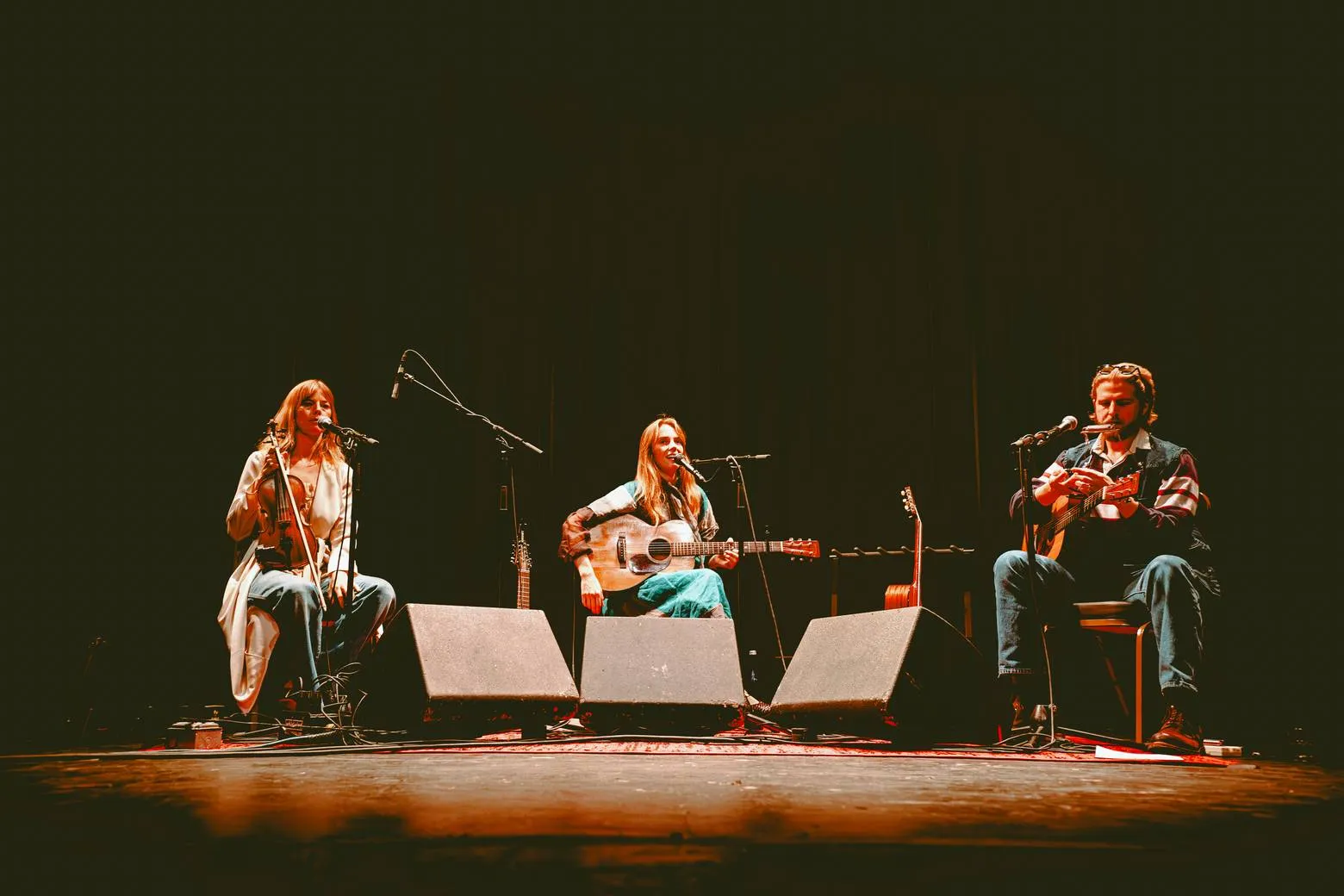
Seated beside producer and new husband Christian Lee Hutson, along with violinist Odessa Jorgensen, Hawke crafted an evening that felt less like a performance and more like an intimate gathering of friends. The trio navigated through her newly released album “Maitreya Corso,” which had officially dropped that same day. Remarkably, much of the audience already knew the words, singing along to tracks they’d only hours earlier added to their music libraries.
Stripping Away the Unnecessary
The concert’s opening moments felt deliberately underwhelming by conventional standards. No pyrotechnics exploded across the stage. No elaborate lighting schemes painted the walls in dramatic colors. No backup singers crowded the runway. Hawke and her small ensemble simply walked onto the stage and took their seats, as if settling into someone’s living room for an evening of unplugged music.
That initial restraint, however, quickly revealed itself as the evening’s most powerful artistic choice. Without the distractions that typically dominate modern concerts, attendees found themselves transported into a rare creative space where they functioned less as passive spectators and more as active participants in something genuinely communal.
Hawke articulated this philosophy directly to her audience, explaining that the tour represented “a celebration of humanity and realness—knowing that things can go wrong occasionally and understanding that love and collaboration help us navigate through anything.”
Moments That Defined an Unscripted Evening
What separated this concert from countless others was Hawke’s instinctive ability to transform every pause between songs into something meaningful. Rather than letting silence dominate, she filled those spaces with personal anecdotes, spontaneous jokes, and direct invitations for audience interaction. Her humor drew frequent laughter, while her openness made the enormous room feel surprisingly personal and intimate.
During one memorable exchange, Hawke responded to fan questions about her creative work. She revealed that her favorite acting project was “Asteroid City,” while she cited “The Producers” as her mother’s best television work—a nod to Uma Thurman’s distinguished career.
The artist also shared the story behind her album’s intriguing title. “Maitreya” represented a name her mother once considered for her, while “Corso” honored her father Ethan Hawke’s beloved poet, Gregory Corso of the Beat Generation. Hawke described the combined title as “sort of my alter-ego,” inviting listeners into the mythological space she creates through her music.
The evening embraced such looseness that when an audience member raised a birthday sign, Hawke immediately paused the show to lead a heartfelt “Happy Birthday” chorus. Later, she accommodated a fan’s request for “Hang In There,” incorporating impromptu moments that prioritized authentic connection over polished perfection.
Musical Craftsmanship at Its Purest
In an era where auto-tune dominates mainstream music production, Hawke’s commitment to unfiltered vocals felt revolutionary. Her voice—raspy, warm, and possessing a quietly commanding quality—anchored every performance without technological enhancement. The rawness of her delivery resonated with listeners seeking genuine artistic expression amid an industry saturated with artificial perfection.
Jorgensen’s violin wove delicate emotional layers throughout the performance, with harmonies blending seamlessly into Hawke’s lead vocals. The instrumentation never overpowered the songs but instead added depth and texture that elevated each composition.
Hutson’s acoustic guitar work provided steady foundation, while his occasional harmonica playing particularly illuminated “Terms of Estrangement.” That track showcased the evening’s most developed folk textures, with the harmonica’s mournful qualities deepening the song’s emotional resonance.
A Setlist That Told a Story
The concert opened with “Devil You Know,” an immediately engaging introduction that demonstrated Hawke’s distinctive lyrical approach—quick, clever phrases alternating with slower, more contemplative verses. The opening number established the evening’s tone and signaled that audiences were in capable hands.
“Great Minds” and “Last Thoughts on a Morning Star” unfolded with rhythmic qualities resembling spoken-word poetry, while “Heavy Rain”—which Hawke personally identified as her favorite track—delivered one of evening’s most mesmerizing moments. During that particular song, the trio layered overlapping lyrics that created an almost hypnotic effect, drawing listeners deeper into the music’s emotional core.
The performance demonstrated Hawke’s versatility as both lyricist and performer, moving effortlessly between introspective ballads and more upbeat compositions. Each selection felt carefully chosen to advance the evening’s narrative of human connection and authentic expression.
One absence went conspicuously unnoticed by official sources but generated considerable speculation among attendees. Joe Keery, also known by his stage name Djo and Hawke’s Stranger Things co-star, inspired whispered conversations about a potential surprise appearance. The Newburyport native’s absence, however, ultimately underscored the evening’s core message: this night required no special guests or elaborate spectacle to succeed.
Final Thoughts
As the final notes faded and the lights rose, what remained was the memory of a concert that offered something increasingly rare in live entertainment. Maya Hawke stripped music down to its essential elements—voice, story, and human connection—proving that vulnerability and sincerity resonate far more deeply than production tricks or celebrity cameos. For those fortunate enough to witness it, the evening at Crystal Ballroom served as a timely reminder that authentic artistry, presented with genuine care for an audience, creates experiences that linger long after the final applause.