

Do you ever feel like the world is rigged against the average person? Have you ever wanted to strike back at a system that seems designed to keep creative mindsdown? If these questions resonate with you, then Boots Riley’s latest cinematic experiment offers exactly the outlet you’ve been searching for. I Love Boosters arrives as a feverish, unapologetically bold satire that refuses to play by conventional filmmaking rules while simultaneously delivering one of the most entertaining experiences in recent memory.
For those who have tracked Riley’s evolution from music with The Coup to groundbreaking films like Sorry to Bother You and the limited series I’m a Virgo, this latest offering feels like an artist hitting his stride. Riley has always worn his activism on his sleeve—albums like “Kill My Landlord” and “Steal This Album” make that abundantly clear—but I Love Boosters demonstrates a remarkable maturation. Rather than delivering a heavy-handed lecture dressed in entertainment clothing, Riley has crafted something far more subversive: a film that works brilliantly as pure comedy while embedding its social critique so deeply that viewers absorb it without feeling preached to.
The result is a movie that manages to be crowd-pleasing and challenging, accessible and surreal, heartfelt and ridiculous all at once. It represents the work of a filmmaker who has learned to balance his passionate convictions with genuine cinematic craft.
Synopsis
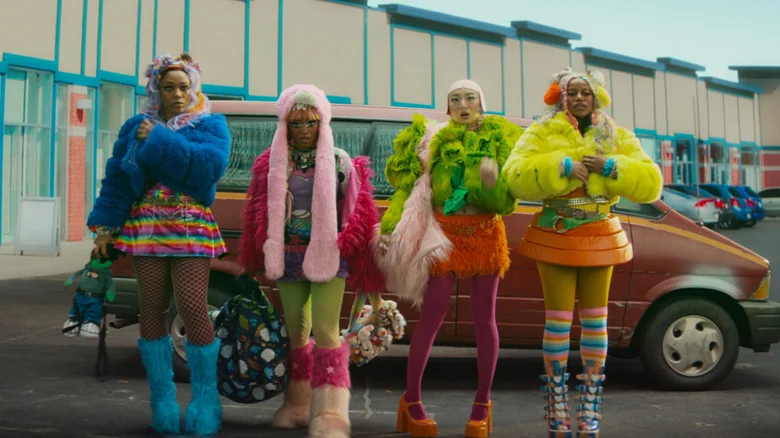
At its heart, I Love Boosters follows Corvette, a talented fashion designer played by Keke Palmer, whose dreams have been crushed by circumstances beyond her control. Living—quite literally—in the ruins of her ambitions, she has taken up residence in an abandoned fast-food chicken restaurant while leading a crew of clothing thieves known as the Velvet Gang. Her two closest confidantes, Sade portrayed by Naomi Ackie and Mariah brought to life by Taylour Paige, share her vision and her desperation.
What makes the Velvet Gang different from ordinary thieves is their specific target: no ordinary high-end boutique will do. Instead, they focus their efforts on the luxury empire of megastar designer Christie Smith, portrayed by Demi Moore. This fixation isn’t merely criminal—it becomes almost philosophical, as Corvette grapples with the complicated feelings of being both an admirer and an adversary of someone who represents everything she might have become.
As their heists grow increasingly elaborate and ambitious, the Velvet Gang finds themselves entangled in a web of interconnected conspiracies that extend far beyond simple theft. They encounter a disaffected boutique worker portrayed by Eiza González, a trapped sweatshop employee brought to life by Poppy Liu, an impossibly smooth pyramid scheme promoter played by an unrecognizable Don Cheadle, and a dangerously intriguing male model embodied by LaKeith Stanfield. Each encounter adds layers to a story that refuses to remain constrained within any single genre or narrative framework.
The plotting becomes almost kaleidoscopic as the film progresses, with characters and scenarios spinning off in unexpected directions that somehow all connect back to the central themes of exploitation, creativity, and resistance.
Performances
Keke Palmer delivers a career-defining performance as Corvette, capturing both the frustration of an artist stifled by economic reality and the fierce determination that makes her a compelling protagonist. She brings humanity to a character who could easily have become a mere symbol, making viewers genuinely invest in her journey despite—or perhaps because of—her questionable methods.
The supporting cast proves equally remarkable. Naomi Ackie and Taylour Paige bring warmth and wit to Sade and Mariah, creating a trio whose chemistry feels authentic and whose banter provides much of the film’s comedic energy. Their performances grounds the surreal elements in genuine human connection.
Demi Moore’s turn as Christie Smith revels in the absurdity of celebrity culture, playing the fashion mogul with a perfectly calibrated mix of charm and menace. Meanwhile, Don Cheadle transforms almost beyond recognition as the pyramid scheme huckster, proving once again why he remains one of cinema’s most versatile talents. LaKeith Stanfield adds his distinctive energy to the enigmatic male model, creating a character whose seductiveness carries genuine threat.
The ensemble work extends to smaller roles as well, with each supporting performer seeming to understand the assignment: contribute to the film’s revelry while maintaining individual distinctiveness.
Behind the Lens
Boots Riley has assembled a creative team that elevates I Love Boosters from mere satire to genuine cinematic artistry. Cinematographer Natasha Braier collaborates with production designer Christopher Glass and costume designer Shirley Kurata to create a visual experience that rival any arthouse experiment while remaining accessible and entertaining.
The film’s visual language owes debts to multiple sources—from the maximalist energy of early 1990s cult films like Freaked to the stylized worlds of Michel Gondry and Wes Anderson. Yet Riley synthesizes these influences into something genuinely his own. The costume work deserves particular attention, with Kurata creating a visual feast that comments on fashion industry excess while remaining genuinely beautiful.
Technical elements push boundaries in unexpected ways. The inclusion of extensive stop-motion animation and creatures designed by FX veteran Alec Gillis demonstrate Riley’s willingness to experiment with format and medium. A climactic action sequence built around charming miniatures showcases craftsmanship that rivals any big-budget production.
The film’s visual ambition occasionally threatens to overwhelm its narrative—the early sequences particularly embrace a Terry Gilliam-esque approach where visual invention takes precedence over story mechanics. Yet this maximalism serves a purpose, creating a world where the characters’ increasingly desperate schemes feel naturally at home.
Final Verdict
I Love Boosters represents both a culmination and an evolution of Boots Riley’s cinematic vision. Where earlier works like Sorry to Bother You and I’m a Virgo sometimes struggled to balance their ambitious concepts with emotional accessibility, this latest effort finds that equilibrium more consistently. The film shares DNA with Everything Everywhere All At Once in its willingness to pursue ideas to their logical extremes, yet avoids that movie’s occasional dips into sentimentality.
Not everything works perfectly. The sheer density of concepts and scenarios occasionally threatens to collapse under their own weight, and some viewers may find the pacing exhausting. Certain climaxes feel slightly anticlimactic—not because the build-up fails, but because the film’s ambitions naturally resist tidy resolution. These imperfections, however, feel almost intentional, reflecting the reality that the systemic issues Riley examines resist simple answers.
For activists seeking purely confrontational cinema, I Love Boosters might feel too entertaining, too playful in its provocations. For casual viewers seeking straightforward comedy, its maximalism might prove overwhelming. But for those willing to meet Riley on his own terms, the film offers rewards that few contemporary comedies attempt, let alone achieve.
It ultimately succeeds as both Trojan horse and celebration—accessible enough to enjoy on the surface, layered enough to reward deeper exploration. Like the best fashion, like life itself, it invites us to look beyond the immediately visible and discover what lies beneath.
I Love Boosters opened in theaters on May 22, 2026.
Also Read:
Everything to Know About Boots Riley’s Surrealist Crime Comedy: “I Love Boosters”