

Prime Video’s new limited series Cathedrals is a slow-paced crime drama that poses a disturbing question: what happens when a family decides that not knowing is better than facing the truth?
Based on Claudia Piñeiro’s novel “Catedrales” and directed by Pepa San Martín and Fabiana Tiscornia, this six-episode Spanish-language series weaves its story through two different times—1986, when a teenage girl is found murdered near Santiago, and 2018, when her surviving sister returns to reopen the case. The show focuses more on uncovering guilt, religion, and the pain of unspoken hurt rather than relying on dramatic twists. For fans of thoughtful, character-centered mysteries, Cathedrals is a powerful, though dark, journey into the lasting effects of a crime.
Synopsis
In 1986, seventeen-year-old Ana Sardá is discovered burned and cut up in a vacant lot close to her middle-class neighborhood in Santiago. Her religious parents, Adolfo and Dolores, choose to hide the tragedy with their faith and refuse to look into the case. The investigation is closed, and the family tries to go on, carrying the loss like a silent prayer.
Thirty years later, Ana’s older sister Lía, who left Chile after disagreeing with the family’s strict religious beliefs, returns to care for her sick father.
Honoring Adolfo’s wish to finally find out what happened to his daughter, Lía looks into old reports, witness statements, and forgotten secrets. As she puts together parts of Ana’s life, she finds a complex network of hidden relationships, religious pressure, and buried anger that involves more than one member of the Sardá family. The series constantly moves between the 1980s and the present, showing how choosing to stay quiet has changed how each generation sees themselves and values loyalty and morality.
Performances
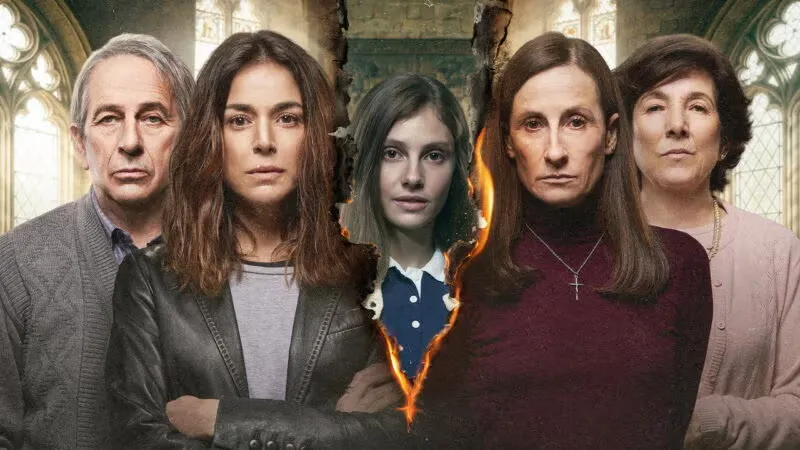
Alfredo Castro and Paulina García give quiet but strong performances as Adolfo and Dolores, showing the silent suffering of parents who use religion to protect themselves from grief. Their small actions—like holding a prayer or showing stress during dinner—say more than any speech.
Vivianne Díez, as adult Lía, and Ignacia Baeza, as her younger self, show how a daughter struggles between loyalty and the need to tell the truth. Díez’s strong determination contrasts with Baeza’s restless energy, representing the main conflict of the series.
Octavia Bernasconi’s portrayal of Ana, mainly through flashbacks and haunting images, makes a lasting impression. She shows Ana as innocent yet defiant, hinting at why she became a threat to the family’s strict values. Supporting roles from Paula Luchsinger, Amparo Noguera, Muriel Santa Ana, and Carolina Kopelioff add depth, showing how different Sardá women handle or fail to handle their loss.
Behind the Lens
Pepa San Martín and Fabiana Tiscornia direct each episode, but the visual style stays consistent. The series uses a muted color palette—earthy tones for the 1980s, cooler blues for the present—to show the time changes without using title cards. Cinematographer José Luis Alcaine uses close-ups of hands in prayer or holding a rosary, turning everyday religious items into symbols of control.
The screenplay, by Fredjkes and Quesada, stays true to Piñeiro’s novel while removing extra stories to keep the focus on the family’s internal conflict. The dialogue is simple, letting the actors’ silence carry emotion. Details like Santiago’s buildings and late-1980s fashion are shown with care, creating a world where tradition feels both comforting and trapping.
Music is used very little; a low, constant sound grows louder only when something big is revealed, showing how truth, when finally spoken, echoes like a bell in an empty church.
Final Verdict
Cathedrals is a deep reflection on how families can turn grief into a belief system, choosing silence over responsibility. While the mystery is part of the story, the series doesn’t try to be a typical detective show. Instead, it treats the investigation as a mirror, showing the characters’ moral decline and small signs of change.The pacing is slow and thoughtful, which might not be for everyone looking for fast-paced action or sudden surprises. However, the acting is deeply moving, and the way the scenes are directed creates a strong mood, making even the quietest moments feel meaningful and impactful.
This series is a good choice for people who enjoy stories that focus more on ideas and emotions than on big action scenes. Cathedrals offers a meaningful and reflective experience. It doesn’t completely change the crime genre, but it’s a nicely made show that fits well within Prime Video’s collection of high-quality Latin American dramas.