

As the holiday season descends upon us, the cinema landscape becomes a battlefield for your entertainment dollar. Studios roll out their biggest guns, hoping to capture the festive spirit (and your cash) with a mix of blockbuster sequels and feel-good fare. The new Angel Studios release, Hershey, enters this fray with the subtlety of a sledgehammer, aiming directly for your heartstrings while also reaching for your wallet. While it’s certainly not the worst option playing at the local multiplex, it raises a pertinent question: does a story this sanitized and sweet actually do justice to its subject?
There are undeniably more intellectually stimulating options, such as the gripping Paper Tiger or the wryly humorous Wild Horse Nine, which might be a better fit for audiences seeking something with a bit more substance. Yet, this film offers a safe, comfortable space for a family outing. If you’re already navigating the delicate social dynamics of a Thanksgiving dinner, pretending to enjoy Aunt Carol’s dry turkey, then perhaps a predictable, comforting movie is just what you need to keep the peace.
Synopsis
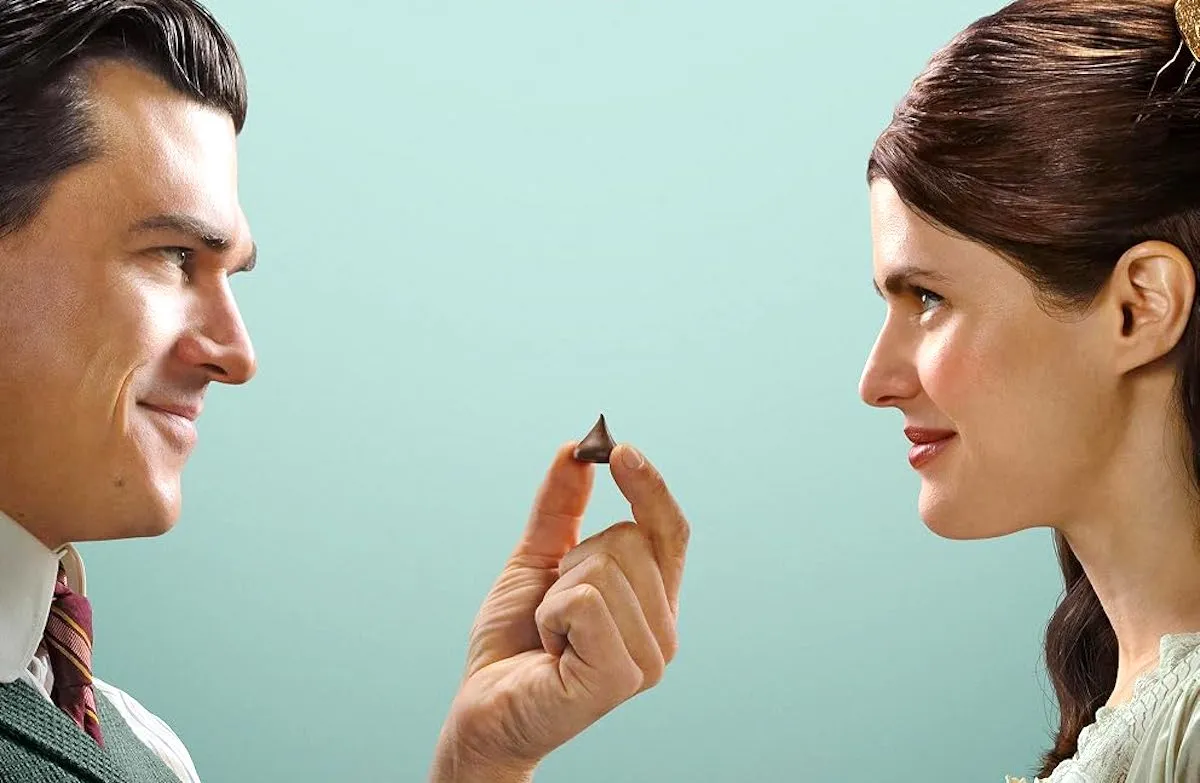
The narrative centers on the life of Milton S. Hershey, portrayed by Finn Wittrock. We are introduced to him as a young dreamer, a boy whose fascination with confectionery is sparked by a local candy maker. This initial wonder shapes his future ambitions. As an adult, Milton’s path to success is not linear; it’s a journey of failed ventures and determined perseverance. His life takes a pivotal turn with the introduction of Catherine, better known as Kitty, played by Alexandra Daddario.
Kitty is not just a romantic interest. She is a fiercely independent and charitable woman who becomes the emotional anchor in Milton’s life. She provides the vision he lacks, teaching him that true success isn’t measured in financial gain but in the positive impact you have on others. Their relationship becomes the lens through which his transformation from a driven businessman to a benevolent philanthropist is viewed. The story charts his growth, his relationship with his ambitious father Henry and his pragmatic mother Fanny, and his ultimate goal to perfect his product in a way that aligns with his new values.
Performances
Finn Wittrock is a beacon of earnest charm in the lead role, offering a performance that is as polished and pleasant as the candy bars his character creates. He effectively captures Milton’s relentless optimism and inherent decency, though he’s rarely challenged by the material. The script hands him a saint, and he plays him accordingly, without the opportunity to explore any of the complexities or contradictions that might have made the character more compelling.
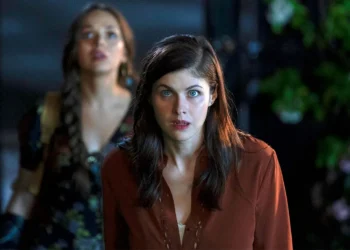
The supporting cast is equally competent but similarly constrained. Alan Ruck brings a weary, world-weary quality to Henry, Milton’s father, while Francesca Faridany provides a grounding, sensible presence as his mother, Fanny. However, it is Alexandra Daddario who shines brightest. As Kitty, she injects the film with its most potent and believable moments. Her portrayal of a woman with a strong moral compass and independent spirit feels authentic, and her chemistry with Wittrock provides the film with its only real spark of life. She elevates her character beyond the archetypal “supportive wife” role, giving the audience a glimpse of the person who truly shaped a legacy.
Behind the Lens
The creative stewardship of this project falls to director Mark Waters, a filmmaker whose career has seen him navigate the highs of Mean Girls and the lows of Bad Santa 2. Here, he seems to have dialed his style to ‘safe’, perfectly adhering to a formula that is more about delivering familiar comfort than challenging his audience. He’s clearly comfortable within the confines of a romantic dramedy format, but he struggles to elevate the material beyond its own sentimentality.
The film’s biggest enemy is its own screenplay, penned by Sharon Paul and Timothy Michael Hayes. It is unapologetically hagiographic, presenting a life story that feels more like a corporate-sanctioned origin myth than a nuanced biography. The dialogue is often clunky and on-the-nose, spelling out the film’s themes in a way that leaves little to the imagination. The decision to portray the invention of the Hershey’s Kiss as a grand romantic gesture is a prime example of the film’s tendency to prioritize saccharine moments over factual accuracy. It’s a cute, crowd-pleasing idea, but it feels disingenuous and deeply simplifies the historical record.
Final Verdict
Hershey is a movie that suffers from an identity crisis. It’s neither a serious, insightful biopic nor a purely fun, escapist romance. It tries to be both and succeeds at neither. By the time the end credits roll, we have a pleasant but ultimately hollow feeling. We’ve learned the highlights of a man’s life, but we’ve been given no real insight into who he was as a person, his flaws, his fears, or the sacrifices he had to make. The film is so focused on polishing every rough edge that it forgets to tell a compelling story.
For those simply seeking a two-hour escape filled with likable actors and uplifting music, Hershey will do the job. However, for anyone looking for a biographical film that offers more depth than the inspirational quotes printed on the inside of a candy wrapper, it will be a major disappointment. It’s a film that looks sweet on the surface but ultimately leaves you with little to chew on.
Hershey is exclusively in theaters starting November 25th.
Also Read:
Angel Studios Reveals First Trailer for “Hershey” Biopic: A Sweet Journey Through Chocolate History