

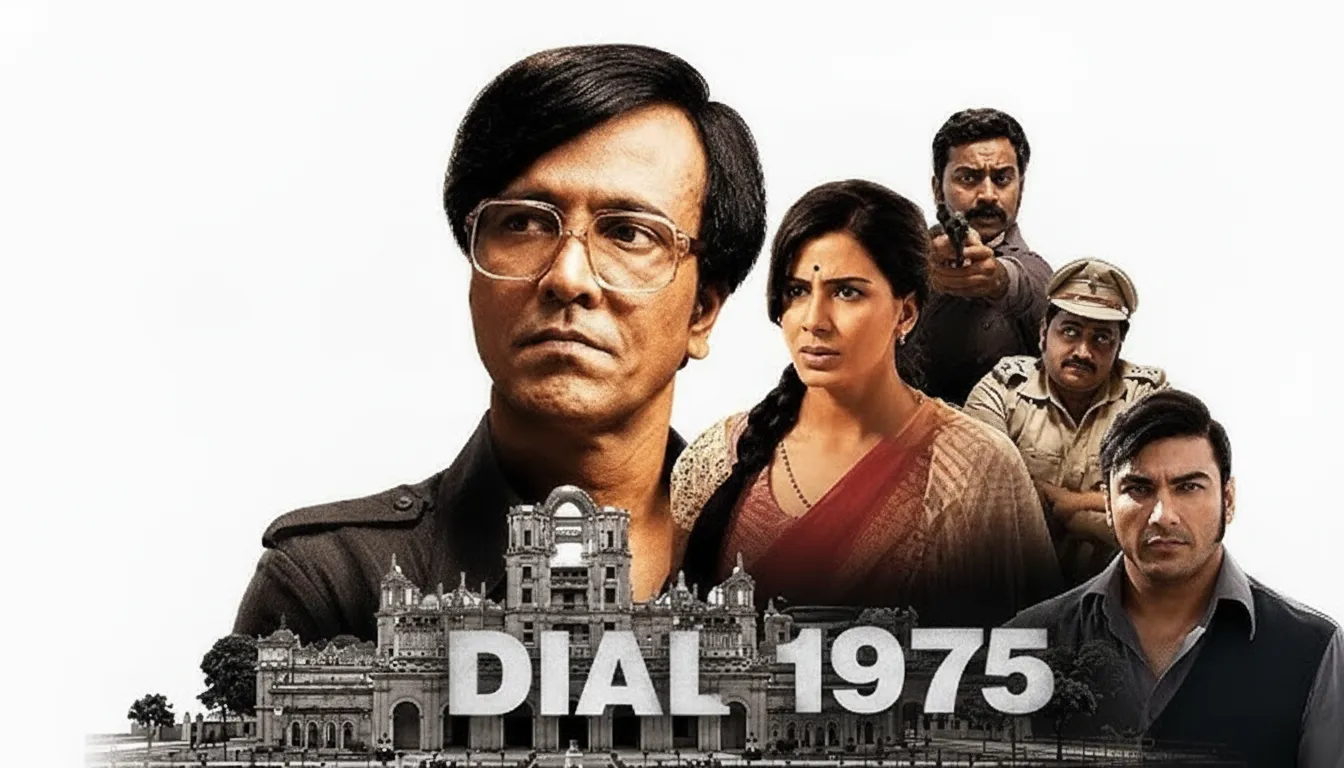
The political tension of India’s Emergency era provides a fertile backdrop for storytelling, and Dial 1975 attempts to harness that atmosphere with a premise centred on a covert wireless telephone. Directed by Navneet Behal and Vibhu Kashyap, the series debuted on WAVES on 21 August and features a solid ensemble led by Kay Kay Menon. While the concept bristles with intrigue, the execution falters under the weight of an overcrowded plot, leaving viewers with a sense of missed potential rather than sustained suspense.
Synopsis
During the Emergency, a senior politician covertly orders a German‑made wireless phone to communicate safely with his allies. When the shipment goes awry, a disparate mix of government officials, criminals, and opportunists become entangled in a frantic scramble to locate both the device and the money tied to the deal. The narrative follows a court‑martialled soldier, a schoolteacher secretly recording conversations, a jailor tasked with retrieving a taped exchange, and a convict released for the mission. As alliances shift and motives surface, the story spirals into a chase that tests loyalties and exposes the paranoia of the era.
Performances
Kay Kay Menon leads as Govind, the disillusioned ex‑soldier whose sudden violence lacks sufficient motivation. Menon brings intensity to the role, but the script leaves his inner turmoil under‑explored, leaving audiences guessing about his true drive. Pravesh Rana, portraying the convict‑turned‑operative Prakash, delivers the most grounded performance; his earnestness shines even when the plot stalls. Kirti Kulhari’s Meena is pleasant but under‑utilized, offering little beyond a supportive presence. Veteran actors such as Lt Tom Alter (Irish), Uday Chandra (Thapar), and Shubham Vardhan (Baansath) perform competently, yet their characters remain peripheral, failing to leave a lasting imprint. Overall, the cast does justice to the material they are given, but the writing does not afford them the depth needed to elevate the film.
Behind the Lens
Navneet Behal and Vibhu Kashyap attempt to capture the claustrophobic atmosphere of the Emergency through period‑accurate set design and costume work, successfully transporting viewers to the mid‑1970s. Cinematography highlights the stark contrast between bustling urban corridors and dim, conspiratorial hideouts. However, the screenplay—over‑complicates a straightforward premise, inserting unnecessary subplots that dilute tension. Editing suffers from abrupt jumps that disrupt narrative flow, causing moments of genuine suspense to dissipate quickly. The decision to employ the wireless phone as a narrating device feels gimmicky rather than insightful, often pulling focus away from character development. In short, while the production values hint at a promising thriller, the directional choices prevent the story from coalescing into a cohesive whole.
Final Verdict
‘Dial 1975’ starts with a compelling premise: a politically charged hunt for a secret communication device during one of India’s most turbulent periods. The film’s strength lies in its evocative setting and the committed efforts of its lead actors, especially Kay Kay Menon and Pravesh Rana. Yet, a meandering screenplay, under‑developed character arcs, and inconsistent pacing keep it from realizing its potential. What could have been a razor‑sharp political thriller ends up as an uneven experience that leaves viewers wishing for a tighter script and more focused direction. For enthusiasts of era‑specific dramas, the film offers occasional flashes of brilliance; for those seeking a sustained thriller, it falls short.