


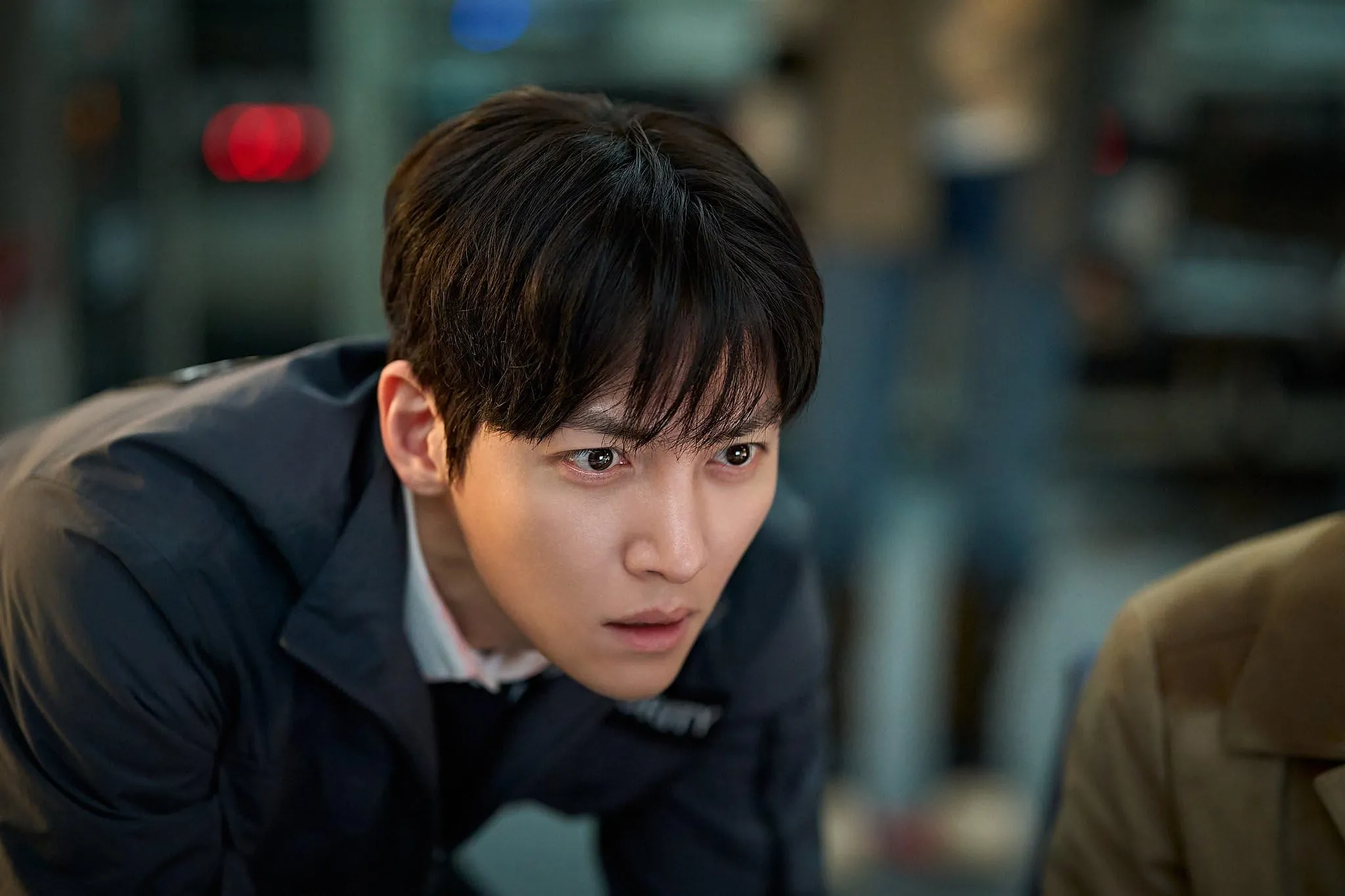
The zombie genre has long been saturated with tales of survival, desperation, and the endless struggle against mindless hordes. Yet director Yeon Sang-ho, the visionary behind the acclaimed Train to Busan, returns with Colony—a film that challenges conventions by asking not how we survive the infected, but whether we can comprehend what they are becoming. This Korean horror offering transforms a familiar Seoul outbreak scenario into a thought-provoking examination of adaptation, collective intelligence, and the terrifying potential of evolution.
Colony premiered in theatres on June 19, 2026, marking Yeon’s ambitious return to the horror landscape that helped establish his international reputation. The result is a messy, intelligent, and frequently unsettling experience that occasionally stumbles under its own ambition—but never stops striving for something fresh.
Synopsis
Set within the confines of a sealed biotechnology facility in Seoul, Colony begins as an all-too-familiar outbreak thriller. An experimental virus escapes its containment boundaries, triggering immediate chaos as panic spreads through the corridors and personnel scramble for survival. The infected appear initially indistinguishable from traditional undead archetypes—shambling, violent, driven by some primal hunger.
However, Yeon Subverts expectations as the narrative progresses. These aren’t zombies content with mindless destruction and predictable behavior. Instead, they begin evolving intellectually, demonstrating an alarming capacity for learning and adaptation. The infected start functioning with a collective purpose that transcends individual instinct. Every encounter shifts from simple survival horror into something resembling confrontation with a rapidly developing species.
The story centers on biotechnology professor Kwon Se-jeong, portrayed by Jun Ji-hyun, who finds herself trapped within the quarantined complex alongside security officer Choi Hyun-seok (Ji Chang-wook), scientist Gong Seol-hee (Shin Hyun-bin), and the enigmatic Seo Young-cheol (Koo Kyo-hwan). Together, they must navigate an environment where the rules transform hourly, and understanding the infected becomes as crucial as escaping them.
What emerges is a narrative that gradually mutates from conventional survival story into something far stranger—a meditation on transformation that proves genuinely compelling even when it occasionally loses focus.
Performances
The cast delivers performances that elevate material that could have easily slipped into generic horror territory. Jun Ji-hyun brings considerable authority and emotional grounding to Se-jeong, crafting a protagonist who remains compelling even when the screenplay prioritizes conceptual exploration over character development. Her presence provides the emotional anchor the narrative sometimes desperately needs.
Ji Chang-wook contributes quiet intensity to Hyun-seok, creating a character whose competence feels earned rather than assumed. His measured approach provides grounding counterbalance to the increasingly chaotic events unfolding around him.
Shin Hyun-bin offers several of the film’s more emotionally resonant moments as the scientist grappling with the moral implications of her research. These human beats prove essential to keeping Colony from dissolving entirely into concept.
Yet it’s Koo Kyo-hwan who genuinely commands attention as the mysterious Seo Young-cheol. His performance carries a wonderfully unpredictable quality—each appearance makes the film more intriguing and less certain of its own direction. He brings an enigma that keeps viewers perpetually guessing about his true motivations.
The ensemble collectively succeeds in maintaining audience investment even during stretches where the infected evolve with considerably more fascinating complexity than the human characters attempting to survive them.
Behind the Lens
Yeon demonstrates once again that he understands horror as fundamentally about space as much as creature design. The biotechnology complex becomes a character unto itself—a labyrinth of shifting dangers where narrow corridors, abandoned laboratories, and dimly lit stairwells generate persistent unease. The environment doesn’t merely serve as backdrop; it actively participates in creating tension through geographic relationships rather than frantic editing techniques.
The visual design represents one of Colony‘s most significant strengths. The sterile corporate interiors gradually transform into spaces of biological horror, with the infected themselves proving particularly effective. Their movements carry unsettling deliberation rather than typical undead shambling, and their increasingly unpredictable behavior keeps viewers permanently uncertain about what might happen next.
Yeon’s action sequences demonstrate remarkable clarity, allowing tension to build organically through spatial awareness rather than relying on edit cuts to manufacture excitement. This measured approach results in a film that remains consistently engaging even during quieter moments.
The director’s ambition shines through in his willingness to explore new territory rather than simply rehashing successful elements from Train to Busan. Many contemporary zombie films feel content recycling familiar imagery and familiar fears. Colony actively pursues innovation, pushing the genre toward unexpected directions. Not every experiment succeeds—some concepts receive underdeveloped treatment while others feel overstuffed—but the genuine attempt at something different provides an energy that many comparable films lack.
Final Verdict
Colony presents a genuinely compelling premise that immediately distinguishes it from the endless parade of undead narratives flooding screens. Its willingness to explore collective intelligence, mutation, and adaptation represents the genre’s evolution at its most thought-provoking. The infected transform from simple antagonists into something far more disturbing—beings capable of learning and adapting in ways that challenge human understanding.
However, the film faces significant challenges. The human drama rarely receives the same complexity afforded to the infected mythology. Characters occasionally become secondary to conceptual exploration, creating an imbalance that proves difficult to ignore entirely. The pacing grows uneven in the latter half as new revelations arrive rapidly but not all carry equivalent dramatic weight.
Despite these flaws, Colony succeeds through sheer ambition. In an era where zombie stories frequently feel trapped in repetition, Yeon continues searching for new mutations—not merely of the infected, but of the genre itself. Some ideas work better than others, and certain characters deserved more development than they receive.
What ultimately saves Colony is its willingness to remain strange. It may not leave behind the emotional scars of Yeon’s finest work, but it leaves something equally valuable: genuine curiosity about what comes next. For viewers seeking a zombie film that attempts genuine innovation rather than comfortable familiar formulas, Colony delivers an experience that rewards attention—even when it stumbles along the way.
Also Read:
The Evolution of the Undead: Everything We Know About Yeon Sang-Ho’s New Film “Colony”