

Blade Runner 2099 arrives as a visually arresting continuation that probes ideas of revolution with uneven gravity. The show flips the script: replicants, once hunted by the LAPD, have ascended to positions of power, and the old victims now wear the badges. The premise initially unsettles; it promises to reveal the mechanics of oppression by reversing them, only to risk becoming a tidy gloss on power’s universality. The series lingers at that edge, asking what victory might mean for beings still bound by the choices of their former masters.
Synopsis
Fifty years after the upheaval that followed Blade Runner 2049, Los Angeles keeps its city silhouette but rearranges its power lines. Human workers endure restrictive labor, potential exile off-world, and a policing force staffed by replicants—the same lineage that once faced persecution now administering the regime. The upheaval appears to have preserved its stationery, yet a sharper historical intuition sits beneath the surface: institutions outlive the ideology that erected them, especially when new beneficiaries discover their utility. The police, the city’s caste divisions, and the people who endured oppression learn to wield the apparatus with unsettling efficiency—perhaps with less retraining than expected.
This is not just a revenge fantasy; it’s a meditation on how systems persist beyond the narratives that birthed them. The twofold lens—Cora’s desperate flight and Olwen’s regulated authority—offers a provocative symmetry that keeps the show’s ideas in play even when the plotting feel lean. The juxtaposition of two women with opposing stakes creates a tension that can verge on allegory, but both performances harness a palpable humanity within the coded framework of their roles.
In a city rebuilt after revolt, a human fugitive, Cora, dodges capture while protecting her ill brother Elias. To vanish, she must pass as a replicant and infiltrate the LAPD to obtain an object that could ferry her out of town. Her ally is Olwen, a Blade Runner with real authority and a limited window before her programmed lifespan ends. One woman fights to stay human; the other wields power over humans but cannot escape mortality. The hunt for an elusive prize drives the narrative, while the characters’ personal mutations illuminate the broader question: what does freedom mean when the instruments of control are now in your hands?
Performances
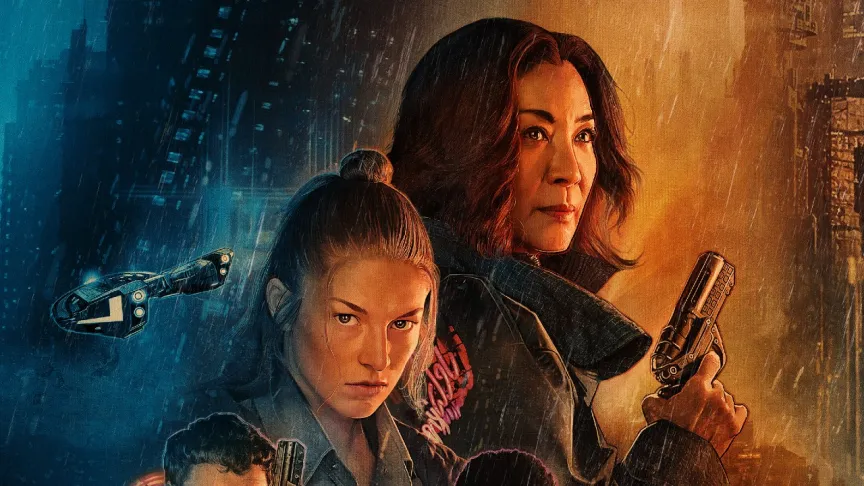
Hunter Schafer embodies Cora with urgent desperation and a compelling counterpoint of restraint. Her early pursuit scenes inject kinetic energy into a role that could have skewed toward cool detachment, balancing emotion with a cool, disciplined facade. Michelle Yeoh, as Olwen, exudes controlled authority tempered by an emergent fragility—fear that seeps into her confidence in deliberate, measured increments. The dynamic between these two leads sustains tension even when the plot thins.
The supporting cast enriches the texture without overloading the central mission. Arguably, the most memorable turn comes from the nuanced portrayal of vulnerability beneath the vigilante exterior, as the show probes how human longing persists under synthetic governance. The continuity of performance craft sustains the atmosphere, even as the narrative occasionally toggles toward inversions that feel more thematic than dramatic.
Behind the Lens
Visually, the series sustains the Blade Runner heritage with a fresh but familiar palette: rain-slick streets, neon hazards, and a daylight that seems harsher and more punitive than in previous chapters. Production design anchors the world in tactile realism. The city’s grime and the claustrophobic interiors echo the earlier films, while new environments—such as an arched memory bank abroad—signal a civilization that preserves experience even as it reorganizes power.
Costuming sharpens identities within the dense frame. Protagonists’ silhouettes—distinctive but complementary—signal their moral alignment and the personal histories they carry. The atmospheric score blends mournful jazz with orchestral layers and synths, underscoring the emotional gravity of scenes that might otherwise rely solely on dialogue. Cinematography favors deliberate framing over rapid cuts, allowing performances to breathe and the setting to contribute as a character in its own right.
The direction emphasizes the paradox at the heart of the premise: a revolution that keeps the machinery intact. This tension is echoed in the pacing, which often prefers measured investigation over decisive breakthroughs. While the world-building remains persuasive, the storytelling occasionally leans into a preservation of the original’s look as a substitute for fresh ideas, risking a lull in momentum as the mystery unfolds.
Final Verdict
Blade Runner 2099 delivers a striking meditation on revolution’s afterlife: a world where former oppressed subjects become the enforcers, yet the old standards of personhood now trade as commodities. The strongest contributions come from its central performances and its lavish, immersive production design, which together sustain an atmosphere of elegiac, haunted possibility. Michelle Yeoh and Hunter Schafer invest their roles with emotional weight that reaches beyond the plot’s occasional fragility, ensuring the core tension—whether humanity persists when the definition of life is redefined—remains palpable.
Where the series stumbles is in its plotting, which sometimes relies on familiar beats and a few too-convenient reversals. The middle act can feel episodic, pulling away from the political stakes to chase a sequence of revelations that don’t always illuminate the regime so much as illuminate the mechanics of investigation. A more rigorous exploration of the political economy behind replicant existence and the social histories of characters like Greta or Elias might have deepened the resonance. The finale, while emotionally cathartic, leans on a neat intervention that leaves certain threads underexplored and certain ethical questions underexamined.
Nevertheless, Blade Runner 2099 remains an impressive continuation—visually sumptuous, conceptually provocative, and emotionally attentive. Its most compelling achievement lies in tracing a paradox: a revolution that preserves the machinery of oppression while narrowing the distance between the rulers and the ruled. In that sense, the show’s ambition outlasts its occasional narrative hesitations. It asks big questions and, for a time, answers with atmosphere, character texture, and a haunting sense of what it means to want to live under a rule you helped to overthrow.