

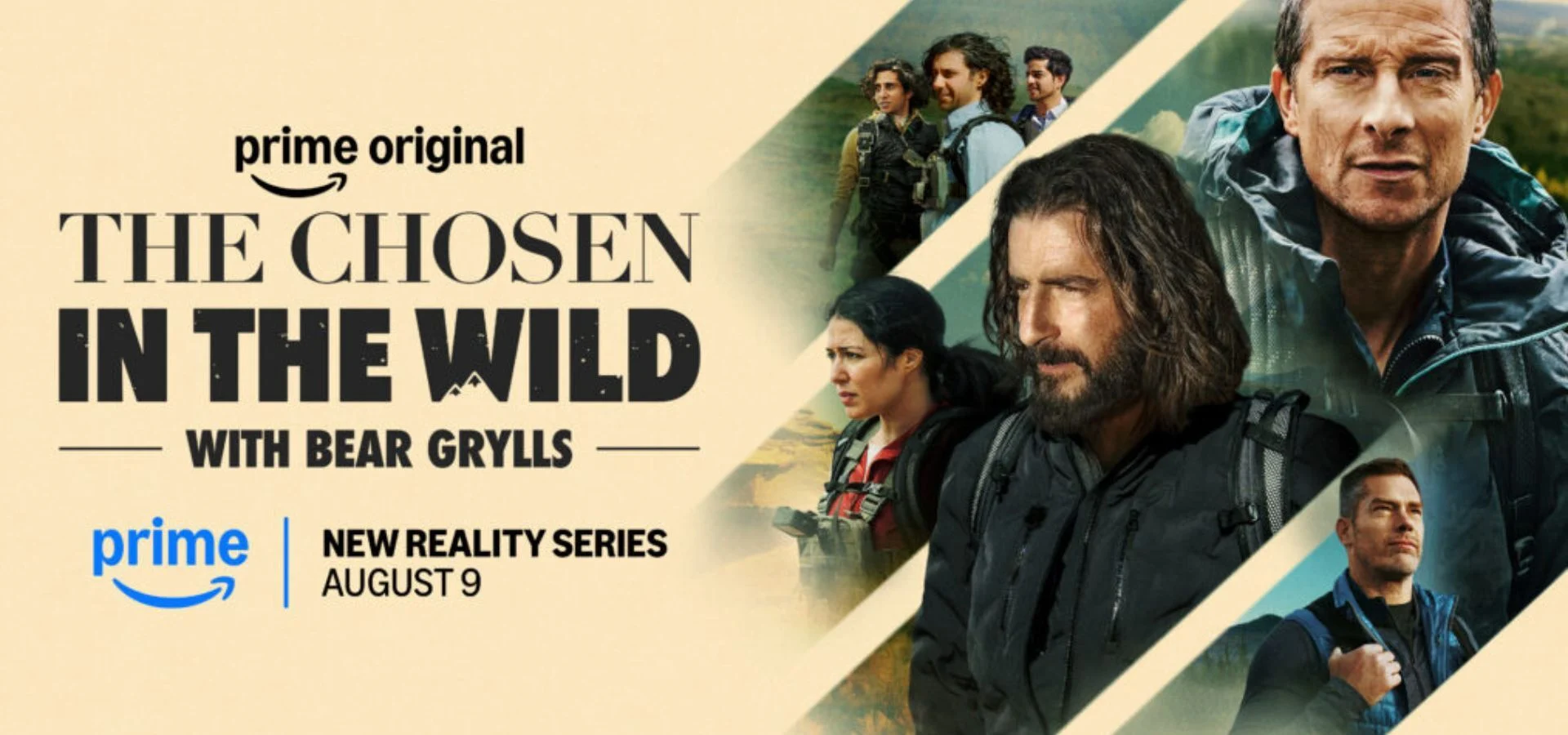
Imagine taking a group of actors beloved for portraying figures of unwavering faith and stripping away their meticulously crafted scripts, their social safety nets, and the familiar comforts of a film set. Now, place them face-to-face with the raw, untamed wilderness alongside one of the world’s most formidable survival experts. This is the audacious premise of The Chosen in the Wild with Bear Grylls, a Prime Video series poised to redefine both adventure television and faith-based entertainment.
Premiered on August 9, 2026, with all six episodes available at launch, this series promises an unprecedented look at the human spirit when conviction is tested not by dialogue, but by sheer will and physical endurance.
A Radical Departure from the Familiar
For five years, Jonathan Roumie has captivated audiences as a man personifying unshakeable certainty in The Chosen, a record-breaking crowdfunded drama. His portrayal has resonated deeply, offering comfort and answers to millions. Yet, as Bear Grylls guides him to the precipice of a Utah cliff, the ability to quote scripture or embody a character’s resolve takes a back seat to a primal decision: to step, or not to step. This pivotal choice forms the bedrock of the entire show.
The Chosen in the Wild with Bear Grylls strategically plucks ensemble members from the most-watched crowdfunded drama ever made and meticulously removes the very element that makes them recognizable: the script. Over six compelling episodes, Grylls immerses a single cast member at a time into the rugged American backcountry, challenging them with his signature gauntlet of feats. From skydiving to rock scaling, ziplining across canyons, and even confronting the prospect of consuming insects, the survival aspect is undeniably real. However, the true genius of the series doesn’t lie in the danger itself, but in what the danger reveals.
The Unveiling: One Guest, One Journey
The brilliance of this production hinges on a singular structural decision: dedicating each episode to one guest. This isn’t a typical celebrity stunt where stars engage in casual banter on a ropes course before cutting away to avoid genuine introspection. Instead, each hour-long segment isolates an individual – Jonathan Roumie, Paras Patel, Elizabeth Tabish, Noah James, Luke Dimyan, and even series creator Dallas Jenkins – granting Grylls the entire runtime to meticulously chip away at their practiced personas.
Alone in a desolate canyon, an actor has no ensemble to blend into, no director to guide their performance, and no character to hide behind. Bear Grylls, known for his relentless pursuit of authenticity, is deeply interested in the raw, unguarded statements that only emerge when a person is physically exhausted and emotionally vulnerable. This format is expertly designed to elicit precisely such moments. By dismantling the ensemble dynamic, the show strips away the social facade that allows performers to remain in character even between takes. This subtle yet profound “violence of design” leaves them exposed. On a traditional set, an actor is supported by colleagues, crew, and a defined role. On a windswept cliff face with only a host and a camera, the role has nowhere to reside. The series doesn’t demand a performance of faith; it probes what its guests genuinely feel when their footing disappears, and crucially, it keeps the cameras rolling.
Beyond Performance: Unearthing True Conviction
Beneath the thrilling stunts, Grylls crafts each hour with a consistent objective. As the physical challenges unfold, he artfully draws out each guest’s personal narrative and their unique perspective on the character they embody. This interaction is the true revelatory “tell.” The show’s core curiosity isn’t whether Jonathan Roumie can execute a perfect rappel. It’s about what a man discovers within himself after five years of being perceived as an almost hallowed figure. The arduous physical task serves as a powerful catalyst; the intimate conversation on the precarious ledge is the ultimate payoff.
This is where the dimension of faith transcends mere marketing and becomes a profound subject of inquiry. While much of the series’ initial discussion might focus on its implications for believers, the more precise insight is mechanical. The Chosen asks its performers to embody conviction for eight hours a day – to portray individuals whose defining characteristic is their absolute lack of doubt. The unforgiving wilderness, however, poses a more fundamental question: how much of that conviction is truly their own? The chasm between these two demands constitutes the entire program. Grylls, who openly shares his own faith, isn’t there to simply affirm or validate. He is there to push boundaries until that affirmation either solidifies or fractures, and to capture the unfiltered result on film.
The Wilderness as a Mirror: Terrain as a Test
Grylls employs the environment itself as an instrument of revelation, selecting terrains not for their generic beauty, but for their specific and varied hazards. He utilizes named, distinct landscapes – Castle Valley and Canyonlands in Utah, the Ausable River, the Colorado River, the Great Basin Desert, the Adirondack Forest – understanding that each offers a unique form of pressure. A surging river tests resilience differently than a sheer cliff face, or the scorching heat of an open desert. Each distinct landscape applies a different pressure, shaping the episode around which challenge unearths a particular aspect of the individual. The editorial choices interpret the guests through the very ground they are placed upon.
Strategic Casting, Deeper Insights
The casting choices amplify this inherent curiosity. Luke Dimyan plays Judas, a character whose destiny is betrayal; watching the actor behind that portrayal precariously hang from a rope, with a host who will not allow him to perform his way out of the situation, poses a compelling question. Elizabeth Tabish embodies Mary Magdalene, a figure defined by redemption from her darkest self; the desert, in its own impartial way, offers a stark perspective on who is truly rescued. Paras Patel (Matthew) and Noah James (Andrew) each carry distinct relationships to belief, while Dallas Jenkins, the architect of The Chosen, must step from behind the camera he typically commands and confront the wild directly. The wilderness, after all, cares little for hierarchy.
This approach imbues the season with a sophisticated internal architecture that conventional celebrity-driven formats often lack. Running Wild with Bear Grylls, its conceptual predecessor, thrived on showcasing unrelated A-listers grappling with challenging environments. The Chosen in the Wild with Bear Grylls inverts this logic: one interconnected ensemble, one overarching thematic throughline, and six distinct variations on a singular, profound question. The actors already know each other, and the audience is intimately familiar with their characters. This allows the show to bypass lengthy introductions and immediately delve into the “seam” – the fragile connection point where the actor and their role are stitched together, and where fatigue and altitude begin to unravel that delicate bond.
Bridging Audiences, Redefining Fame
The implicit contract this series forges with its two primary audiences is more nuanced than either might initially anticipate. To its dedicated faith-based viewers, it promises inspiration. To the adventure-seeking Grylls fanbase, it guarantees thrills. What it ultimately delivers, however, resides in the space between these expectations, belonging fully to neither: the raw, unscripted moment a performer, known for portraying certainty, visibly runs out of it, on camera, with a daunting drop below. This is neither a devotional moment nor merely a stunt. It is a profound character beat, precisely the authentic revelation the format was subtly engineered to achieve.
It is crucial to remember the context of The Chosen itself. It stands as the most-watched crowdfunded scripted series ever created, financed directly by its viewers, distributed predominantly through its own app and theatrical releases, and followed with an intensity that many mainstream dramas never achieve. Its cast members aren’t tabloid fixtures; they are revered personalities to a specific, devoted audience who hold their characters sacred. This unique form of fame is precisely what the wild is adept at deconstructing.
For Prime Video, this acquisition represents a strategic move to engage an audience that has largely operated outside the traditional mainstream streaming ecosystem. The Chosen built its enormous following through its proprietary app and special theatrical events, largely independent of the platform wars that defined the last decade. Now, Amazon MGM Studios is channeling this dedicated following through a global storefront, treating a faith-based property as a mainstream acquisition target rather than a niche offering. The series will launch across the United States, Canada, Australia, New Zealand, Latin America, the United Kingdom, and Sub-Saharan Africa. The underlying wager is that the compelling crossover between a survival format and a faith-driven drama can reach beyond the existing confines of both fan bases.
Consistent Vision, Profound Study
Robert Austin Vanover directs all six episodes, ensuring a powerful consistency in the season’s perspective from one guest to the next. His approach demonstrates the same patient willingness to allow silence to unfold and to let a climb continue long enough that it ceases to be merely about the physical ascent. This consistency is vital in a format as exposed and vulnerable as this. A rotating director each week might have reduced it to a mere succession of stunts; instead, a single directorial vision elevates it to a profound character study.
The question that the show bravely opens, and ultimately leaves for the viewer to ponder, is a deeply honest one. Does conviction, meticulously crafted for a camera, hold any true weight when the camera itself is the only constant? Grylls can guide an actor to the summit of a rock face. But he cannot tell the viewer whether the words uttered at that height belong to the character or to the person carrying the rope. The wild efficiently strips away the script. It does not, however, simply hand you the untainted truth beneath. It merely illuminates where the seams once lay, and then it challenges you to discern for yourself what you have truly witnessed.