

The Hallmark Channel continues to delight mystery enthusiasts with its beloved Hannah Swensen franchise, delivering another satisfying installment that proves why this series has captured the hearts of viewers for over a decade. The fourteenth entry, Best Served Cold: A Hannah Swensen Mystery, premiered on May 16, 2026, bringing audiences back to the quaint fictional town of Lake Eden, Minnesota, where pastry meets prosecution in perfect harmony. The film made its streaming debut the following day on the Hallmark+ platform, ensuring that fans could conveniently access this latest culinary whodunit from the comfort of their homes. This particular installment marks a intriguing departure from the series’ traditional small-town cozy mystery format, embracing a more structured legal procedural framework that adds depth and tension to Hannah’s investigative pursuits.
What makes this franchise entry particularly compelling is its willingness to evolve while maintaining the essential elements that fans have come to adore. The balance between Hannah’s baking business and her investigative endeavors has always been the soul of these adaptations from Joanna Fluke’s literary series, but Best Served Cold introduces a more pronounced legal dimension that elevates the storytelling beyond typical cozy mystery conventions. The production demonstrates that the franchise can successfully incorporate procedural elements without sacrificing the warmth and accessibility that defines the Hannah Swensen universe.
Synopsis
The narrative thrust of Best Served Cold begins with the unexplained disappearance of Lucas Straub, a prominent prosecutor whose sudden vanishing creates immediate complications within Lake Eden’s legal community. This absence places significant pressure on District Attorney Chad, Hannah’s romantic partner, who must navigate the political and emotional fallout of a high-profile missing persons case that quickly takes darker turns. Hannah’s investigative instincts activate almost instinctively, and she teams up with her mother to follow the trail left behind by the missing prosecutor.
The investigation evolves into something far more complex when it becomes intertwined with a courtroom drama concerning Mitzi Jacobson, a woman accused of orchestrating an elaborate forgery scheme centered on counterfeit Civil War gold coins. The screenplay masterfully connects the disappeared prosecutor to the murdered con artist, creating a legal and moral mechanism that drives the narrative forward with compelling momentum. As Hannah digs deeper, she finds herself receiving anonymous death threats specifically demanding that she abandon the case, transforming her pursuit of justice into a matter of personal survival.
The stakes extend beyond professional obligation when anonymous threats target Hannah directly, forcing her to balance civic responsibility against immediate personal danger. This element introduces an existential dimension to the mystery, raising questions about free will and moral courage under pressure. The ticking clock of the trial, combined with the physical threats against our protagonist, creates a tension that propels the story through its runtime with satisfying efficiency.
Performances
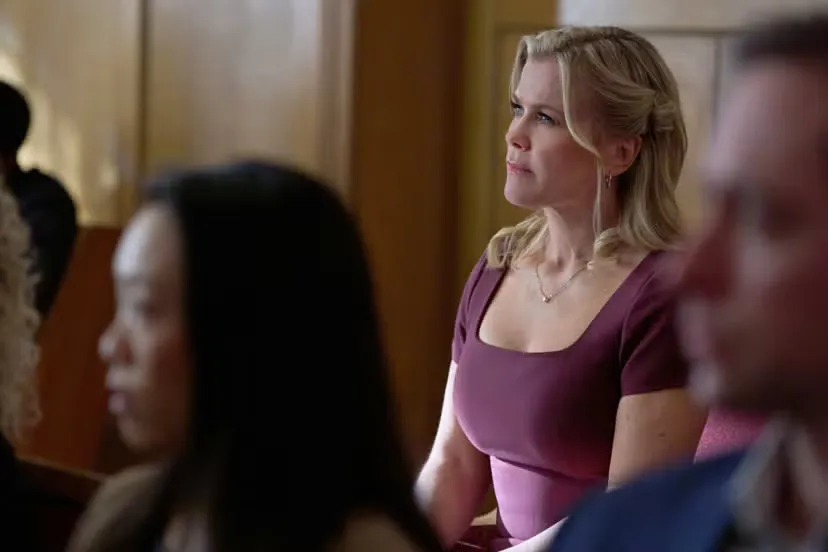
Alison Sweeney continues to embody Hannah Swensen with remarkable consistency, demonstrating why she has become synonymous with this character over the franchise’s extensive run. Her dual role as both star and screenwriter on this production adds an additional layer of authorship that permeates the character work throughout. Sweeney’s understanding of Hannah’s methodology shines through in every scene, particularly in how the character approaches danger through systematic pattern recognition rather than emotional reactivity. This measured approach to characterization gives Hannah a distinctive investigative voice that separates her from other fictional detectives while maintaining the accessibility that cozy mystery audiences require.
Victor Webster’s portrayal of Chad receives notably expanded treatment in this installment, allowing the character to move beyond his traditional narrative position as Hannah’s romantic interest and into the moral machinery at the heart of the story. The film dedicates meaningful screen time to exploring the private psychological reasons behind Chad’s well-documented refusal to eat Hannah’s celebrated baked goods, adding unexpected emotional vulnerability to their relationship dynamic. This character development humanizes Chad in ways that strengthen his function within both the legal drama and the personal narrative threads.
Barbara Niven’s performance as Delores Swensen injects welcome energy into the proceedings, bringing an eccentric charge that cuts through the heavier dramatic material. Her character evolves from mere comic relief into an active investigative participant, conducting undercover surveillance operations to locate counterfeit minting plates before shifting into theatrical witness-stand mode during the trial sequences. Niven manages to balance theatrical flourishes with authentic maternal instinct, preventing Delores from becoming a one-dimensional caricature and instead creating a character whose presence enriches every scene she inhabits.
The supporting ensemble delivers variable contributions, with Sheriff Ron Ealing and Detective Lonnie providing stoic dependability to the official investigation threads. However, familiar faces like Sister Michelle and bakery assistant Lisa receive considerably thinner treatment, functioning primarily as decorative elements within the compressed psychological field of the narrative. This uneven distribution of character attention represents one of the film’s minor shortcomings, as the compressed runtime seems to prioritize the central legal drama over the broader community dynamics that typically enrich the franchise.
Behind the Lens
Director Peter Benson brings a deliberate directorial philosophy to Best Served Cold that distinguishes it from more kinetic approaches to mystery storytelling. His preference for measured pacing over rapid-fire editing aligns the production with traditional detective fiction conventions, allowing conversations to breathe and dialogue to serve as the primary instrument of suspense rather than relying heavily on visual tricks or action sequences. This approach requires patience from viewers accustomed to modern thriller editing rhythms, but rewards those who appreciate the methodical accumulation of clues and character insights.
The visual design philosophy embraces pristine brightness in place of noir’s traditional chiaroscuro, effectively transforming the shadow grammar of thriller cinematography into what might be described as sanitized domestic glow. This aesthetic choice carries thematic significance, suggesting a noir sensibility that has been thoroughly wipe-clean for Hallmark’s family-friendly audience. The courtroom settings provide opportunities for controlled claustrophobia, as Benson uses the rigid architectural lines of legal chambers to narrow emotional space and concentrate narrative tension.
The production’s treatment of culinary elements deserves particular attention, as the camera composition frequently privileges hyper-real beauty shots of Hannah’s baked creations. Blueberry lavender panna cotta, lemon whippersnappers, morning glory muffins, and butterscotch marshmallow cookies punctuate the criminal investigation like edible punctuation marks, anchoring the film’s comfort aesthetic while providing visual counterweight to the darker narrative material. These close-ups serve both atmospheric and thematic purposes, grounding the legal drama within the domestic sphere that defines Hannah’s world.
The approach to violence remains clinically restrained, with the body appearing as a clinical fact rather than grotesque spectacle. Bright color palettes contain potential dread, while sound design and pacing guide audience perception through careful restraint rather than shocking confrontation. The film builds its tension through deduction, witness interviews, and orderly inference rather than graphic intensity, creating a world where violence enters, gets cataloged, and is gradually subdued by logic, social observation, and the reassuring presence of fresh-baked goods.
Final Verdict
Best Served Cold: A Hannah Swensen Mystery succeeds as an evolution of the franchise that maintains its essential character while embracing more ambitious narrative structures. The integration of legal procedure with traditional cozy mystery elements creates a hybrid that should satisfy both hardcore procedural fans and casual viewers seeking comfortable entertainment with genuine dramatic stakes. The courtroom sequences provide welcome change of pace from the standard small-town questioning that defines earlier installments, even if some supporting characters suffer from reduced screen time.
For dedicated viewers of the franchise, this installment offers sufficient novelty to justify engagement while respecting the established formula that has proven successful over thirteen previous entries. For newcomers, Best Served Cold serves as an accessible entry point that does not require extensive prior knowledge of the series’ accumulated history. The film ultimately delivers exactly what its audience expects: a satisfying mystery wrapped in bakery warmth, with enough procedural innovation to keep the formula fresh after all these years.