

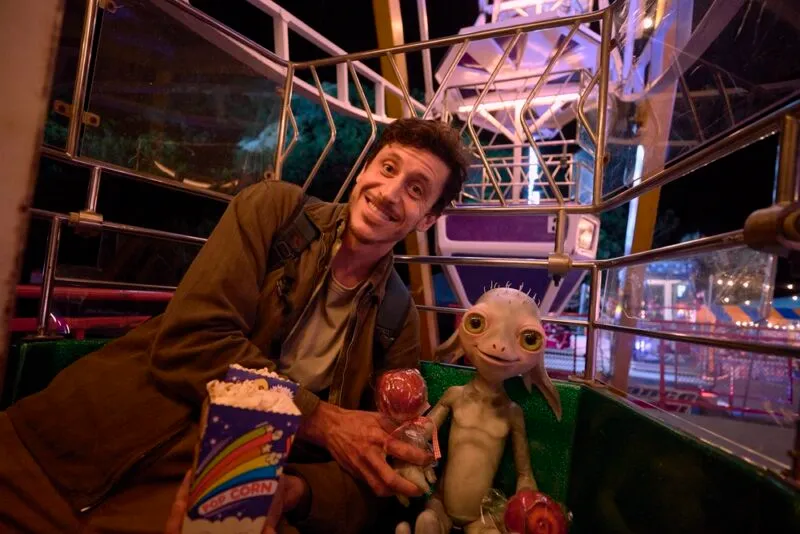
Ludo Studio has built a reputation on colorful, heartfelt animation, most notably through the global phenomenon Bluey. With Allen, the Australian company steps into live-action territory for the first time, delivering a 105-minute family fantasy co-directed by Daley Pearson and Jeffrey Walker. The film arrives on Netflix carrying the weight of that pedigree, asking audiences to embrace a story about a grown man still waiting for the childhood alien friend who once vanished into the sky. It is a premise brimming with emotional potential, even if the execution occasionally fights against its own charm.
Synopsis
Allen follows Petey, a young boy on the Queensland coast who befriends a small extraterrestrial visitor. After sharing snacks, games, and a promise to stay together forever, the creature known as Allen disappears in a beam of light, leaving behind a ring-shaped scar on Petey’s palm. Two decades later, Petey remains stuck in the past, living in his brother’s home and scanning the stars for a sign. When Allen finally returns, the reunion forces Petey to confront whether clinging to childhood magic is a gift or a life sentence.
Performances
TJ Power anchors the adult version of Petey with a convincing blend of goofy humor and quiet melancholy. He carries the film’s emotional core well, making Petey’s arrested development feel sympathetic rather than merely frustrating. Charlotte Nicdao and Josh Helman provide real warmth as Petey’s brother and sister-in-law, offering a grounded counterweight to the whimsy. Their exasperated affection keeps the human relationships believable.
Benedict Hardie appears as local police chief Rory, though the role feels like a stock antagonist dropped in from a different production. The non-human performance belongs to Allen himself, realized through a mix of physical puppetry and digital effects. The creature’s expressive eyes and soft vocalizations carry much of the early charm, even if the writing rarely gives the character depth beyond cute.
Behind the Lens
From a technical standpoint, Allen is a triumph for Ludo Studio’s live-action ambitions. The creature design blends practical puppetry with CGI so seamlessly that the actors appear to be performing opposite a living being. The opening act bathes Queensland in a warm, dreamy glow, packed with 1990s nostalgia—bedroom shelves crammed with toys, a folder of Tazos, and a stash of Cheezels—that invites viewers to remember being nine years old again. Visually, however, the color palette is pushed so high that some sequences look glossy and artificial, undercutting the handmade appeal of the creature work.
The script represents the film’s biggest stumbling block; emotional moments are stated outright and then repeated, leaving little room for the audience to discover feeling on their own. The second half grows darker and stranger than the cheerful marketing implies, showing narrative nerve even when the execution turns clumsy. The conclusion wraps things up neatly while leaving the door ajar, resulting in a finale that earns more smiles than shrugs.
Final Verdict
Allen is a sweet, uneven, sincerely made oddity. Its creature effects and nostalgic details justify the price spent on streaming, and TJ Power’s central performance holds the human side together. Yet heavy-handed dialogue and an over-explained emotional arc keep the film from reaching true greatness. A lighter touch with the writing would have turned this into something special. For general viewers seeking a family-friendly sci-fi curio with heart, Allen delivers enough warmth to recommend, even if it stumbles along the way.