


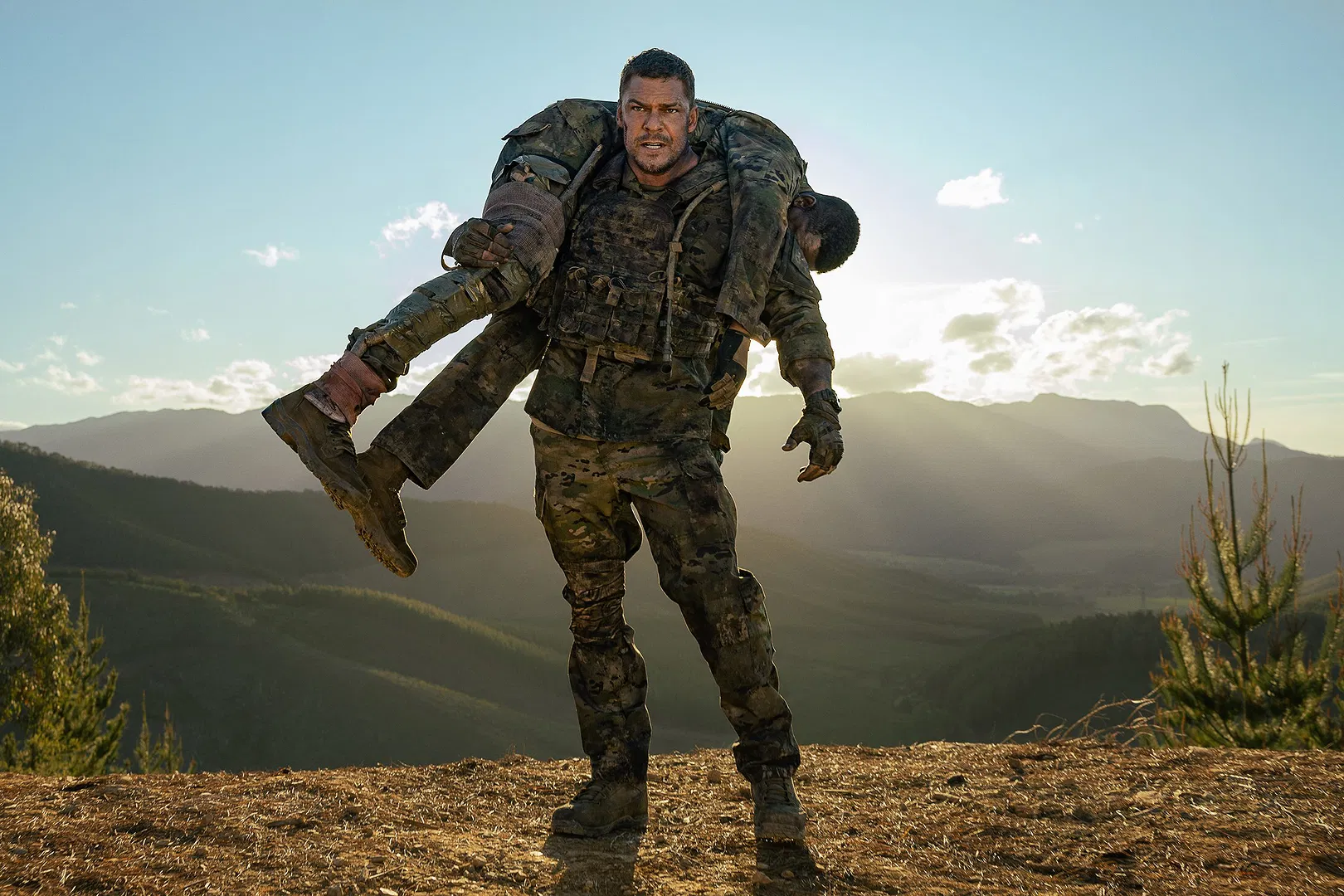
Netflix has debuted its latest high-concept actioner, War Machine, a film that enters the streaming library with minimal fanfare but a promising “man vs. metal” premise. Directed by Patrick Hughes—who continues his collaboration with the platform following The Man from Toronto—the film offers a gritty, sci-fi reimagining of the classic B-movie survival kit. Co-written by Hughes and James Beaufort, the project leans heavily on the physical prowess of its lead, Alan Ritchson, setting the stage for a relentless battle against an extraterrestrial threat.
Story
The narrative logic of War Machine is refreshingly, if not dangerously, simple: a group of specialized soldiers encounters a massive, lethal alien machine and must survive its onslaught. The film immediately adopts a breakneck pace, thrusting viewers into visceral combat sequences that emphasize raw chaos over tactical finesse. While the core concept of a lone warrior facing a mechanical titan has inherent pulp appeal, the script fails to flesh out the world. We are given zero lore regarding the machine’s origins or motivations. This lack of context transforms what could have been a gripping sci-fi epic into a predictable series of tropes that feel all too familiar to the genre.
Performances
Even with a seasoned lead like Alan Ritchson, the human element of War Machine feels strikingly hollow. Known for his tactical charisma in other roles, Ritchson is relegated here to brute force and sprinting. His character—referred to only by a number—lacks the emotional depth needed to make the audience care about his survival. This “numbered” naming convention, likely intended to feel gritty and dehumanized, only serves to alienate the viewer.
Supporting veterans Jai Courtney and Dennis Quaid are unfortunately sidelined, appearing in roles that offer little room for character development or memorable dialogue. They function more as plot devices than people, leaving the emotional stakes feeling flat throughout the nearly two-hour runtime.
Behind the Lens
Technically, War Machine is a mixed bag. The editing in the first half is remarkably sharp, maintaining a high-intensity rhythm that keeps the momentum from sagging. Patrick Hughes clearly understands how to frame kinetic action, and for the most part, the visual effects give the alien machine a terrifying, tangible presence. However, the film’s quality is inconsistent. The VFX occasionally falter, breaking the immersion, and the direction lacks a distinct visual identity, often feeling like an interchangeable “Netflix Original” product. Clocking in at nearly 120 minutes, the film suffers from a bloated second half that could have been significantly improved by a tighter 90-minute cut.
Final Verdict
War Machine is a functional, high-adrenaline distraction that provides exactly what the trailer promises: Alan Ritchson fighting a robot. However, it lacks the soul, story, and character growth required to transcend its generic roots. While it satisfies a craving for raw action, its “disposable entertainment” nature means it will likely fade into the depths of the Netflix algorithm as quickly as it arrived. It’s not a total failure, but it is a missed opportunity for something truly unique.