


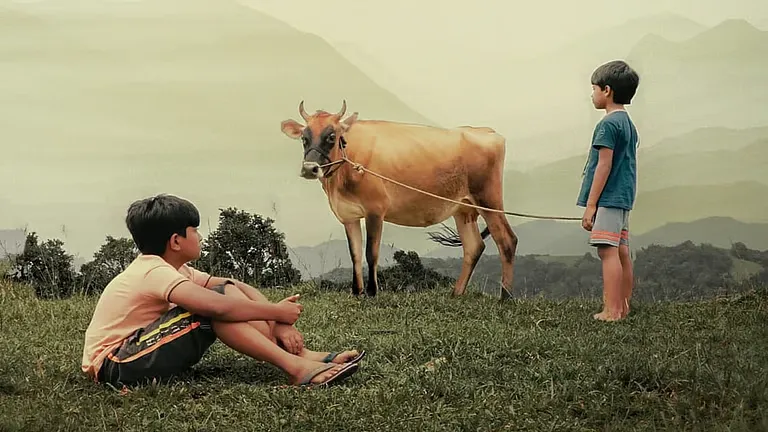
Sutan Gowda’s Valavaara, a Kannada language film released in theatres on January 30, is not a conventional coming-of-age tale. It sidesteps melodrama and moral lessons to present something far more intimate—a child’s experience of growing up in a world quietly tilted by partiality. With a story, screenplay, and dialogues all penned by Gowda himself, the film immerses viewers in the emotional climate of a small rural family where love, fear, and bias coexist without clear boundaries.
Story
The film opens on a startling image: a man tied to a tree, consumed by rage, only for the scene to dissolve into a terrified child waking from a nightmare. This dramatic shift sets the tone—authority comes before comfort, and fear precedes understanding.
We soon meet Kundeshi (Vedic Kaushal), the elder of two brothers, who becomes our emotional anchor. He prefers the affectionate name his mother calls him, a small but meaningful act of self-assertion. His younger brother Kosudi (Shayan) shares an easier bond with their father, something Kundeshi quietly resents but never confronts directly.
Through ordinary moments—a street cricket match, hand-me-down clothes, and late-night money counting—Gowda paints a vivid mosaic of domestic life. The family’s dynamics are revealed not through dialogue-heavy confrontations but through repetition and silence. The mother (Harshitha R Gowda) often positions herself between husband and son, absorbing emotional shocks that ripple through the household.
The story takes a turn when Gowra, the family’s pregnant cow, becomes Kundeshi’s emotional refuge. His care for her mirrors his craving for fairness and affection. When the cow goes missing, the film shifts from gentle observation to raw panic. What unfolds is not a suspenseful chase but a painful unraveling of a child’s helplessness in the face of adult realities—money troubles, failed plans, and delayed help.
Performances
The emotional power of Valavaara lies in its performances. Vedic Kaushal delivers a deeply internalized portrayal of Kundeshi—his silence speaks volumes, his gaze revealing fear, anger, and longing all at once. Shayan, as Kosudi, embodies innocence and privilege without exaggeration.
Harshitha R Gowda gives the mother a quiet dignity, balancing tenderness with exhaustion, while Malathesh H V, as the father, captures how favoritism can exist without deliberate cruelty. Abhay S, playing Yadukumar, brings youthful realism to his scenes, offering a glimpse of a world just outside Kundeshi’s.
Behind the Scenes
Sutan Gowda’s direction thrives on restraint. Instead of dramatic highs and lows, he chooses natural rhythms of rural life. The cinematography captures textures of mud lanes, fading sunlight, and lived-in homes, creating an atmosphere that feels both poetic and grounded.
The background score stays unobtrusive, allowing emotions to emerge organically. Each technical choice—lighting, framing, pacing—serves the film’s central idea: that inequality in affection is not always dramatic but deeply embedded in everyday gestures.
Final Verdict
In its closing moments, Valavaara resists conventional closure. A birthday is celebrated without a cake, a cow gives birth, and lost money is found—yet life remains imperfect. The emotional resolution comes not from joy but from the painful clarity of a mother’s words.
Gowda’s film reminds us that partiality is not always born of cruelty—it often hides in ordinary acts of love distributed unequally. By choosing observation over moralizing, Valavaara gives voice to the quiet ache of a child learning how unfair love can sometimes be.
Valavaara is a deeply felt, beautifully acted meditation on childhood, love, and the invisible lines that divide families.
Rating: ★★★★☆ (4/5)