

Set against the paralyzing backdrop of 1937 Soviet Russia, Sergey Loznitsa’s Two Prosecutors emerges as a devastating examination of institutional decay wrapped in bureaucratic absurdity. Co-written with Georgy Demidov and adapted from Demidov’s novel, this political satire dares to locate dark comedy within the machinery of totalitarian evil. While the subject matter—encompassing state torture, manufactured confessions, and the NKVD’s systematic brutality—demands solemnity, the film’s true horror lies in the maddening mundanity of administrative delay. The narrative suggests that fighting fascism often means first navigating an endless labyrinth of waiting rooms.
Story
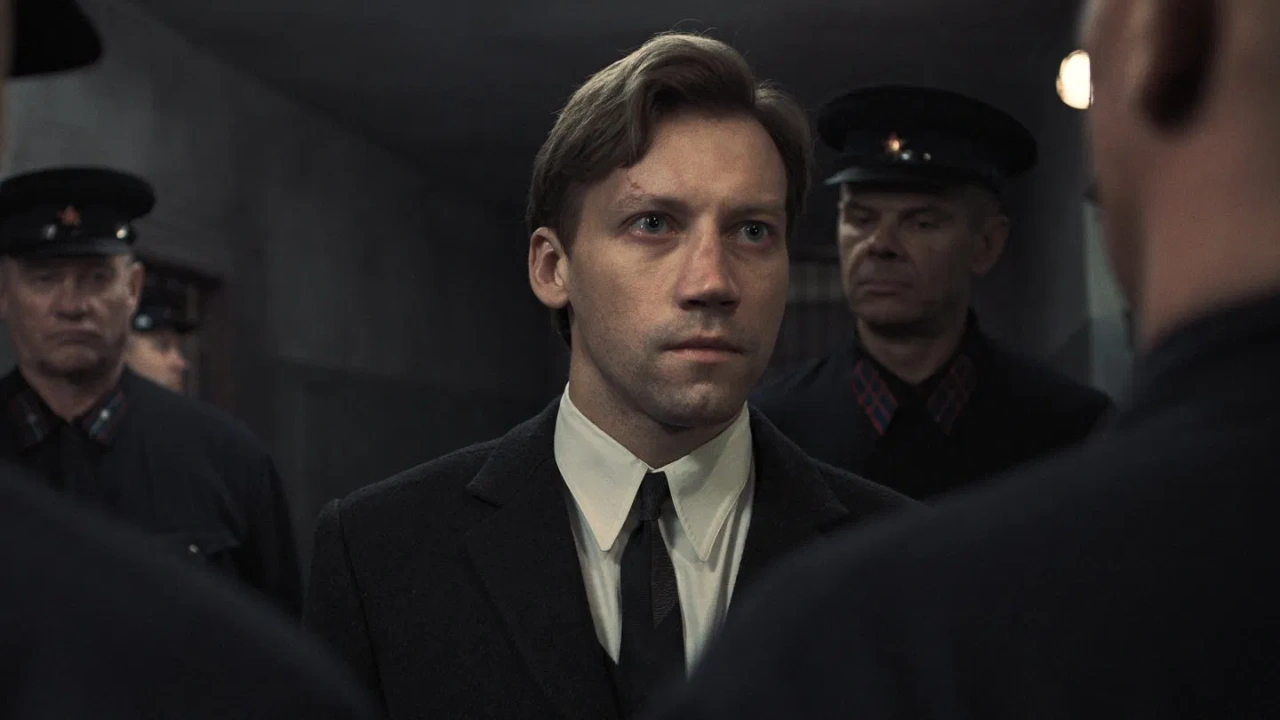
The narrative follows Artyom Kornyev, portrayed by Alexander Kuznetsov, a newly minted prosecutor who stumbles upon an explosive letter from a Bryansk prisoner named I.S. Stepnyak. This correspondence exposes rampant corruption within the secret police, prompting Kornyev to investigate the Bryansk penitentiary personally. Upon arrival, he encounters what the guards sinisterly designate as “the special block”—a dilapidated, unsanitary sector where Stepnyak languishes. Immediately, Kornyev finds himself trapped in an elaborate dance of procedural obstruction. Prison authorities engineer countless delays, forcing him through a labyrinth of corridors and closed doors simply because they possess the power to do so. Undeterred, Kornyev employs patience as his weapon, gradually penetrating deeper into the facility’s bowels. His persistence eventually yields a face-to-face meeting with Stepnyak, magnificently embodied by Aleksandr Filippenko, who reveals the harrowing truth about coerced confessions extracted through torture. What follows is Kornyev’s Sisyphean attempt to transport this evidence to Moscow’s Prosecutor General, a journey impeded by every conceivable bureaucratic technicality imaginable.
Performances
Alexander Kuznetsov anchors the film with remarkable restraint, communicating volumes through silence and subtle facial expressions. His portrayal captures the quiet terror of confronting impossible institutional barriers, particularly in moments where his eyes alone convey a volatile mixture of righteous anger and primal fear. Aleksandr Filippenko, though limited to roughly twenty minutes of screen time, delivers an unforgettable turn as the broken but dignified Stepnyak, embodying the human cost of red fascism with devastating authenticity. Anatoliy Beliy and Dmitrijus Denisiukas round out the principal cast, contributing to the oppressive atmosphere that suffocates every frame.
Behind the Lens
Cinematographer Oleg Mutu transforms visual stasis into psychological torment, utilizing locked-down, claustrophobic framing that mirrors the protagonist’s confinement. Each static shot deliberately restricts the viewer’s field of vision, creating a sense of entrapment that parallels the prisoners’ suffering. The recurring motif of prison bars opening and closing serves as a bitter metaphor for justice itself—accessible yet perpetually gated. Loznitsa’s direction mines unexpected humor from the ridiculous inefficiency of authoritarian systems, drawing uncomfortable parallels between Soviet queues and modern administrative nightmares. Whether navigating disability claims or legal filings, audiences will recognize the universal frustration of institutional stonewalling.
Final Verdict
Two Prosecutors concludes with an intentionally infuriating finale that retroactively recontextualizes every preceding frame as warning rather than mere narrative. The film suggests that once authoritarianism infiltrates governmental safety nets, resistance becomes an exhausting war of attrition fought in lobbies and corridors. This message resonates profoundly in contemporary contexts, reminding viewers that preserving democratic institutions requires the same stubborn patience exhibited by Kornyev. Destined for the Criterion Collection, this proves that cinematic tension requires no explosions—sometimes, the most gripping spectacle is simply a man refusing to leave until he speaks to the right person.
Two Prosecutors released in cinemas on March 27, 2026 and is available on Prime Video very soon.