

Originally penned in 1964 by Amiri Baraka, The Dutchman remains one of the most provocative plays of its era, dissecting race, gender, and betrayal with unflinching honesty. Six decades later, director Andre Gaines reimagines the off-Broadway piece for the big screen, co-writing the screenplay with Qasim Basir. With an exceptional cast led by André Holland and Kate Mara, this cinematic version aims to deliver a timely commentary on identity, relationships, and the weight of societal expectations. While visually compelling and thematically rich, its ambition occasionally overwhelms its narrative clarity.
Story
The film opens with Clay (Holland) and Kaya (Zazie Beetz) in a tense couples therapy session with Dr. Amiri (Stephen McKinley Henderson). Kaya’s infidelity has shattered their marriage, and while she hopes to repair the damage, Clay struggles under the dual burden of betrayal and the daily realities of being a Black man in America.
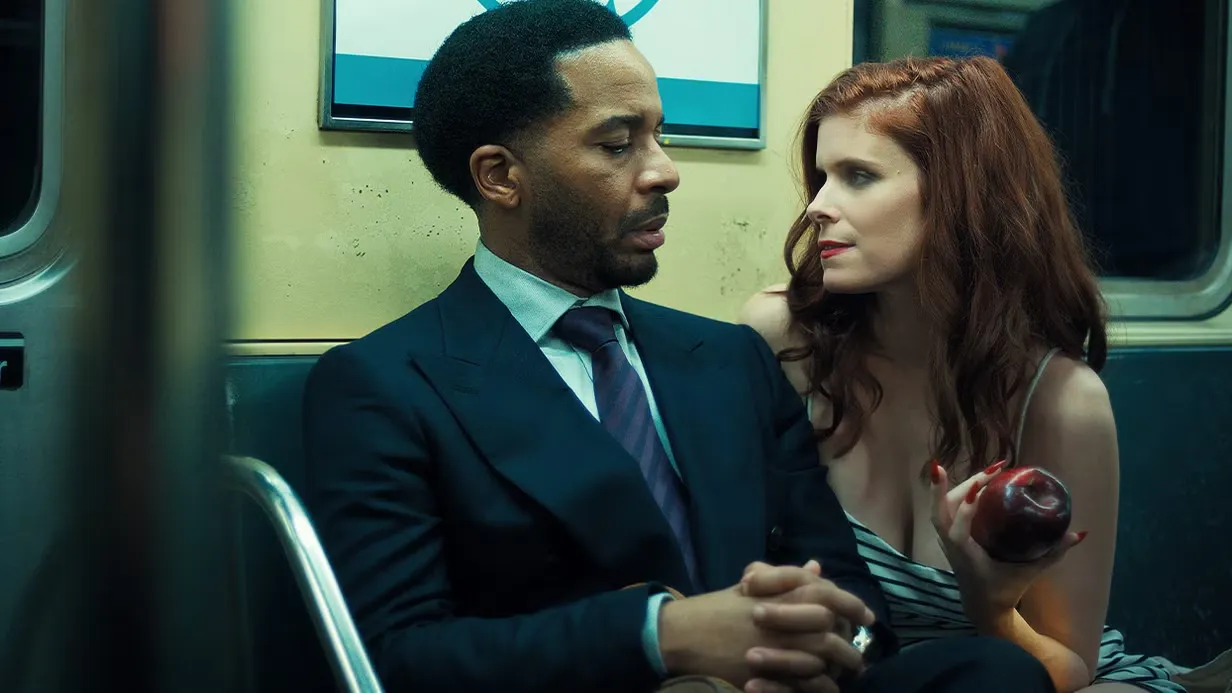
Clay’s personal turmoil is compounded by his involvement in helping his friend Warren (Aldis Hodge) run for city council in Harlem. When Dr. Amiri gives him a copy of The Dutchman—claiming it could change his life—Clay’s journey takes a surreal turn. On a subway ride, he encounters Lula (Mara), an enigmatic and unapologetically forward stranger whose seductive and racially charged provocations push Clay toward a dangerous crossroads.
The narrative blurs the line between reality and psychological allegory, leaving viewers to question what’s literal and what’s symbolic.
Performances
The film’s emotional core rests on its leads. Holland delivers a restrained yet deeply affecting portrayal of a man fractured by conflicting identities and desires. His subtle performance avoids theatrical exaggeration, instead drawing audiences in with quiet intensity.
Mara, as Lula, is equally magnetic—by turns alluring, unsettling, and outright vicious in her verbal assaults. She walks a fine line between stylized menace and believable human volatility, ensuring the character remains impactful.
Beetz brings warmth and dignity to Kaya, preventing her from being reduced to “the cheater” stereotype. Hodge and Henderson serve as strong supporting presences, adding texture to Clay’s world without overshadowing the central dynamic.
Behind the Scenes
Gaines’ debut fictional feature is steeped in theatrical sensibilities. His direction emphasizes moody, dark visuals and a stage-like intimacy that mirrors the play’s origins. While the film’s ambition to tackle multiple weighty themes—race, class, infidelity, mental health—demonstrates courage, it occasionally risks scattering its focus. The choice to keep much of the meaning open-ended invites reflection, though a late scene that spells out some ideas feels unnecessary in an otherwise interpretive piece.
Final Verdict
The Dutchman is a challenging watch—both in its subject matter and its refusal to spoon-feed its audience. Its 88-minute runtime bursts with ideas, and while not all land perfectly, the artistry and performances make it a worthwhile experience. Holland and Mara elevate the adaptation beyond its occasional narrative missteps, leaving viewers with lingering questions and images.
If you’re willing to engage with a film that values metaphor over strict realism, The Dutchman offers a thought-provoking examination of identity and human frailty.