


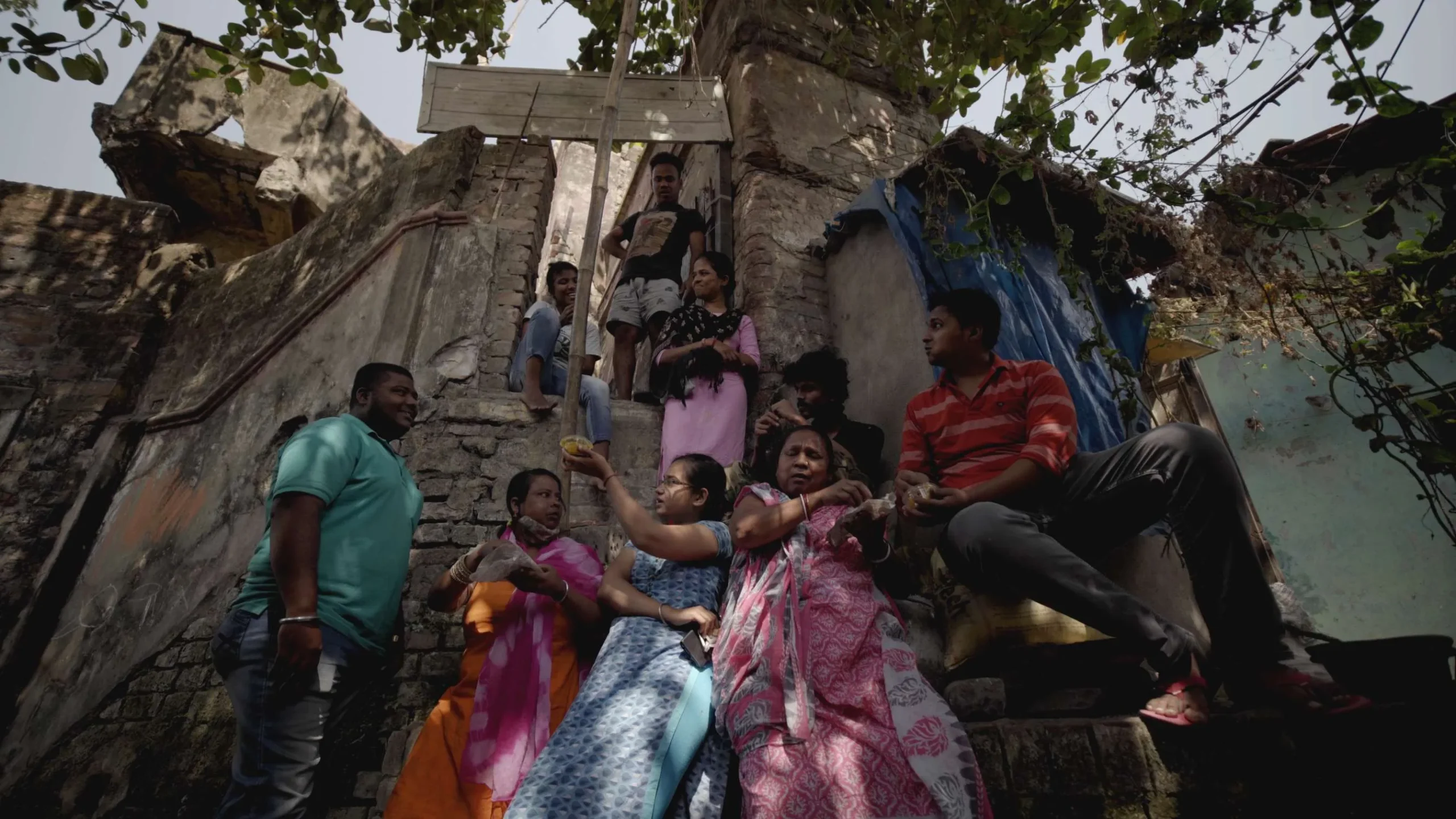
The inspiring documentary feature Redlight to Limelight celebrated its global debut at the Sheffield DocFest on June 19, 2025. Set in the Kalighat red-light district of Kolkata, the film charts a revolutionary path as local sex workers and their children set up an independent media collective. Together, they write, direct, and perform in short films that mirror their own realities. This compelling work is currently reaching audiences worldwide through international film festivals and television broadcasts on BBC Storyville.
At the heart of the documentary lies a powerful recurring motif. First, we learn of a woman from the Big Lane district who has survived domestic abuse, abandonment, or grinding financial hardship. In the next moment, we watch her recreate that exact trauma for a camera operated by a member of her own community. Director Bipuljit Basu positions his camera in the fragile gap between these two moments, demonstrating how converting painful memories into scripted fiction can grant a long-overdue sense of personal control.
Shifting the Gaze from Victimhood to Creative Agency
The heart of this artistic rebellion is the Camera On collective, a production group formed by the residents of the red-light district. Their current project is a fictional drama titled The Anklet: The Story of Two Sisters, which weaves together common struggles faced by the local women. The story follows two siblings: one desperately fighting to escape the cycle of sex work, while the other has resigned herself to it. Rabin, whose mother was tragically trafficked into the trade as a young child, serves as the director.
Rather than presenting a polished, corporate-style success story, Bipuljit Basu prioritizes raw authenticity. We watch the crew struggle with lighting, camera placements, and performance timing. This unrefined aesthetic is crucial; a highly polished film would have sanitized the harsh material realities of the district. By preserving natural mistakes, missed cues, and spontaneous adjustments, the film captures the genuine thrill of self-taught artistic discovery.
Reclaiming Melodrama as Personal Testimony
While popular cinema in the region has frequently used heightened melodrama to express collective suffering, The Anklet: The Story of Two Sisters subverts this tradition. Here, the actors are not stepping into a distant fantasy; they are reenacting situations that run parallel to their actual lives. This proximity alters the emotional gravity of the performances. Dramatic acting becomes a safe form of public testimony, shielded by the protective boundary of fiction.
Consider Meena Haldar, who plays the mother in the project. Her real-life journey to the district began when she was physically abused and cast out of her marital home while seven months pregnant. After a taxi driver brought her to the neighborhood, she found safety among the local women. Rather than dramatizing this past with cinematic flashbacks, Bipuljit Basu simply has Meena Haldar recount her story directly to the viewer. He then observes her channeling her lived experiences of maternal anxiety and exhaustion for the Camera On crew.
The boundary between Meena Haldar and her fictional counterpart is thin, yet it remains wide enough to provide a sense of play and liberation. Between takes, the women share laughs, debate performance choices, and actively shape their own onscreen representation. These lighthearted sequences serve as a powerful counterweight to typical documentaries that freeze marginalized communities in static, sorrowful close-ups.
The Harsh Realities of Economic Survival
Similarly, Bilkis, who acts under the name Srina Khatun, plays the older sister striving for a different future. In her daily life, she earns a meager living by carefully pasting synthetic plastic gems onto clay religious icons. Despite her meticulous labor, a promised wage increase from her distributor never arrives. The parallel between her real life and her character is striking: both are trapped in a desperate search for financial independence that remains just out of reach.
There is a deep cultural irony in her work. Bilkis spends her days beautifying sacred objects for a society that marginalizes and fails to protect her. Bipuljit Basu wisely lets this detail speak for itself, avoiding heavy-handed narration. The visual contrast is already deeply moving.
Structural Gaps and the Search for Deeper Truths
The documentary is strongest when showing how collective filmmaking reshapes local social dynamics. In a world largely dominated by financial dependence and male exploitation, the set of Camera On becomes a democratic space. Rabin leads not through rigid authority, but through gentle collaboration and mutual trust.
Rabin’s own background is complex enough to merit its own feature. Separated from his mother during childhood, he was eventually taken back by her at age eleven in a dramatic escape where he was blindfolded to prevent him from finding his way home. While Bipuljit Basu touches on these events, he quickly moves on, leaving the deeper emotional impact of Rabin’s past unexplored.
This omission highlights a central conflict within Redlight to Limelight. The director consciously avoids defining his subjects solely by their past suffering—a refreshing choice in an industry that often exploits poverty for emotional leverage. However, this restraint sometimes results in a lack of narrative depth, leaving some community members feeling slightly obscured. For instance, Afsara Khatun, who portrays the younger sister, remains a quiet presence, while Meena Haldar’s teenage son, Bunty, displays a quiet teenage withdrawal that hints at deeper emotional struggles that are never fully examined.
A Humanizing Standard for Documentary Filmmaking
The fragmented editing of the film mirrors the chaotic energy of the neighborhood and the production itself. While this free-flowing structure lends the documentary a welcome spontaneity, it occasionally allows the male directors and editors to dominate the narrative space, leaving the women who provide the emotional core of the project with less focus.
Nevertheless, the question of creative control makes Redlight to Limelight a landmark piece of media. Traditionally, depictions of sex workers in cinema have succumbed to moral judgment, romanticized martyrdom, or tragic exploitation. Bipuljit Basu bypasses these worn-out tropes. Meena Haldar and Bilkis are depicted as complex individuals: mothers, workers, and active creative partners.
By handing the camera over to those who are usually the subjects of the lens, Redlight to Limelight subverts the traditional power dynamics of documentary cinema. While Bipuljit Basu’s hesitant style occasionally leaves some personal stories incomplete, the film successfully honors the resilience of the community. It stands as a moving testament to how art can foster solidarity and self-determination in the face of systemic adversity.