

Ra. Karthik’s Made in Korea arrives on Netflix with an ambitious mandate: to weave the ancient bonds between Tamil Nadu and South Korea into a contemporary coming-of-age narrative. The film draws inspiration from the legendary journey of Princess Sembavalam—better known as Queen Heo Hwang-ok—who traveled from Tamil lands to the Gaya Kingdom in 48 AD. While this historical thread offers a rich tapestry for cross-cultural exploration, the Tamil-language feature struggles to translate its promising premise into compelling cinema. Priyanka Mohan steps into the spotlight as Shenba, a village dreamer chasing her Korean fantasy, but the execution falters precisely where cultural authenticity matters most.
Story
Hailing from the rustic hamlet of Kolapplur, Shenba develops an obsession with South Korea after portraying the ancient Tamil princess in a school play. Her pilgrimage to the peninsula, however, quickly unravels into isolation. Betrayed by her boyfriend Mani and severed from familial support, she finds herself unemployed and adrift in Seoul.
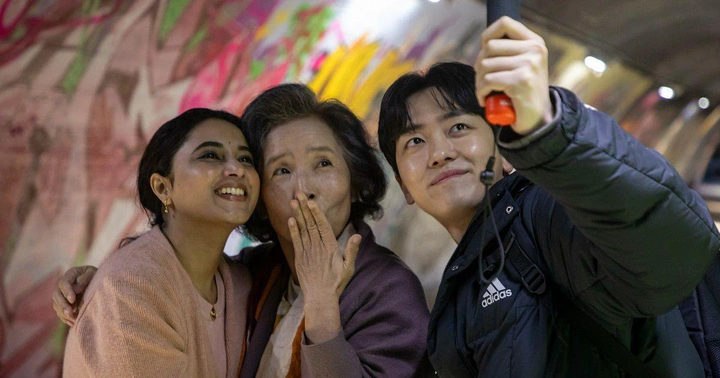
Salvation appears in the form of Heo Jun Jae, a relentlessly kind local who introduces her to Korean traditions while securing her a position as caregiver to a spirited elderly woman. What follows attempts to chart Shenba’s metamorphosis through friendship and resilience, though the narrative relies too heavily on circumstantial relationships rather than organic character evolution.
Performances
Mohan’s portrayal of the protagonist exposes the limitations of both the script and her interpretation. For someone allegedly consumed by Korean culture, Shenba’s linguistic repertoire extends only to “Kamsahamnida,” undermining the credibility of her lifelong obsession. Her initial fish-out-of-water moments show flickers of potential, yet the performance never deepens beyond superficiality.
In stark contrast, veteran Park Hye-Jin—recognizable from Squid Game and Pachinko—injects remarkable vitality into the elderly charge, creating the film’s most genuine emotional anchor. Si-hun Baek’s Jun Jae borders on impossibly virtuous, while Shenba’s circle of friends remain indistinguishable ciphers, failing to register any lasting impression.
Behind the Lens
The transition from Tamil Nadu to South Korea marks where Ra. Karthik’s screenplay begins to crumble. Having established an intriguing foundation, the director resorts to rapid montages to resolve complex emotional conflicts, rushing through crucial developmental beats.
Musical sequences feel equally hurried, sacrificing narrative cohesion for picturesque Seoul tourism. The overdependence on voiceover exposition further distances viewers from Shenba’s internal journey, telling rather than showing her transformation. While the cinematography capably captures K-drama locales, the tonal imbalance between levity and drama creates a disjointed viewing experience that undermines the potential of its cross-cultural setting.
Final Verdict
Made in Korea functions adequately as a visual postcard of Seoul’s vibrant streetscapes, but its emotional core remains elusive. The tentative bond between Shenba and her elderly patient offers sporadic warmth, yet these moments cannot salvage the hasty final act or its ambiguous resolution.
With the Korean wave dominating global pop culture, the film possessed ample room to explore meaningful romance or identity discourse. Instead, much like its protagonist’s limited vocabulary, the movie remains lost in translation—a well-intentioned but ultimately underwhelming adventure.
Also Read:
“Made in Korea” Movie: Priyanka Arul Mohan’s OTT Release Date & Story
“Made in Korea” Featuring Priyanka Mohan Set for Netflix Release in 2026