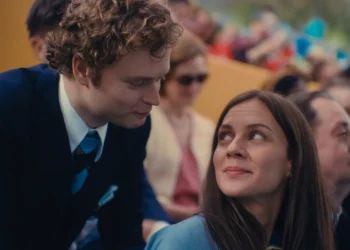


When DTF St. Louis first premiered on March 1, 2026, many expected a raunchy romp based on its provocative title. Instead, creator Steven Conrad (the visionary behind Patriot) delivered something far more profound: a seven-part limited series that uses suburban infidelity as a gateway to exploring the deepest corners of the human psyche.
The Story: A Suburban Noir with a Twist
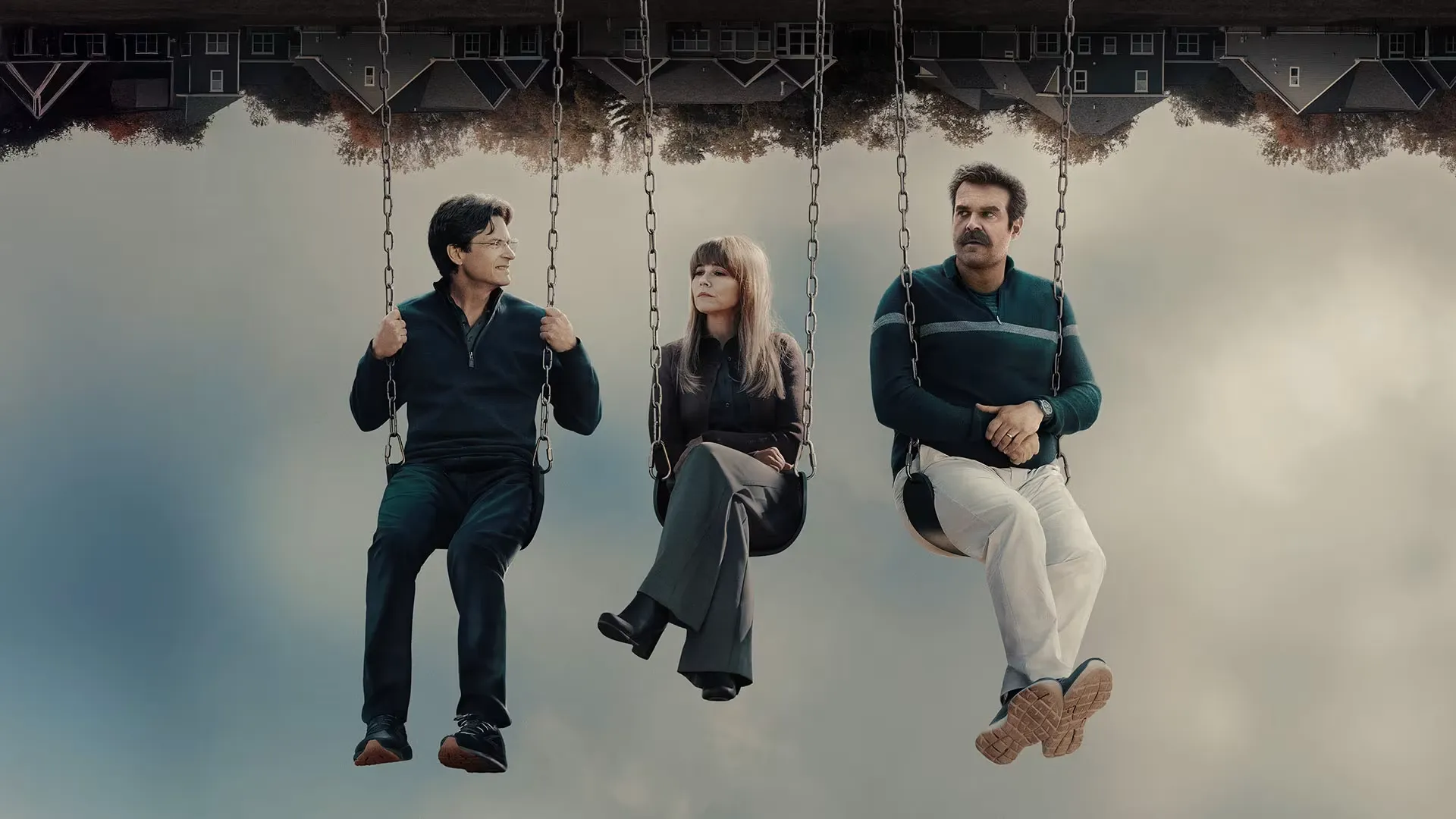
Set against the backdrop of 2018 Missouri, the series utilizes a “whodunit” framework to dissect the suspicious death of Floyd Smernitch (David Harbour), a sign language interpreter. The investigation uncovers a volatile love triangle involving Floyd, his wife Carol (Linda Cardellini), and a charismatic yet calculating local meteorologist, Clark Forrest (Jason Bateman).
The catalyst for this tragedy is a niche dating app designed for married couples—a digital escape for those suffocated by the monotony of middle-class life. Structurally, the show is a puzzle; it fragments the timeline between the present-day investigation and the events leading up to the crime. This non-linear approach forces viewers to constantly re-evaluate the motives of its central trio, turning a simple police file into a complex moral maze.
The Performances: A Trio of Excellence
The casting is the show’s greatest strength. Jason Bateman expertly weaponizes his signature “everyman” persona, masking a restless and manipulative energy beneath a calm, professional exterior. Opposite him, David Harbour delivers a career-defining performance as Floyd, capturing a raw, “uncool” vulnerability that is both heartbreaking and deeply relatable.
However, it is Linda Cardellini who serves as the emotional anchor. As Carol, she navigates the pressures of domestic financial strain with a sharp-edged realism. She isn’t just a trophy or a victim; she is a woman fighting for agency in a world that often overlooks her. Supporting turns from Richard Jenkins and Joy Sunday provide a grounded counter-rhythm as the detectives tasked with untangling the mess.
Behind the Lens: Daylight Noir
Visually, the series rejects the typical shadows of the noir genre. Instead, Conrad employs a “daylight noir” aesthetic, where moral decay occurs in the most mundane locations—smoothie shops, grocery stores, and quiet neighborhood streets. The overcast, cold color palette of St. Louis mirrors the internal isolation of the characters, while the sharp, “anti-comedy” writing highlights the absurdity of their desperate attempts at connection.
Final Verdict
DTF St. Louis is a rare series that rewards patience. While it occasionally stumbles over its own intricate pacing, it excels at moral recontextualization. It transforms what could have been a cynical tabloid story into a compassionate study of loneliness and the dangerous lengths people go to feel seen. It is a haunting, funny, and ultimately sincere exploration of the “souring” of the American dream.
DTF St. Louis is now available on JioHotstar.