

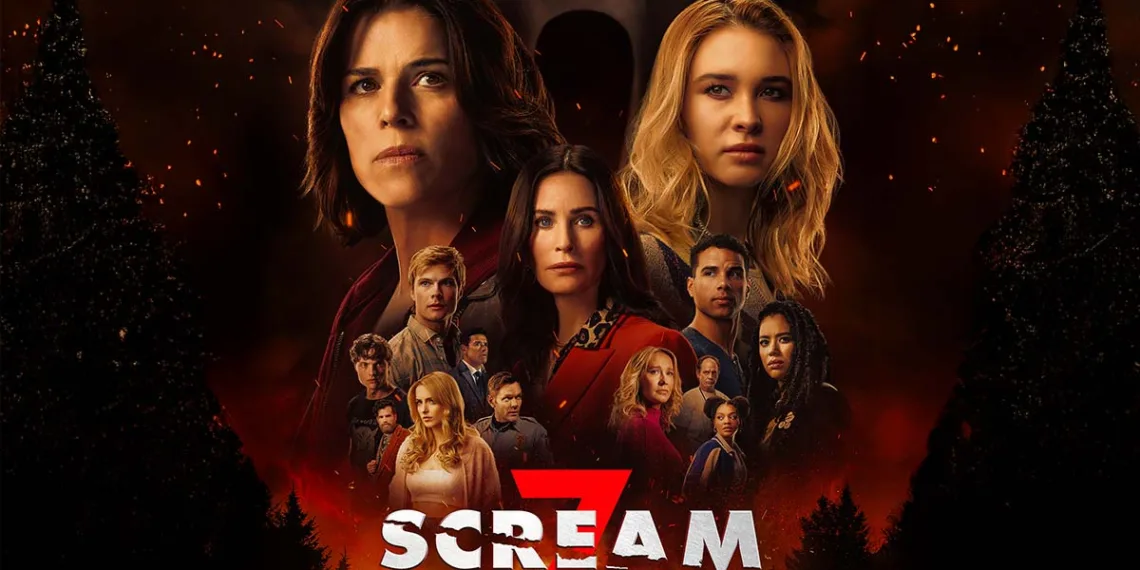
The Scream franchise has always thrived on a double-edged sword: the clockwork precision of a whodunit paired with a sharp, meta-commentary on horror culture. In Scream 7, this legacy continues under a more intimate lens. With franchise creator Kevin Williamson stepping into the director’s chair, the film attempts to close the blinds on global spectacle and return the terror to where it feels most invasive—the living room. It is a chapter that trades the sprawling cityscapes of recent sequels for a claustrophobic focus on family, legacy, and the ghosts of Woodsboro.
The Story: Deepfakes and Domestic Dread
Sidney Prescott (Neve Campbell) has moved on to Pine Grove, a quiet town where she plays her most challenging role yet: a mother. However, the peace is shattered when Ghostface returns with a modern twist. The film introduces a plot centered on AI and deepfakes, using the “legend” of Stu Macher to haunt Sidney through digital manipulation.
The narrative engine is fueled by the friction between Sidney and her teenage daughter, Tatum (Isabel May). While Sidney tries to protect her children through silence, Tatum demands the truth about the violence that defines her family’s history. The stakes shift from survival to the preservation of reality, asking a chilling question: when images can be faked, what is the value of a survivor’s memory?
Performances: The Matriarch and the New Blood
Neve Campbell remains the franchise’s moral compass, playing Sidney with a weary, tactical grace. She’s no longer just a “Final Girl”; she is a veteran who views every room through the lens of a threat assessment.
Isabel May delivers a standout performance as Tatum, capturing the resentment of a teenager living in the shadow of a famous tragedy. Their chemistry provides the film’s emotional backbone. Meanwhile, Courteney Cox returns as Gale Weathers, offering her signature sharp-tongued wit, and the return of Mindy and Chad Meeks-Martin brings a much-needed spark of “genre-rule” humor, even if their inclusion feels slightly untethered from the main plot.
Behind the Lens: Williamson’s Vision
Kevin Williamson’s direction brings a rhythmic, operatic quality to the violence. The cold open—a brutal subversion of true-crime tourism set at the original Macher house—is a franchise high point. Williamson excels at staging setpieces that blend suspense with “contractual chaos,” such as a pulse-pounding sequence involving a catwalk and a drywall-piercing hunt.
However, the film occasionally struggles with its own pacing. While the practical effects and kills are creative and nasty, the geographical layout of Pine Grove feels somewhat underdeveloped. The ambitious AI subtheme, while timely, loses momentum in the final act, occasionally taking a backseat to the franchise’s reliance on nostalgia.
Final Verdict
Scream 7 is a polished, high-stakes entry that succeeds in making Ghostface feel like a personal threat again. While the “meta” commentary on deepfakes doesn’t cut as deep as the social media satire of previous installments, the emotional core of the Prescott family keeps the tension high. It is a film that honors its roots while acknowledging that for Sidney Prescott, the past is never truly buried—it’s just waiting for a new mask.
Rating: 3.5/5 Stars