

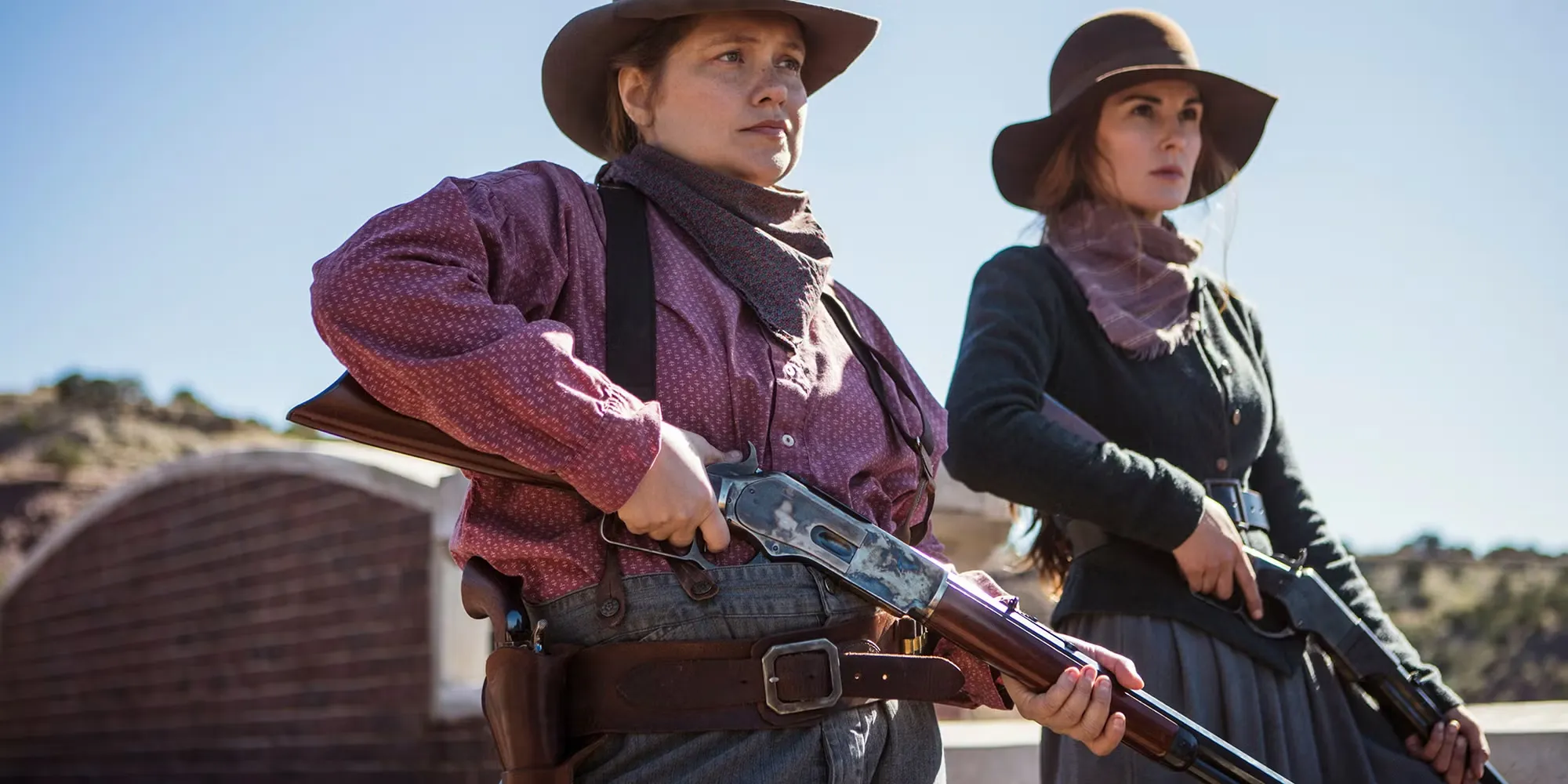
Netflix’s 2017 Western miniseries Godless stands as a rare gem in modern television—offering a gripping, self-contained story culminating in one of the most masterfully executed final gunfights ever seen on the small screen.
Written and directed by Scott Frank, co-creator of The Queen’s Gambit, this seven-episode limited series blends traditional Western grit with a fresh narrative perspective. Set in the late 1800s mining town of La Belle, New Mexico, the drama unfolds in a community where women dominate due to a tragic mining accident that claimed most of the town’s men.
The peace is shattered when notorious outlaw Frank Griffin, played by Jeff Daniels in an Emmy-winning performance, rides into La Belle in search of Roy Goode (Jack O’Connell), his former protégé turned fugitive. Roy has found refuge with Alice Fletcher (Michelle Dockery), herself an outsider, forcing her and Mary Agnes McNue (Merritt Wever, also an Emmy winner) to rally the townspeople against Griffin’s approaching gang.
While Godless embraces many hallmarks of the Western genre—moral dilemmas, dusty shootouts, and rugged landscapes—it subverts expectations by placing women and marginalized figures at its core. The narrative builds toward a tense, emotionally charged showdown that is as much about survival and solidarity as it is about gunfire.
The climactic battle is a masterclass in action storytelling. As Griffin’s gang closes in, La Belle’s residents prepare by gathering every available weapon and fortifying the town’s strongest building—the iron-and-brick hotel. The ensuing sequence is meticulously choreographed: viewers always know where each character is positioned, who is firing at whom, and what’s at stake. The editing allows the tension to breathe without losing momentum, making every moment land with impact.
Unlike many genre shootouts where heroes emerge unscathed, Godless embraces realism—characters fall abruptly, decisions carry permanent consequences, and survival is never guaranteed. This unpredictability heightens the suspense and makes the finale deeply satisfying.
In narrative terms, the gunfight is fully earned. Every character arc converges in the final moments, ensuring that each shot fired resonates with emotional weight. The hero’s journey here is collective rather than individual, with the women of La Belle embodying the true force capable of standing against Griffin’s tyranny.
Though fans might wish for a second season, Godless was designed as a standalone story. By the time the dust settles, every plot thread is resolved, leaving little room for continuation without losing the impact of its tight, interconnected structure. Its strength lies in precisely that limitation—offering a rich, complete tale in just seven episodes, perfect for a weekend binge.
Viewers seeking more Western drama after Godless can explore Netflix’s upcoming American Primeval (set in 1857), AMC’s railroad epic Hell on Wheels, Prime Video’s revenge drama The English, or 1883, the acclaimed Yellowstone prequel streaming on Paramount+.