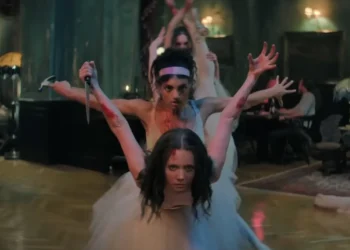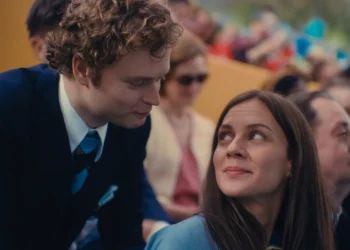


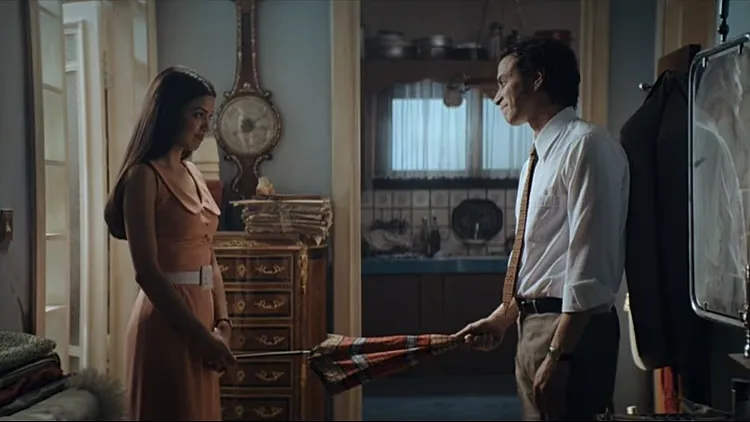
Orhan Pamuk’s 2008 literary masterpiece, The Museum of Innocence, has long been celebrated as a profound exploration of memory and desire. Today, that layered narrative has found a new home on Netflix. More than just a standard adaptation, the series provides a respectful reconstruction of Pamuk’s intellectual universe, sparking a massive cultural resurgence for the novel and its real-world museum companion in Istanbul.
A Cinematic Journey into 1970s Istanbul
Directed by Zeynep Günay and penned by Ertan Kurtulan, the series transports viewers to the 1970s, a period defined by rigid social hierarchies and a shifting cultural landscape. The story centers on Kemal (Selahattin Paşalı), a wealthy heir, and his intense, transformative love for his distant relative, Füsun (Eylül Lize Kandemir).
The production excels in its historical realism, meticulously recreating the textures of 20th-century Istanbul without falling into nostalgic clichés. The casting of the relatively unknown Kandemir alongside the seasoned Paşalı creates a palpable tension that mirrors the book’s enigmatic nature.
The Archaeology of Emotion
A unique feature of this adaptation is the inclusion of Orhan Pamuk himself, appearing as both the author and a character within the narrative. This meta-commentary honors the original novel’s goal: blurring the boundaries between fiction and reality.
In Pamuk’s world, objects are not merely props; they are “vessels of narrative.” The series mirrors the philosophy of the physical Museum of Innocence in Istanbul’s Çukurcuma district. Just as Kemal collects Füsun’s cigarette butts and hair clips to sustain her presence, the show treats every visual detail as a tangible trace of a recollection. It asks a haunting question: Do we love a person, or do we love the time we spent with them?
A Cultural Phenomenon Reborn
The Netflix launch has triggered a “Pamuk Fever” across Turkey and beyond. The novel has surged back to the top of bestseller lists, social media is saturated with period-accurate aesthetics from the show, and the physical museum has seen a dramatic increase in foot traffic.
Critics have noted that the series successfully navigates the complex morality of the original text. It presents Kemal’s obsession not as something to be judged, but as an exploration of how love shapes identity. By focusing on “who remembered love more” rather than “who loved more,” the production achieves a tragic, beautiful depth that resonates with modern audiences.
The series adaptation of The Museum of Innocence effectively translates Orhan Pamuk’s complex narrative into a compelling visual medium. By maintaining the novel’s emotional depth through meticulous period details and symbolic storytelling, the production moves beyond a traditional romance to explore the “aesthetics of remembering.” Central to its success is the concrete representation of Pamuk’s philosophy on object-memory correlation, where physical items serve as the primary vessels for history and emotion. The result is a faithful and nuanced portrayal of how memories are preserved and visualized.
As both a spatialized narrative and a visual feast, The Museum of Innocence stands as a benchmark for literary adaptations, proving that some stories are too vast to be contained by a single medium.
Also Read:
“The Museum of Innocence” Review: A Gilded Cage of Obsession on Netflix