


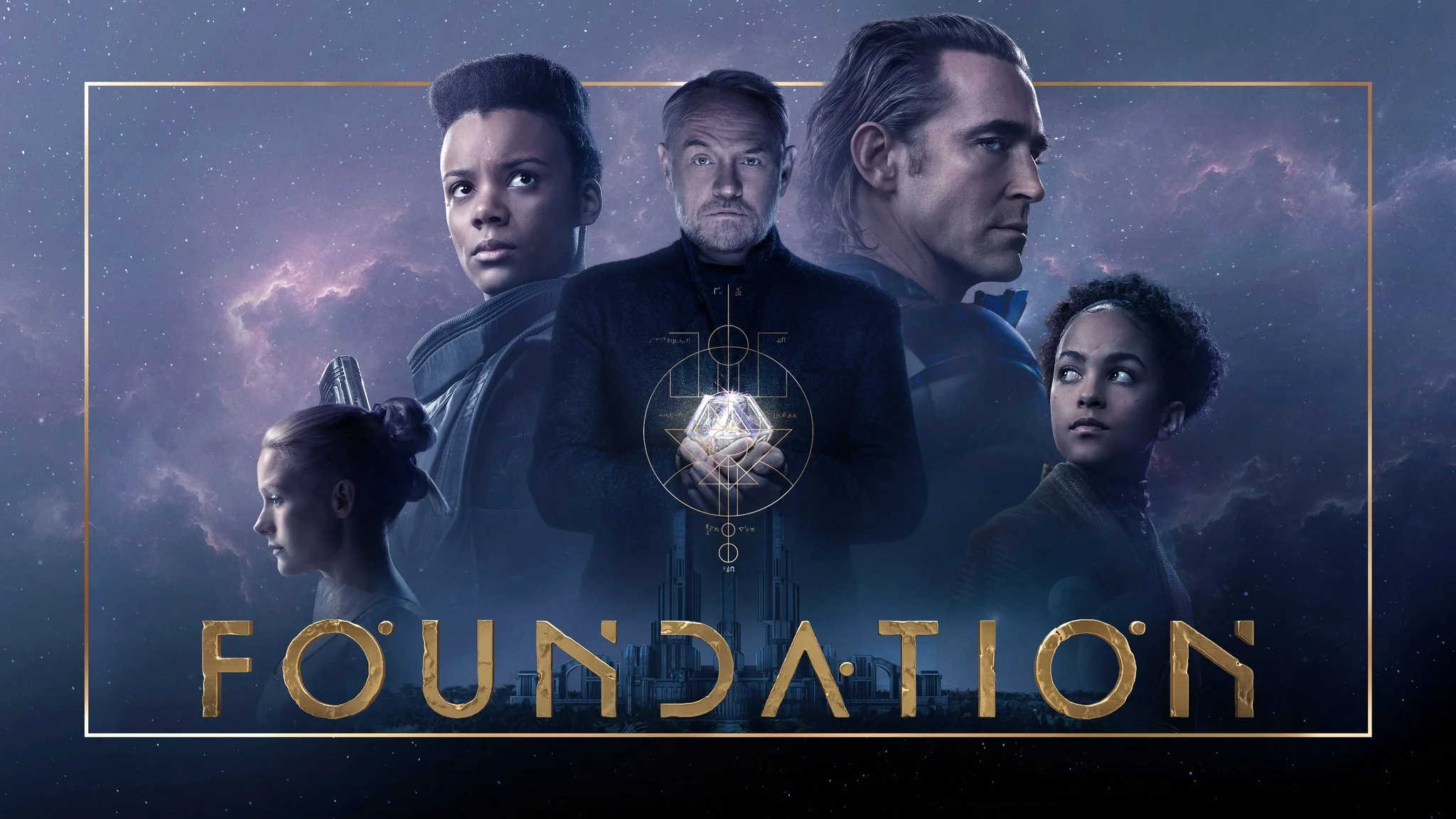
Apple TV’s Foundation has become a standout in modern science fiction, earning impressive acclaim—an 87% audience rating speaks for itself. Adapted from the legendary works of Isaac Asimov, this ambitious series has not only honored its source material but also reignited interest in serious, idea-driven sci-fi for the 2020s.
Asimov’s original Foundation novels sit alongside genre-defining classics like Frank Herbert’s Dune and William Gibson’s Neuromancer. While Dune’s cinematic adaptations have dazzled audiences and a Neuromancer project looms on the horizon, Apple’s Foundation proves that cerebral storytelling still has a place in a visually driven world.
Though Asimov held a PhD in chemistry, his novels emphasized social science over hard physics. Psychohistory—the fictional field predicting humanity’s collective behavior—was a mix of mathematics, sociology, and speculation. The Apple TV adaptation takes that abstract concept and gives it tangible, visual form. Through striking CGI and meticulous world-building, psychohistory becomes a living, evolving discipline. The show’s depiction of the Prime Radiant, a device that visually maps probability and destiny, turns a once-mysterious theory into a breathtaking scientific spectacle.
Set against the vast backdrop of a decaying Galactic Empire, Foundation dives deep into the philosophical and political consequences of technology. The Cleonic dynasty, replicated through cloning for centuries, symbolizes the stagnation of power. In contrast, the First Foundation represents progress, intellect, and innovation—embodying the eternal tension between knowledge and control.
The series also grounds its futuristic setting with scientific realism. Space travel obeys orbital mechanics, jumpdrives echo quantum theory, and planetary ecosystems feel plausible. The influence of modern scientific disciplines—such as climate modeling and data analytics—can be felt throughout. The result is a show that feels both visionary and credible, bridging Asimov’s mid-century optimism with today’s data-driven reality.
While the original novels left much of their technology to readers’ imaginations, Apple’s adaptation fills in those gaps with stunning visuals and narrative clarity. From whisper-ships powered by neural drives to the enigmatic Vault guarding Hari Seldon’s legacy, Foundation balances spectacle with substance.
The story of Foundation doesn’t conclude with the first installment. The rise of the Second Foundation—an organization originally formed by psychic psychohistorians—takes on far greater significance in the television adaptation. In Isaac Asimov’s novels, these “mentalics” operated entirely in secrecy, their existence concealed not only from other characters but also from readers. This approach may have reflected Asimov’s own skepticism toward the scientific plausibility of psychic abilities.
Apple TV’s version, however, brings these hidden figures into the light. The series expands their influence and gives several key characters, including Gaal Dornick—who was not depicted as a mutant in the books—distinct mental powers. Telepathy, telekinesis, and foresight are introduced as defining traits, bordering on the mystical rather than the realm of hard science. These abilities resemble the superstitions of less advanced worlds more than the empirical logic that Asimov’s universe is known for.
Even so, the show carefully balances its speculative science with elements of the fantastic. Too much technical detail can make a narrative feel heavy, while a touch of the extraordinary keeps audiences engaged. Sometimes, viewers are more drawn to the impossible than the merely improbable. Although psychic phenomena will never find grounding in real-world science, their inclusion adds depth and wonder to Foundation’s vast interstellar saga.
Ultimately, Foundation stands as a triumph of adaptation—a rare blend of intellectual depth and cinematic brilliance. It captures the essence of Asimov’s message: science, when applied with wisdom and imagination, can illuminate the darkest corners of human destiny.