

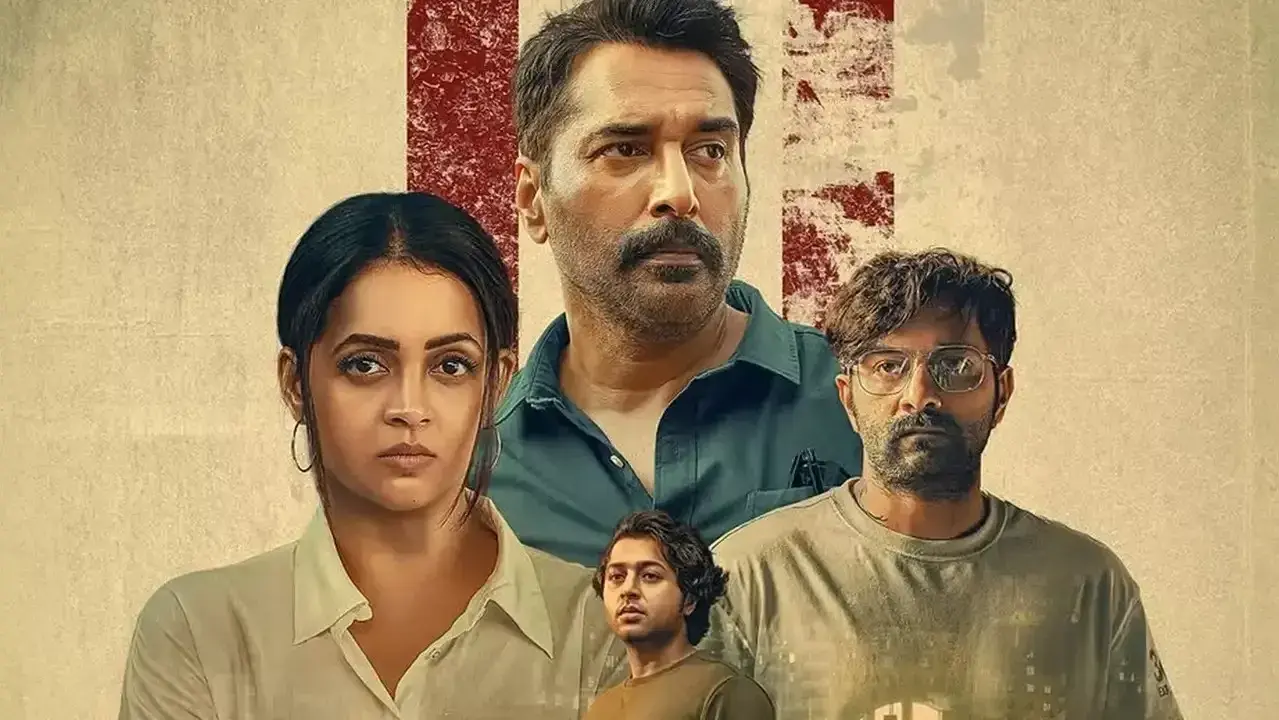
Anomie, the latest Malayalam mystery thriller from writer-director Riyas Marath, enters the crowded whodunnit space with a bold blend of psychological drama, forensic science, and futuristic speculation. Led by the talented Bhavana in the lead, the film sets up an emotionally charged narrative rooted in grief, loss, and the search for truth. Yet, despite its high-concept ambitions and a runtime stretching 152 minutes, Anomie often feels like a puzzle with too many mismatched pieces — cluttered with red herrings, bogged down by clichés, and distracted by subplots that add bulk without depth.
The film’s core idea — exploring the emotional aftermath of suicide and humanity’s desire to escape pain through altered consciousness — is both poignant and timely. Unfortunately, this thematic richness gets buried under a mechanical plot that prioritizes twists over emotional authenticity and spectacle over substance.
Story
Anomie follows Zaara Philip (Bhavana), a forensic specialist still reeling from the loss of her parents. Her fragile emotional state is further shattered when her younger brother, Ziyan, goes missing under suspicious circumstances. What begins as a sister’s desperate search for answers quickly spirals into a chilling investigation involving a string of young individuals suffering from psychological distress — all linked by a disturbing pattern of self-harm and suicide attempts.
Enter Ghibran (Rahman), a disgraced police officer battling his own demons and a tarnished career. As Zaara and Ghibran converge in their pursuit of truth, the film transitions from an intimate tale of familial grief to a routine serial-killer procedural — complete with cryptic clues, mood-heavy montages, and cold-case echoes. The narrative piles on subplots, including Ghibran’s redemption arc and vague hints of institutional conspiracy, diluting the emotional core that anchored the opening act.
By the time the mystery unravels, it’s wrapped in speculative science — a vision of consciousness manipulation and digital afterlife. While conceptually intriguing, these ideas feel tacked on rather than organically developed, leaving the audience more confused than enlightened.
Performances
Bhavana delivers a performance of quiet strength and layered vulnerability. As Zaara, she embodies both resilience and sorrow, carrying the film’s emotional weight with sincerity. Her portrayal grounds the chaotic narrative in human feeling, especially in early scenes that explore sibling bonds and parental loss.
Rahman, as the troubled cop Ghibran, appears underutilized. Despite his experience, the character lacks depth and charisma, partly due to a fragmented script and rapid-fire editing that offers little room for character development. The supporting cast largely blends into the background, serving the plot more than enriching it.
Behind the Scenes
Riyas Marath’s direction leans heavily on stylistic flourishes — stark cinematography, abrupt cuts, and a pulsating score — aiming to create tension. While these elements align with thriller conventions, they often feel repetitive and overused, failing to build a cohesive or immersive world.
The film’s visual language mirrors its narrative chaos: short shots, disorienting transitions, and over-reliance on flashbacks enhance the sense of unease but compromise clarity. That said, the final act brings a noticeable shift. The concluding sequences — where fragmented threads are woven together — showcase improved pacing, stronger writing, and a more focused tone. The finale’s sci-fi revelations, though ambitious, offer a rare moment of originality in an otherwise formulaic journey.
Final Verdict
Anomie is a film of contradictions — emotionally ambitious yet narratively stagnant, visually intense but thematically shallow. It raises profound questions about grief, consciousness, and the ethics of digital immortality, only to resolve them with contrived sci-fi mechanics that feel out of sync with the grounded tragedy that opened the story.
The film’s saving grace is its final stretch, where Marath attempts a cohesive payoff — tying loose ends and offering a visual and narrative crescendo that, while kitschy, brings a measure of closure.
Ultimately, Anomie feels like a meal where the dessert outshines a bland main course: intriguing in concept, underwhelming in execution. It’s a routine thriller propped up by a few flashes of genuine curiosity — and Bhavana’s stellar performance — but fails to leave a lasting impression.
Final Rating: ★★☆☆☆ (2.5/5)
Anomie — more noise than signal, but not without its moments.