

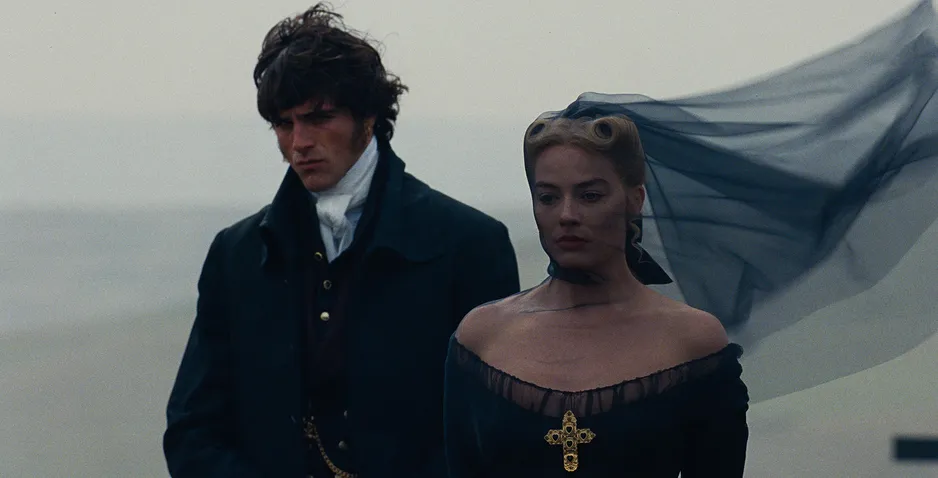
Emily Brontë’s timeless novel Wuthering Heights has long sparked debate, even prompting her sister Charlotte to issue a correction in 1850, noting its “import and nature were misunderstood.” It seems this sentiment resonates anew with writer-director Emerald Fennell’s latest interpretation, a production so liberally adapted it bears little resemblance to its source material. Marketed as Wuthering Heights in quotation marks, this film swiftly reveals itself as a bold but ultimately superficial take, leaning more towards a modern, steamy romance than Brontë’s profound exploration of obsessive love and societal constraints.
Story
Fennell’s Wuthering Heights discards the book’s narrative structure, jettisoning key characters and the original’s chronological framework. Instead, it plunges viewers into a stark, highly sexualized world, opening with a shocking, violent scene that sets a sensationalist tone. This adaptation frames Catherine Earnshaw’s journey as a raw “sexual awakening,” largely sidelining Brontë’s intricate themes of class conflict, racial prejudice, and generational trauma in favor of explicit content. It’s less a faithful homage and more a fan-fiction reimagining, recalling the sensationalism of Fifty Shades of Grey rather than the literary depth of Brontë’s unflinching portrait.
Performances
The casting choices for the central lovers, Margot Robbie as Catherine and Jacob Elordi as Heathcliff, raise significant questions. While both are undeniably charismatic, Robbie’s age works against portraying Catherine’s youthful recklessness, and Elordi’s portrayal, while charismatic, echoes his Euphoria character more than Brontë’s complex antihero. The film’s abundance of steamy encounters fails to forge genuine chemistry, feeling manufactured rather than passionate. Conversely, supporting actors like Hong Chau as Nelly and Alison Oliver as Isabella Linton shine, offering nuanced performances that hint at the story’s original potency, with Oliver, in particular, demonstrating a captivating presence that makes one wonder about alternate casting.
Behind the Scenes
The film’s screenplay notably omits the Gothic supernatural elements crucial to the novel’s atmosphere, simplifying Brontë’s evocative dialogue into paraphrased fragments. It also streamlines the potent social commentary surrounding Heathcliff’s ambiguous ethnicity and the brutal consequences of his revenge, diluting these profound aspects. While Linus Sandgren’s cinematography beautifully captures the wild beauty of the Yorkshire Moors, the lavish production design of Thrushcross Grange feels jarringly anachronistic. Combined with an overwhelming musical score and pop-infused original songs, the film’s aesthetic choices often distract from, rather than enhance, the emotional core of its iconic characters.
Final Verdict
Emerald Fennell’s Wuthering Heights is a dazzling, yet ultimately hollow, reimagining of a literary masterpiece. While not every adaptation needs to be a carbon copy, this version sacrifices the Gothic soul and thematic weight of Brontë’s novel for a streamlined, overly romanticized narrative. For those unfamiliar with the original text, it might prove an engaging, albeit superficial, watch. However, devoted fans of Wuthering Heights will likely find this interpretation obscures the profound brilliance of Brontë’s vision, leaving its celebrated themes largely misunderstood.
Experience the passion and tragedy of Wuthering Heights on the big screen. The film premieres internationally on February 11, 2026, and arrives in theaters across the United States on February 13.